On Monday morning, as an exasperated federal judge was demanding that the Trump administration abide by her orders, Noah Mihalovic, 4, was chasing a little yellow golf ball across the mini-golf course at East Potomac Park.
Noah had come to the park in Washington, D.C., with his mother, Caroline Mihalovic. She used to come here in her younger days and once ran around it in the annual Cherry Blossom 10-mile race. Now she had brought her son to what is, for now, the oldest continuously operating mini-golf course in the country for what might be a last round if the president gets his way.
“I heard that things potentially might get demolished, or renovated,” Ms. Mihalovic lamented. “I wanted to get him out here to experience the old-school course.”
For months, President Trump has been trumpeting his plan to fully revamp the East Potomac Golf Links, a historic 36-hole facility that lies on an okra-shaped spit of land in the Potomac River. The course takes up most of the island but shares it with other features long enjoyed by people in the area, including the mini-golf course, a bike trail, a playground and a picnic area.
Vowing to make the golf links “one of the Most Wonderful and Spectacular Golf Courses anywhere in the World,” Mr. Trump has insisted a full renovation begin immediately, the latest project in his extreme D.C. makeover.
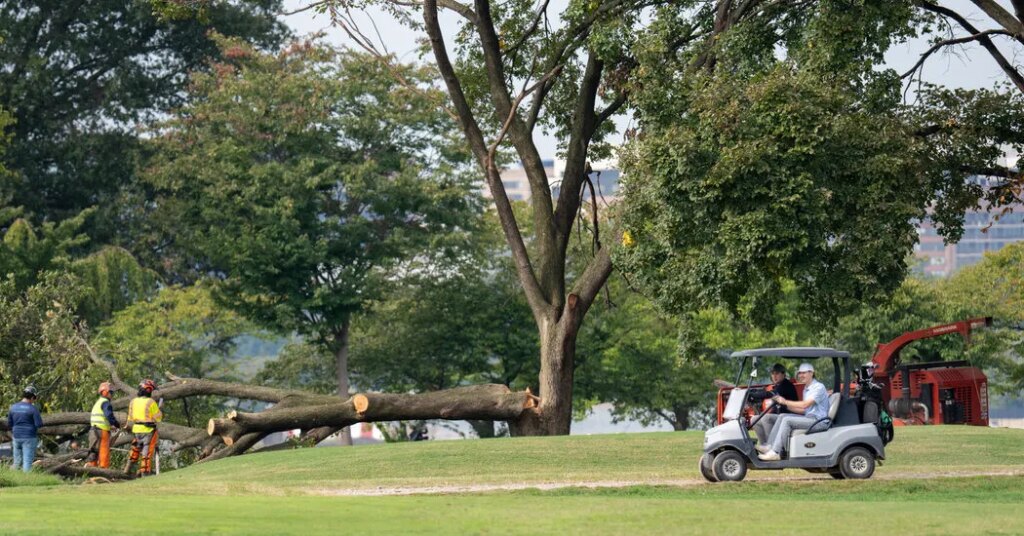
Hundreds of trees have already been cut down, though the administration’s lawyers said this was routine maintenance. And while preservationists continue to fight the plan in court, Mr. Trump, who early Tuesday morning posted a slew of photographs of things needing repair on the current course, which he referred to as “Trash Island,” has unveiled a proposal for his vision on social media.
This plan notably leaves out almost everything but a clubhouse, a driving range and single 18-hole course.
East Potomac, like the two other public golf courses in Washington, has had maintenance issues over the years, including serious drainage problems. Even the mayor of Washington, Muriel Bowser, acknowledged that some attention is due. “You won’t be surprised that I think all of the golf courses need rehabilitation,” she said in a news briefing on Monday morning. “They’re federal golf courses, and they should be rehabilitated.”
But the East Potomac property, as the mayor also alluded to in her remarks, encompasses more than just another golf course.
With easy access for city residents and low greens fees, East Potomac Golf Links has been known by many as the “people’s country club,” where working-class Black Washingtonians would come to play golf and socialize. As Washington has gentrified over the years, the democratic nature of the course has waned somewhat. But it is still inexpensive, and it is still nearby.
“Everyone who comes here says this is one of the greatest things that D.C. has, like a public course this close to the District as cheap as it is and decent quality,” said Michael Peterkin, 49, who was making his way through a bucket of balls at the driving range. “Certainly, good enough golf.”
And there is more to it than the course. Every day, hundreds of runners, walkers and cyclists follow the route around the links, looping the grassy common at the park’s tip, known as Hains Point. Here, families settle down for noonday picnics, and fishermen come to cast rods in the evening.
Groups have gathered for generations of family reunions and long summer afternoon cookouts. Children come to climb and slide at the playground, or play the mini-golf course, where on Monday Noah Mihalovic scored a hole in one.
And there are hundreds of maples, birches, cherry blossoms, oaks and other trees, if fewer than there were a few weeks ago.
“I’m worried about the trees,” said Anoa Gibson, 39, a medic at a construction site near the entrance to the park. She had trained for a triathlon here, putting in miles on the bike path around the park. But she also just enjoys sitting in the quiet on her lunch break. “These trees, some of them are like 100 years old,” she said. “That’s what I’m most concerned about.”
In an interview on Fox News on Monday, Doug Burgum, the U.S. secretary of the interior, said that removing trees was “restoring it back to its historical nature,” referring to photos of the course in the 1920s that showed presidents golfing with “barely a tree” around. He also insisted the course would remain public after the renovation.
“It could be the best course in America with the lowest prices,” he said.
At the hearing on Monday, Judge Ana C. Reyes, a federal judge who Mr. Trump has said “may be insane” and whom the administration is trying to get removed from the case, grilled the lawyers from the Justice Department, saying it looked as if the Trump administration was simply moving forward with the overhaul even as officials had sworn that no decisions had been made.
“The disturbing thing about how this administration goes about things is, they don’t ask permission,” Mr. Peterkin said. It’s just rolling over people, he added, “not caring what they think, what they want.”
Chuck Thies, a political consultant based in D.C., is discouraged by the whole debate. The main course at East Potomac is not in great shape, he said, and a sports-obsessed city like Washington, which in recent years has furiously and successfully fought to keep its pro basketball team and bring home its pro football team, could use one championship-level golf course. At the same time, Hains Point really is a city treasure, he said, as are the bike path and many of the old trees.
“There’s room for 18 holes and a bike path and a place to barbecue,” he said. “The problem here is the politics.”
A little after lunchtime, Barbara McCann, 55, was making what she called “a prayer circle” around the park, riding her bike on the loop that nearly encircles the golf course. She had spent the first part of the day a couple of miles north, in U.S. District Court, watching Judge Reyes and the lawyers spar over the fate of the park she was now circling.
This whole plan was autocratic, she had concluded, unthinkable, the destruction of a beloved public treasure by the greed of the wealthy. But perhaps more than that: It was an odd thing for the leader of the free world to be so focused on.
“Doesn’t he have better things to do?” she asked.
The post As Trump Wages Golf Course Fight, Many Residents Fear What Could Be Lost appeared first on New York Times.