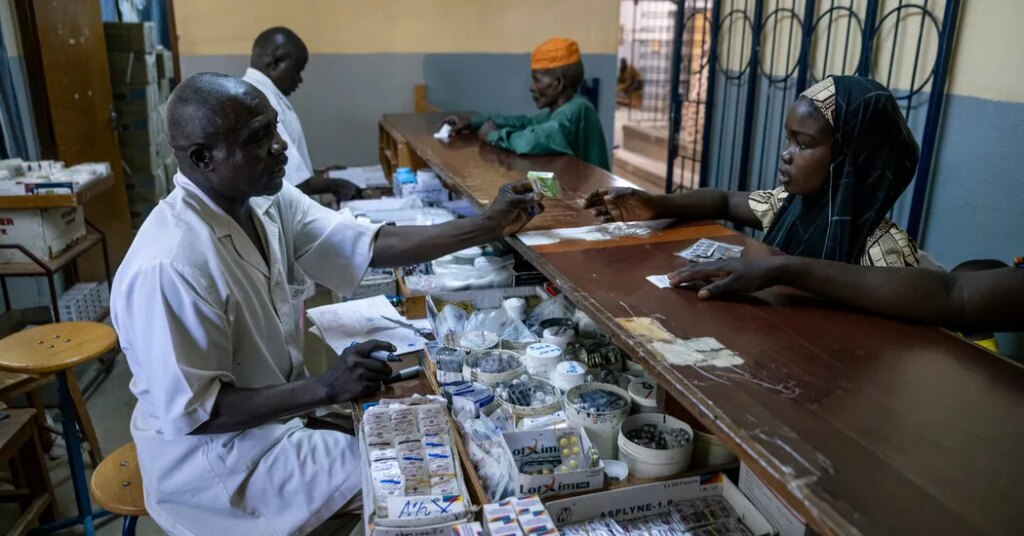
When world leaders gathered at the United Nations in New York last month, there were many somber meetings about how to tackle the crucial problems of global health at a time when governments, led by the United States, have sharply reduced financial support.
But there were also other meetings: small gatherings, in private dining rooms, where new interlocutors grilled veteran leaders of international health organizations with unfamiliar and startling questions: What would you do with another billion dollars? What about $5 billion? What are the “shovel ready” projects that could quickly absorb $100 million or more?
A senior executive, emerging dazed from one of those dinners, described it as “a gold rush,” a frantic scramble as organizations sought to make sure they were in line to grab a share of what is anticipated to be a monumental wave of new funding for health aid.
The source is the wealth coming from the initial public offerings of major artificial intelligence companies, starting as soon as next month. These could put tens of billions of dollars of new philanthropic money in the hands of charities chosen or set up by a new class of ultrawealthy givers, many of whom have a demonstrated interest in global health.
The A.I. windfall, which some are calling a “third wave of philanthropy,” may rival or even exceed the amount given by the governments of wealthy nations.
The new funders bring a tech founder mind-set that could spur ambition, accelerate the introduction of new drugs and tools, and hold sclerotic institutions to new standards of performance.
But these funders tend to have a preoccupation with metrics and results that does not easily graft to the complex work of ending poverty. And as they become some of the most powerful players in the field, the shift could undermine the sovereignty of low-income countries trying to take control of their own health systems after decades of heavy-handed external influence.
“I have a huge amount of optimism that there are large amounts of capital coming in to solve some of the most important problems in the world,” said Dr. Neil Buddy Shah, chief executive officer of the nonprofit Clinton Health Access Initiative, who has become an influential voice with tech executives planning to give away large portions of their coming fortunes. “And that this money is pretty relentlessly focused on trying to chase impact and drive measurable improvements in people’s lives.”
For decades the global health architecture has been structured around wealthy governments that donate to low-income countries reliant on their help, aid agencies that run programs, a few huge multilateral organizations, and a beneficent billionaire, Bill Gates, as an additional playmaker.
Mr. Gates’ foundation will give away $9 billion this year, most of it to global health, the largest amount of philanthropic spending in the world.
The seven co-founders of Anthropic, which is valued at close to a trillion dollars and poised to stage its I.P.O. next month, have pledged to give away 80 percent of their wealth. On Sunday, the company said it will commit five percent of its shares to a new public benefit fund.
The OpenAI Foundation holds 26 percent of OpenAI, which is valued at about $850 billion. OpenAI has already granted roughly $80 billion in vested equity to employees.
Pledged money is not the same as actual donations, however, and concerns about A.I. security could postpone the initial public offerings or lower the companies’ market values. Global health is just one field vying for this money; A.I. security and animal welfare are among other priorities of these new donors.
Scorn for ‘TradPhil’
Many of the new A.I. philanthropists have a background in “effective altruism,” a philosophy that focuses on using data to calculate how to do the most good for as many people as possible. Fifteen years ago, that nascent movement identified the fight against malaria, and in particular the purchase and distribution of anti-mosquito bed nets, as the most cost effective way to save a life.
That highly successful intervention was the gateway to their interest in other relatively low-cost, evidence-backed health measures, such as immunization; deworming; and distribution of oral rehydration salts to treat diarrhea, a top killer of small children.
Effective altruists have been major donors to two large “aggregators,” GiveWell and Coefficient Giving, which research cost-efficient interventions, advise would-be philanthropists and provide a channel for grant making that some entrepreneurs are using even as they start to set up their own foundations.
The new funders bring a Silicon Valley-bred skepticism to their giving, according to health experts who have been asked to advise them. They refer to organizations such as the Gates Foundation as “TradPhil” and are dubious of the large aid agencies, which they see as bloated, inefficient and insufficiently motivated by evidence.
“The way technologists look at problems is, We know how to fix this, you program this,” said Wendy Schmidt, who with her husband, Eric Schmidt, the former head of Google, launched a global health charity last week. Ms. Schmidt said she is learning that there is no substitute for the input of development veterans. “It’s not simple, it’s not an algorithm, you have to get your feet dirty and be on the ground.”
A First Test Case
The biggest signal of the scale and implications of this funding shift is a proposed donation of $2 billion to $3 billion to the Global Fund to Fight AIDS, Tuberculosis and Malaria. The United States, the Fund’s largest donor, gave $1.65 billion last year.
The money is being offered through GiveWell, which would not disclose the identity of the donors making the new offer. But internal Global Fund documents obtained by the Times describe it as a “potentially transformative new source of private philanthropic financing.”
The money would go to fighting malaria in countries where the disease exacts its highest toll. The Global Fund’s board will vote next week on whether to create a new “Malaria Impact Accelerator” as the vehicle for GiveWell’s investment.
In the documents outlining the terms of the deal to the Global Fund board, the organization’s executives said the arrangement would give a donor unprecedented power to decide what interventions a country will use, upending the model the Global Fund has used for nearly 25 years, and noted that the amount and duration of the support is uncertain, tied to a volatile industry.
But those risks are worth taking, they urged the board, to be at the front of the line. “The donor is taking decisions now about which channels to utilize to invest in the fight against malaria, to begin deploying financing as rapidly as possible as soon as it becomes available,” they wrote, and warned that if the fund doesn’t accept the terms, the donor will quickly move on.
While the broader trend in global development in recent years has been to help countries strengthen their health delivery systems, and to move away from programs that focus on a single disease, like tuberculosis or H.I.V., that approach does not fit as well with the kind of impact assessment that effective altruism demands.
A veteran program manager who has been fielding calls to advise new funders said the vision they describe is like a stock ticker, an app on their phones that shows a steadily rising total of children immunized or vitamin A doses delivered.
The head of a large health aid organization who is courting A.I. executives, and who would not speak on the record because those talks are ongoing, said he has seen their attitudes shift as they start to learn more about the complexities of health care delivery in war zones and countries with fragile governments. Where they initially had a “strip everything down, crash out, reinvent” mind-set associated with tech start-ups, they have come to see that the initial approach may not be as effective in this field, he said.
Alexander Berger, the chief executive of Coefficient Giving, said he urges new donors to be open to working with existing large institutions such as the Global Fund and Gavi, which helps low-income countries procure immunizations. They have a proven track record of delivery, he said, and creation of many organizations working on overlapping issues could dilute their impact.
Jacob Trefethen, who heads a division of the OpenAI Foundation focused on life sciences and curing diseases, said there is room for some positive disruption in the field. “We’re trying to think really carefully about which problems we should seed new organizations around and when we should work with established players,” he said. “We’ll do a mix of both.”
His organization, and the aggregators, are rapidly expanding their staffs, bringing on experts from organizations such as the Gates Foundation and the Center for Global Development as they prepare to accelerate the amount of money they move.
New Hope, Big Risks
The foreign aid cuts of 2025 left gaping holes in the health care systems of many developing countries; redirected domestic resources have plugged only part of the gaps. But some governments say that the slim upside is increased control over their own health spending priorities. The new class of donors could reverse that fragile trend.
There are also big questions about whether the influx of new money may lead donor countries, including the United States, to reduce contributions further, thinking the new A.I. money will pay what’s needed to fight malaria or immunize children. “That’s a major risk that we see here, the feeling among the donor governments that they can really pull back without harm,” said Elie Hassenfeld, the chief executive officer of GiveWell.
The interventions that the new effective altruist-influenced donors like best — the ones that perform well when evaluated on metrics like “net benefit for each marginal dollar spent” — require health systems to deliver them. But building a better primary health care system is long-term work, where positive changes are more difficult to measure empirically.
Dr. Shah, who chairs Anthropic’s Long-Term Benefit Trust, said he is encouraging would-be donors to think more broadly about what “effective” can mean in global health. Yes, he tells them, you should count lives saved or illness prevented. But, he argues, there is a beneficial side effect in strengthening the health system that doesn’t show up as neatly on the balance sheet.
Yet, said Mr. Trefethen from OpenAI Foundation, “I think this new influx of money might get us, in the long run, to a more sustainable and more just future.”
“There will be issues and learning along the way,” he conceded. “But when new resources are directed with the intention of benefiting some of the least resourced people on earth, it’s hard not to feel more enthusiastic.”
Theodore Schleifer contributed reporting.
The post A.I. Fortunes Could Bring Critical Funds to Global Health. The Scramble Is On. appeared first on New York Times.