If you want a preview of the country’s political future, look to the exurbs of Denver.
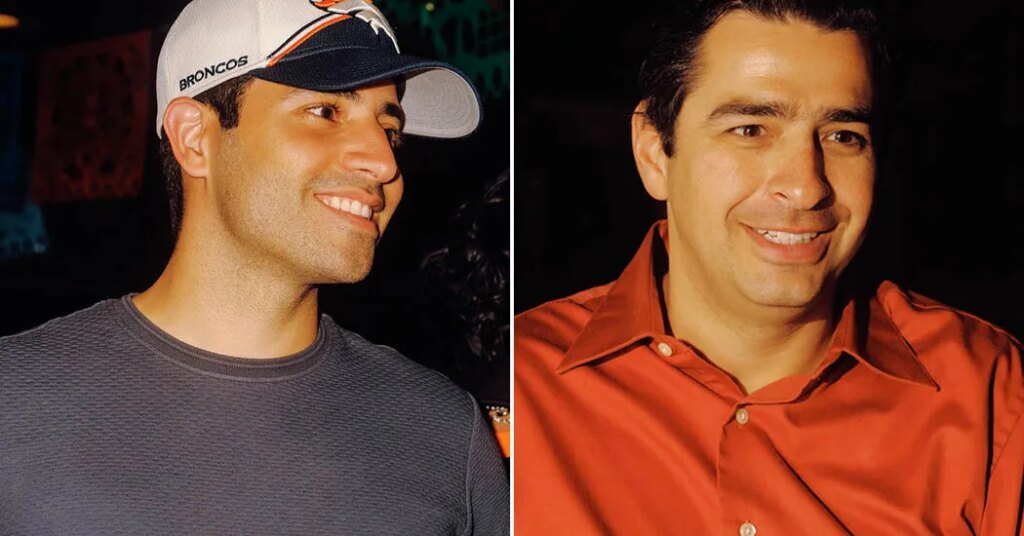
In Colorado’s Eighth District, two millennial candidates competing for a House seat — Representative Gabe Evans, the incumbent Republican, and Manny Rutinel, his Democratic challenger — are having one of the country’s most active debates over the future of A.I.
A.I. has emerged as the Wild West of politics this election cycle, attracting big campaign checks from competing corporate interests and scrambling traditional political lines. Evans and Rutinel, who are running a close race, have both been active in early efforts to regulate the technology.
So last week, while I was in Colorado to report a story on how rising costs are hitting farmers and ranchers, I sat down with both of them to chat about how they’re trying to shape the A.I. future.
‘Immense catastrophic downsides’
To Rutinel, the stakes of the debate are existential.
“This technology has a 10 percent risk of wiping out human civilization,” he told me, in an interview outside a sports bar in Thornton, Colo. “I don’t want human civilization to come to an end.”
Rutinel, who has spent years involved in debates over A.I. regulations and safety, believes government must enact stringent rules dictating how the technology is used.
As a state legislator, he cosponsored a groundbreaking 2024 law that attempted to regulate the use of A.I. by companies and organizations in ways that might be discriminatory. (The law has since been repealed and replaced with a less expansive measure.)
“It’s un-American, it is unpatriotic what’s happening right now. We are just allowing corporate executives to dictate the future of humanity,” he said. “Folks are looking for leaders in this space to make sure that we are putting the right guardrails in place so that we can reap the benefits without the immense catastrophic downsides that are possible.”
What’s surprising is that his arguments for regulation have earned him substantial financial support from the A.I. industry. According to a Times analysis, Rutinel has received more than $240,000 from Anthropic and OpenAI employees, and his campaign has benefited from at least $3 million in spending by PACs with ties to A.I.
‘You can’t smother it’
Evans, on the other hand, is worried about the consequences of doing too much. Like Trump, he warns that overregulation will allow China to develop A.I. more quickly, leaving the U.S. scrambling to catch up and economically flailing.
“We’ve had these conversations about technology for generations, and when the U.S. leads, you typically have a better outcome,” he told me, in an interview at a different sports bar a couple of miles away. “We have to have common-sense guardrails around this stuff, but you can’t smother it, because if you smother, that doesn’t mean it goes away. It just goes to places like China.”
In August, he introduced legislation directing the Commerce Department to support the adoption and use of American open-source A.I. models over those made by China.
Voters aren’t sure what to make of either of these arguments. Polling from The New York Times and Siena University last month found voters split over which party is better equipped to address A.I.
What is clear is that the issue won’t be going away after the election. And the youngest members of Congress may find themselves leading the conversation in a legislature that’s increasingly geriatric.
Whether it’s Rutinel, 31, or Evans, 40, who wins, the next congressman from the district will be one who came of age in an era defined by rapid technological advancement.
“I’m a millennial,” Evans said, “so I’m not scared of technology.”
Get Caught Up
On the trail
-
On Monday, the first day of early voting in Texas, James Talarico and Ken Paxton both held rallies in Fort Worth. For a Senate race with no planned debates, it may be as close as the two candidates ever get.
-
At a campaign rally in Kansas, Trump invoked a centuries-old antisemitic trope to defend Senator Roger Marshall’s debt-collecting tactics, saying Marshall’s opponents had unfairly cast him as “some kind of a Shylock-type guy.”
-
Mysterious fliers have started showing up in Texas voters’ mailboxes that purport to offer help for transgender children. A trans advocacy group cited in the mailers says it had nothing to do with them.
The money race
-
Michael Bloomberg, the billionaire former mayor of New York, is giving roughly $80 million to help Democrats in the midterms. He is particularly focused on ensuring a sizable majority in the House.
-
The Republican National Committee is sending more than $50 million to groups overseeing the party’s efforts to elect House and Senate candidates. The cash infusion is significantly larger than what Republicans have done in the past.
Ad Watch
In Ohio: A new attack ad in the governor’s race features the estranged mother of Amy Acton, the Democratic candidate, accusing her daughter of lying about her past. The two have not spoken since 1978, when Acton, then 12 years old, accused her stepfather of sexual abuse and her mother took the man’s side.
In Michigan: Dr. Abdul El-Sayed would be the first Muslim member of the Senate, and some Republicans have tried to use that against him, labeling him a “jihadist” and a “Muslim radical.” In a new ad, El-Sayed leans into his identity: “I’m Abdul El-Sayed, man of faith,” he says. “That’s a good thing.”
In Mississippi: Senate Democrats’ main super PAC will air more than $1 million in TV ads in the state. The Senate race there has appeared more competitive in recent weeks, after the Republican incumbent, Senator Cindy Hyde-Smith, said Americans upset about rising beef prices could choose a different protein to eat.
In One Graphic
In this final stretch of the midterms, Republicans are spending a tiny fraction of their total ad buys on ads that mention Trump, according to a Times analysis of data and transcripts from the media tracking firm AdImpact.
The total is less than $1 of every $100 spent on ads for House and Senate races from Sept. 9 through Oct. 17. By comparison, Democrats are putting $20 of every $100 in ad spending into spots that mention Trump.
Trump’s new pitch: Vote for the hunks
The president has a habit of complimenting men’s appearances at his rallies, often praising the strength and looks of athletes and service members. But he has been especially effusive about Republican candidates on his recent campaign tour. A few examples:
Jon Husted: “He’s got a jawline,” Trump said of Husted, the Senate candidate in Ohio who played college football. Trump said he had carefully examined Husted’s physique — including his hands, his shoulders and his rear — adding, “I never did that with a man before.”
Ed Gallrein: Trump recalled meeting Gallrein, a House candidate in Kentucky. “I needed somebody good, and this guy walks through the door,” he said. “I said, look at this beautiful guy.”
Mike Collins: Trump said at a rally in Georgia that Collins, the Senate candidate, “is a good-looking man — and he’s all man.” (By contrast, Trump claimed that Senator Jon Ossoff, the Democratic incumbent, resembled Pee-wee Herman.)
Rick Jackson: At the same Georgia rally, Trump hailed Jackson, the nominee for governor, as “a very handsome, distinguished, beautiful-looking guy.”
ONE LAST THING
Does your suit say something about your politics?
“The other day I was in a Brioni suit and was accused of being MAGA,” a reader wrote to our chief fashion critic, Vanessa Friedman. The reader wanted to know: Could the label he wore really send an inadvertent message about his political leanings?
It might.
Gone are the days, Vanessa writes, when the only way to wear one’s politics was with a campaign button. The Trump administration’s facility with personal branding means that certain styles — Florsheim shoes; the navy suit, red tie, white shirt combo — have become shorthands for the president and his supporters.
It’s not just the words on a garment that might give clues to your own political position, Vanessa writes, but the actual mixing and matching of the garments themselves.
Taylor Robinson and Matt Zdun contributed to this newsletter.
The post A High-Tech Debate in Cattle Country appeared first on New York Times.