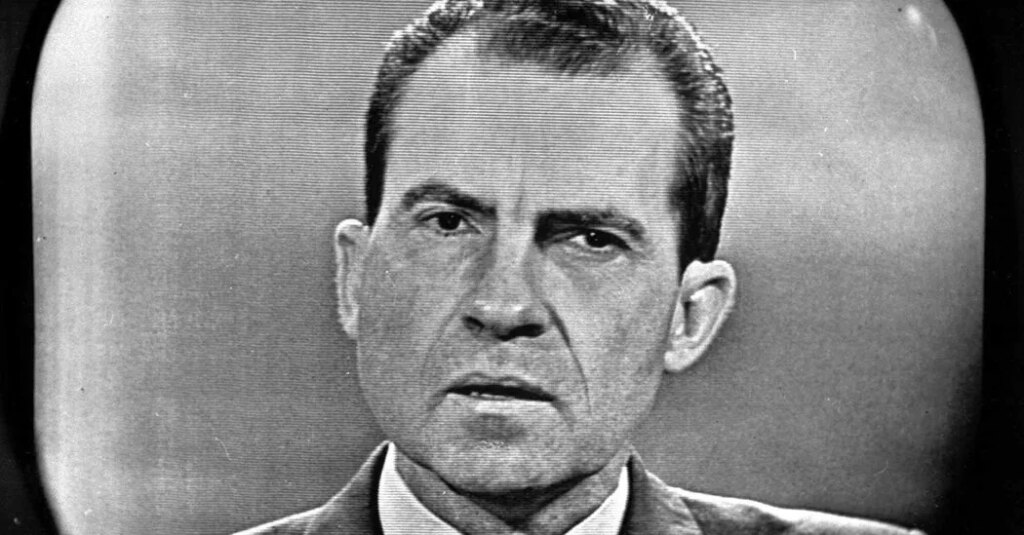
Was Richard Nixon a counterrevolutionary “taken down in a Deep State coup”? A model for the new climate right? Was he also, in some ways, a progressive?
On some parts of the right, Nixon is undergoing a reassessment, or redefinition, known as “Nixonmaxxing.” Young conservatives are celebrating him in Washington and on social media.
With his embrace of tariffs and law-and-order policies — and his insistence that he was unfairly dogged by the deep state — Nixon has some things in common with the current occupant of the Oval Office.
Is this reappraisal of Nixon about the past, or the future, of the G.O.P.? Geoff Kabaservice, the author of “Rule and Ruin: The Downfall of Moderation and the Destruction of the Republican Party, From Eisenhower to the Tea Party,” reflected on these questions in a written conversation with John Guida, an editor in Times Opinion. It has been edited for length and clarity.
John Guida: “Nixonmaxxing” has received a lot of attention this year, but the reappraisal has been a work in progress. For example, in a 2023 video, Christopher Rufo argued that Nixon’s politics represented a counterrevolution against the upheavals of 1968. Was Nixon a counterrevolutionary? What does it mean to call him one?
Geoff Kabaservice: Rufo actually laid out his case for Nixon as a “counterrevolutionary” at great length in his 2023 City Journal essay “Bring on the Counterrevolution.” Rufo’s thesis is that Nixon, particularly in his second term, began to strike back against the “federal agencies” that had been built up by Lyndon Johnson’s Great Society and parts of Franklin Roosevelt’s New Deal.
Nixon aimed to tame the federal bureaucracy by decentralizing power under his “new federalism” approach (which included consolidating federal programs into block grants to states and localities and trying to replace Great Society anti-poverty programs with a guaranteed-income system); to restore “law and order” in a way that would discredit and disempower the left; and to build a “counter-elite” that would supplant the “establishment” that Nixon believed had turned against him. He meant the national news media, elite universities, leading foundations, federal bureaucrats and to some extent upper-class society as well.
Guida: So this was especially a second-term project?
Kabaservice: Nixon definitely intended to take the Republican Party in a more conservative and populist direction in his second term, and present-day conservatives are not wrong to see his rhetoric and intended program as a forerunner of Trumpism. Nixon took significant steps toward recasting the G.O.P. as a working-class party, as Donald Trump briefly succeeded in doing in the 2024 election. Nixon was also, in some ways, an economic nationalist on trade and a proponent of a pro-labor policy — as Trump sporadically has attempted to be.
However, Nixon was a complicated leader who thought and acted in ways we would consider both conservative and surprisingly progressive. He did more than Johnson to desegregate Southern schools and establish federal affirmative action programs, and both Bill Clinton and Barack Obama acknowledged that their national health insurance proposals were built upon Nixon’s innovative 1974 health care proposal.
This complicates the effort to paint him as someone who started the conservative counterrevolution that Trump has carried forward.
Guida: That complication extends to Nixon’s posture to executive power, right? It was his administration that created the Environmental Protection Agency in 1970 as well as other additions to executive-branch bureaucracy (the Consumer Product Safety Commission, for example).
Kabaservice: The E.P.A. is an excellent example of why Nixon is hardly a direct model for today’s conservatives — and one might also add his signing into law of the Occupational Safety and Health Administration, which the right has disliked since its creation in 1970. But Nixon saw both agencies as means of improving the health and safety of Americans, and he was baffled by conservatives’ objections to using the power of government toward that end.
In other ways, however, Nixon seems to have anticipated some of the central claims of what is now known as the unitary executive theory. Nixon used impoundment — withholding congressionally appropriated funds — to prevent money from going to programs he objected to, claiming that the president has independent constitutional authority over execution of the law.
He also, notably, claimed executive privilege during the Watergate crisis, attempting to shield his deliberations (including his secretly taped conversations in the Oval Office) from Congress and the courts. Like Trump, Richard Nixon didn’t believe in a small government in the way past generations of conservatives like Robert Taft had. He wanted a government large and powerful enough to accomplish his goals, which Nixon genuinely conceived as contributing to a more peaceful world and a more prosperous United States.
But in his more vindictive moments, Nixon clearly thought of the power of the state as a weapon with which to strike back at his “establishment” enemies, in ways that prefigured Trump’s attempts to defund elite universities or expel dissenters from the Civil Service. And, as Nixon said to the journalist David Frost in a post-presidential 1977 interview, “Well, when the president does it, that means that it is not illegal.” This is a view for which Trump has considerable affinity.
Guida: Do you see the Trump administration’s direction of the Justice Department as a modern application of that use of government power to strike back at enemies? Or perhaps to intimidate opponents, as in, say, the investigation of Democratic Representative Ilhan Omar?
Kabaservice: Nixon’s “enemies list” was a testament to how he wanted to use the F.B.I., I.R.S. and other government agencies to “screw” his opponents, in ways that again seem to anticipate Trump’s weaponization of the Justice Department.
But it’s important to remember that people who worked for Nixon often saw him as something of a split personality — the good Nixon and the bad Nixon. The bad Nixon wanted to use Machiavellian means to accomplish his ends, even when they went up to the edge of legality and beyond; the good Nixon knew those efforts were illegal and immoral.
So his aides learned to work around what they called his “Alice in Wonderland” moments, when he would order them to attack his enemies in these illegal or unconstitutional ways — only to come back hours or days later and tell them that, after thinking about it, he had decided it would be better not to.
Guida: I’m curious how you think about Nixon and Trump in the context of the Supreme Court under Chief Justice John Roberts. In several decisions — on presidential immunity, presidential control of administrative agencies and more — it has endorsed the unitary executive theory. How do you think about these changes and presidential power?
Kabaservice: The Roberts court obviously has expanded executive power in numerous ways, but it also has struck down Trump’s attempts to bypass congressional authority or the Constitution. One thinks of the court’s ruling against Trump on tariffs, birthright citizenship and his attempts to remove officials without due process.
So in certain ways Trump, like Nixon before him, has been constrained from acting on what he seems to believe is his authority under Article II to do “whatever I want.”
Guida: How would Watergate, or some modern equivalent, go down under the Roberts court?
Kabaservice: I don’t think the Roberts court would countenance Trump forming a “plumbers’ unit” (to use the Watergate term for Nixon’s black-ops team) that would commit burglaries and other crimes in the hopes of plugging leaks and harassing the president’s enemies. Neither would I expect it to countenance the president’s obstruction of justice, evidence of which provided the “smoking gun” that ultimately forced Nixon to resign. However, would a similar scandal even reach the court nowadays? That’s a different question.
Guida: To that point, JD Vance said, about Watergate, “The idea that it would have taken down a presidency is crazy.” What do those remarks reveal about how we view politics today?
Kabaservice: Vice President Vance was more right than wrong when he speculated that if Watergate happened today, it would be a “12-hour news story” rather than a scandal that would bring down an administration. That has less to do with the courts than with the way that our political parties have become intensely partisan and polarized.
Nixon was persuaded to resign when a group of Republican senators came to him and told him he had lost the support of much of his own party. I have a hard time believing that would happen today.
If anything, many conservatives have come to appreciate Nixon more in retrospect because of — not despite — his actions in the Watergate scandal. Trump’s Nixonian willingness to act ruthlessly against his Democratic and deep-state enemies is at the core of his appeal to many of his supporters: “He fights!”
Guida: Will that “he fights!” appeal will be a staple of Republican politics after Trump? Or do you see other paths? For example, Dan McLaughlin wrote for National Review that Ronald Reagan was a better leader than Nixon and should remain the model for modern Republican success.
Kabaservice: Conservatives appreciate that Nixon was hated by what they considered to be all the right people — the anti-anti-Communists, the student protesters, the left-wing professoriate and so on — although the revisionist claim that Nixon was the victim of a “deep-state coup” doesn’t hold water.
Trump supporters also value Nixon as a kind of tribune of working-class people — or as Nixon called them, “the silent majority,” who objected to the disorder and cultural radicalism of the late 1960s. But Nixon was someone who stood at the center of the Republican Party. He didn’t emerge from its right wing — and in fact, the conservative movement began as a protest against the moderation of the Eisenhower administration in which Nixon served as vice president.
Many conservatives had a lifelong sense that Nixon betrayed them when, as vice president, he helped shut down Senator Joseph McCarthy’s anti-Communist crusade.
Guida: Nixon was, in a sense, a party man?
Kabaservice: He can be hard for us to understand because he saw himself as a kind of mediator among the Republican Party’s conservative, moderate and liberal factions, trying to keep them from attacking one another and making sure that each had what he called “a piece of the action.”
Reagan also maintained that big-tent approach to some extent, which is why relatively moderate Republicans like James Baker still played important roles in what was overall a conservative administration. Reagan never had a conservative mutiny because the right saw him as one of their own, and so gave him much greater latitude when he deviated from conservative orthodoxy.
It’s also true that Reagan was more of a party-builder as president — Nixon’s Committee to Re-elect the President shared very little of the money it raised in 1972 with the regular party apparatus — and Reagan validated conservatives in ways Nixon did not.
Guida: How would you rate Nixon, given the complications you convey here, among postwar Republican presidents? From Eisenhower to Trump, how would you rank them?
Kabaservice: I confess to having a great deal of sympathy for Nixon just on a human level. Of all of our presidents, he may have been the most brilliant and the most tormented. Lee Huebner, who served as a speechwriter for Nixon almost up until the end of his presidency, came out with a terrific book recently — “Nixon’s Elusive Totality” — which includes a generous selection of Nixon’s speeches and other statements, including his farewell remarks to the White House staff on the day he left office.
That last, impromptu address reveals Nixon’s genuine idealism about public service as well as his rather self-pitying sense of his own difficult roots in the working class (he said his father would have been considered “sort of a little man, common man,” but “he was a great man, because he did his job”). Nixon exited the national stage as a kind of Willy Loman figure, in a way I find tragic and moving.
In terms of how to evaluate Nixon as a president, you have to give him high marks for his opening to China, which ultimately resulted in making that country a tacit ally in bringing about both the downfall of the Soviet Union and our present globalized economic order. But Nixon’s presidency comes with a lot of asterisks as well, including not only Watergate but his prolongation of the Vietnam War.
I would rank Nixon below Eisenhower in terms of how his actions added to the country’s core strengths, but Nixon had a more difficult assignment in managing the economy as it began to move into the postindustrial era and faced greater overseas competition.
I would rank Nixon above Reagan and George H.W. Bush as an effective government manager, and well above George W. Bush and Trump as a leader able to transform society and move toward a prosperous and peaceful world order.
Guida: So unlike Mr. McLaughlin and I’m sure many others, you would put Nixon above Reagan?
Kabaservice: Reagan restored the morale of much of the country after the setbacks of the 1970s. But he also presided over the continued economic stagnation of the working class and the movement toward uncontrolled deficit spending that poses a serious long-term threat to the national interest.
Guida: The subtitle of Huebner’s book — “It Depends on Who Writes the History” — makes me wonder about historical narratives in the service of shaping politics. Several writers — among them Jonah Goldberg at The Dispatch — have suggested that this reappraisal of Nixon is really about who comes after Trump. It weaves a narrative of a particular type of conservative (a counterrevolutionary and a bare-knuckle political brawler) out of the very real complexity of Nixon that you stress.
How do you think about the construction of these types of narratives, and what makes some of them effective or intriguing (here I’m thinking of “Nixonmaxxing”) while others are forgettable or unconvincing?
Kabaservice: “Nixonmaxxing,” as I first read about it in The Wall Street Journal, really is a kind of vibe more than it is a genuine attempt to rehabilitate Nixon’s legacy or to consider him in his “elusive totality,” to quote the title of Huebner’s book. But history, in a country this divided, is always going to be a contest we wage in the present.
Nixon is an important figure for the Republican Party to think about as it gropes its way toward a post-Trump future. Nixon was a realist — détente was in many ways a recognition of the limits of American power — and at his best he understood that politics in a two-party system has to involve negotiation and compromise with people who disagree with you.
When Nixon listened to his better angels, he remembered that political opponents are still fellow Americans, not enemies to destroy. And Nixon’s legacy ought to be a reminder that if politics is a contest, at times a bitter one, it also has to be played by the rules of the game, including the rule of law and the Constitution.
Geoffrey Kabaservice, the vice president for political studies at the Niskanen Center, is the host of the podcast “The Vital Center” and the author of the newsletter All Things in Moderation and the book “Rule and Ruin: The Downfall of Moderation and the Destruction of the Republican Party, From Eisenhower to the Tea Party.” John Guida is an editor in Times Opinion.
The Times is committed to publishing a diversity of letters to the editor. We’d like to hear what you think about this or any of our articles. Here are some tips. And here’s our email: [email protected].
Follow the New York Times Opinion section on Facebook, Instagram, TikTok, Bluesky, WhatsApp and Threads.
The post Why Is MAGA Swooning Over Richard Nixon? appeared first on New York Times.