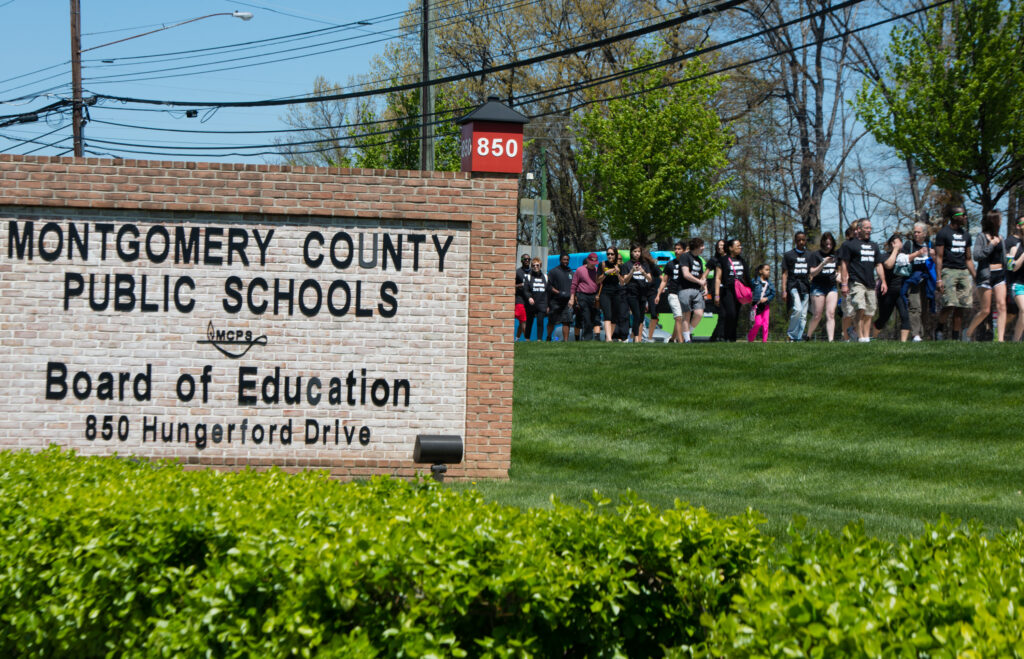
The Supreme Court said Monday it will hear a challenge to admissions criteria for a middle-school magnet program in a Maryland county that some parents argue put Asian American students at a disadvantage.
The criteria do not explicitly rely on race, but a group of mostly Asian American parents claim they are discriminatory because there was a large drop in Asian American representation in Montgomery County, Maryland’s selective middle-school programs after the school district reformulated the standards.
The criteria, which offer slots through a lottery of the top students from each school, were adopted during the coronavirus pandemic. The school district had been reworking its standards after a 2016 report found there were “significant racial and socioeconomic disparities” in enrollment and acceptance in academically rigorous programs in the county.
The Supreme Court’s decision will likely have implications for similar programs rolled out across the country in recent years.
The case comes to the court three years after its landmark decision ending race-conscious admissions programs at Harvard College and the University of North Carolina at Chapel Hill. It continues to reverberate in the academic and corporate spheres.
This newest case presents a different question: whether plaintiffs must prove statistically that a race-neutral enrollment policy put Asian American students at a disadvantage.
The enrollment criteria at issue are seemingly race-neutral. The lottery selects students who score in the the 85th percentile or better on an abilities test. At the same time, the district assesses poverty levels of the students’ schools and compares students against peers at the same school — an effort to give more students from higher poverty schools an opportunity to participate.
But the plaintiffs say that system makes it more difficult for those from high-achieving schools to gain acceptance and is hurting the chances of Asian American students.
Montgomery County, which is a suburb of Washington, D.C., is among the nation’s largest and most diverse school districts.
In the Montgomery County case, a federal judge dismissed a lawsuit by a group called Association for Education Fairness. An appeals court affirmed that ruling, before the group appealed to the Supreme Court to revive the suit.
The high court will probably schedule arguments for early next year and issue a decision in the spring or summer.
Nearly half the students in the county’s four middle-school magnets were Asian American before the new criteria were adopted. Afterward, Asian American students invited to enroll dropped by as much as half at some of the schools. Asian Americans make up about 14 percent of Montgomery County’s school population.
“The Constitution protects students as individuals, not as members of a racial group,” said Chris Kieser, a senior attorney at Pacific Legal Foundation, a conservative legal nonprofit, which is representing the parents. “A school district should not be able to defeat a discrimination claim by showing that its policy did not harm enough Asian American children. Every family deserves admissions rules that judge their child on their own merit.”
Montgomery County Public Schools public information officer Liliana López said in a statement that the Supreme Court is not evaluating specific details related to magnet programs, but rather a “purely legal question” and will “decide what plaintiffs who challenge race-neutral admissions criteria on their face must establish to demonstrate discrimination.”
“Montgomery County Public Schools (MCPS) remains committed to providing equitable access to rigorous opportunities for all students,” the statement added. “This commitment will continue uninterrupted as the judicial process proceeds.”
Last year, the Supreme Court ruled religious parents from the school district could opt their children out of school lessons that involved LGBTQ+-themed storybooks.
The post Supreme Court to hear case challenging admissions criteria for middle-school program appeared first on Washington Post.