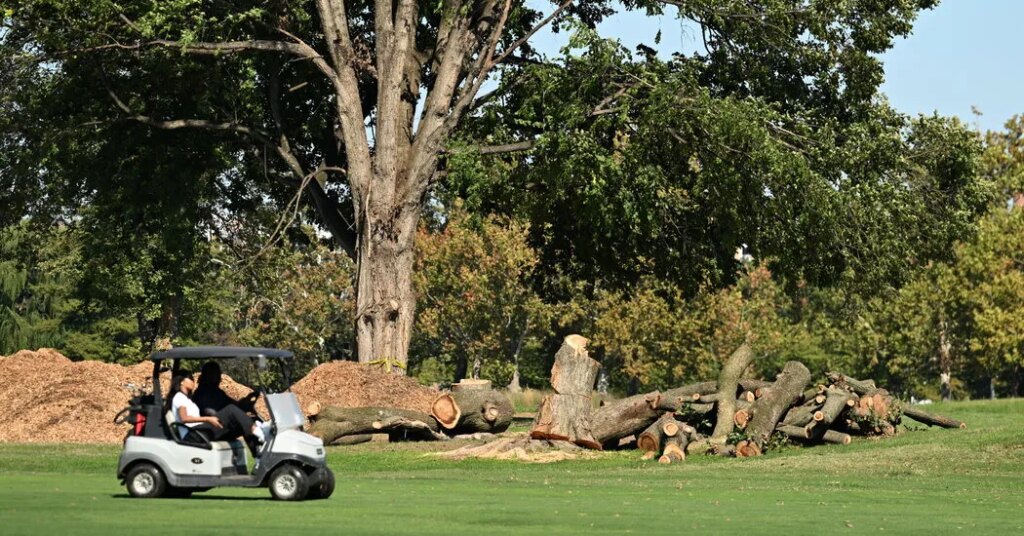
A hearing about the fate of the East Potomac Golf Links in Washington turned into an icy standoff on Monday as a federal judge went to extraordinary lengths to learn who has been responsible for decisions about the property and whether plans to overhaul it have been kept from the court.
A day after President Trump announced that his administration would transform the municipal course into a professional golf venue, Judge Ana C. Reyes summoned a constellation of officials to testify about whether the government has been plotting the renovation even while swearing in court that no decisions had been made.
While the stakes of the case are relatively low — the fate of one municipal golf course on a spit of land not far from the monuments in Washington — it has taken on symbolic importance as the latest blowup between Mr. Trump and the federal courts. It is proving to be a test case for how far Mr. Trump is willing to go to get his way on a project that he has made clear is important to him.
Judge Reyes asked several senior officials to testify on Monday about a decision to cut down hundreds of trees at the course after providing only a few hours of notice. She had requested notice of major changes at the course, so she could consider whether the proposed actions would be legal, given a challenge from a preservationist group trying to halt the project.
The Justice Department responded by alleging that Judge Reyes, an appointee of President Joseph R. Biden Jr., has shown bias in the case and asking her to recuse herself. She declined.
Facing an army of lawyers from the Justice Department, including the department’s third most senior official, Judge Reyes made clear that her patience was running thin. She said the government’s position that the tree removal was part of routine maintenance — not in preparation for a renovation that Mr. Trump has now trumpeted on social media — made little sense.
“There is no universe in which all of this just coincidentally happened at the same time,” she told the lawyers. “There just isn’t.”
In his Sunday post, Mr. Trump announced that the course would close for a 14-month renovation on Nov. 15. On Monday, he followed up to say that work was scheduled to begin immediately.
Judge Reyes has ordered the administration to halt all tree removal until at least Oct. 26, but she is considering a more expansive block on work at the site.
The hearing opened with drama, as Judge Reyes asked all of the Justice Department officials present, including junior lawyers and nonpolitical career lawyers, to raise their hands if they agreed with a filing that had been submitted on Sunday by Stanley E. Woodward Jr., the associate attorney general. If they did, she said, she would order them to add their names to it as well.
That document tried to square the government’s courtroom statements with Mr. Trump’s social media commentary. It argued that federal agencies were still studying the plan and that cutting trees on the property did not amount to a determination about the future of course.
“The plan is not final because the Park Service has not completed its review and the details of the proposal are subject to change during the review process,” it said.
Mr. Woodward told Judge Reyes that her request was “inappropriate.” He added that he would instruct his colleagues not to do as she had ordered.
“I’m the one who’s going to say how we move today, not you,” she fired back.
She then ordered Mr. Woodward to explain in writing by later on Monday why the Justice Department did not have to follow her direction.
The hearing continued with testimony by Gregory Wischer, a deputy chief of staff at the Interior Department, who was involved in meetings about improving East Potomac Park as part of larger “beautification” efforts in Washington.
Facing questions from Abbe Lowell, a lawyer representing the group suing to stop the renovation, Mr. Wischer testified that taking down the trees was a basic aesthetic decision. A 2019 report that proposed restoring the course’s original layout had recommended tree removal, he testified.
“We were just trying to find ways we could clean up the course,” he said.
Mr. Wischer’s testimony on Monday played out against a backdrop of Mr. Trump’s conflicting public statements.
Mr. Trump has attacked Judge Reyes as “a crazed lunatic whose courthouse tapes will reveal, may be insane.” The Justice Department had requested that audio be released of a hearing she conducted last week, in which she angrily took the Trump administration to task for removing trees with minimal notice.
In denying the administration’s request that she step away from the case, Judge Reyes pointed out that she had consistently rejected what she described as premature requests by the preservation group suing that she block work at the course.
Instead, she wrote that she had approached the case as a “pragmatist” who had urged the parties in July to hammer out an agreement on their own, rather than pre-emptively halt work by court order. She had instead asked the government to provide notice before undertaking major work at the course.
“Between February 13, when this case was filed, and October 11, the court had not barred the government from taking any action in East Potomac, including tree removal,” she wrote.
“It is easy to weaponize selective quotations to bring a baseless recusal motion,” she added. “But it is much harder to meet the demanding legal standard against a full record. By any objective measure, the government fails to meet the standard for recusal.”
The post Judge Grills Witnesses About Decisions Behind Trump’s Golf Course Plan appeared first on New York Times.