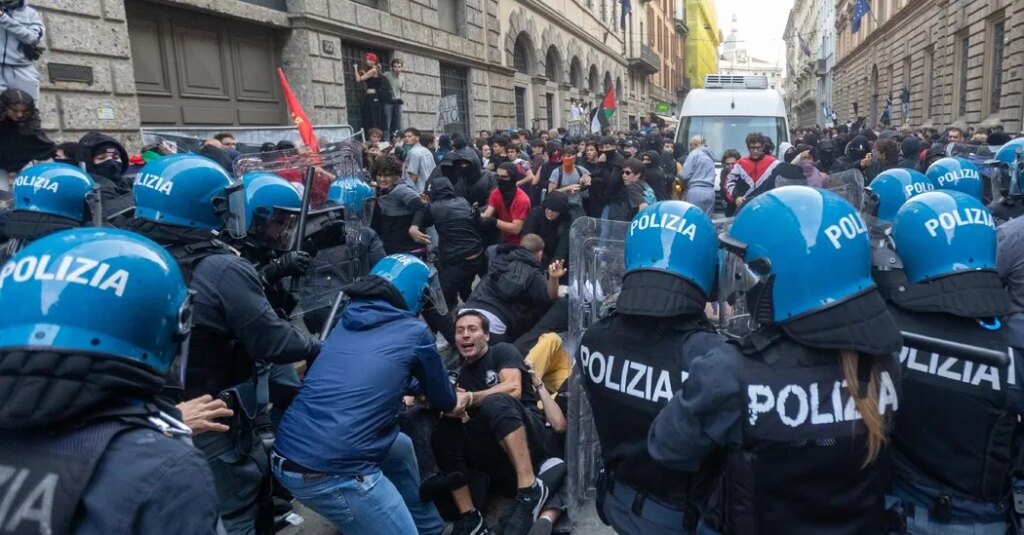
Italy was rocked over the weekend by two separate waves of protests, as students in the north and farmers and truckers in the south demanded government action to staunch rising costs.
In cities across northern Italy on Saturday and Sunday, thousands of student demonstrators marched in protest of low wages, high taxes, rising grocery and gas prices and cuts to public funding. A number of the marches turned violent, as groups of masked protesters looted stores, set fires and lobbed projectiles toward the police, who responded with water cannons and tear gas.
In the country’s south, farmers and truckers have since last week blockaded ports and major highways to protest high fuel prices triggered by the war in Iran, causing shortages at supermarkets and gas pumps. They say price hikes have chipped away at their slim margins and are demanding a stronger government response.
Prime Minister Giorgia Meloni, who has made law and order a pillar of her government, acknowledged her “great respect” for peaceful protesters in a post on social media on Saturday but condemned the violence: “Protesting is a right. Setting our cities ablaze is not.”
She met with government and law officials on Monday to consider harsher penalties for violent protesters.
The protests in both north and south were the latest in a wave of similar movements across Europe. The eviction of an 87-year-old woman in Madrid last month spurred Spaniards to take to the streets to protest rising rents, plunging the government of Prime Minister Pedro Sánchez into a political crisis. Anger in Albania about a planned luxury development by Jared Kushner has swelled into public outrage over perceived political corruption and worsening living standards. In France, students protesting the conditions in their schools unleashed a tide of frustration that has swept the country, leading this weekend to the country’s worst riots in decades.
Italy’s youth protests were much more modest and had wrapped up by Sunday night. About 2,000 people demonstrated in Milan, where the largest protest took place, the city’s police force said. Marches also occurred in Bologna, Turin, Brescia and Bergamo, among other cities.
“There isn’t an electoral solution to our misery,” read a post by the anonymous social media account created earlier this month that issued the initial call to action, urging widespread anti-government demonstrations to “bring the birth of a new Italy and a new Europe.”
Though the majority of protesters in Milan marched peacefully, clashes with the police led to the arrest of 32 people, most of them minors. The police said 14 officers had been injured, one of whom was hit on the head with a cobblestone. A Milan business association estimated on Monday that the unrest had caused more than one million euros, or about $1.1 million, of damage.
In a statement, Giuseppe Sala, the city’s left-wing mayor, called “actions and scenes like those we witnessed on Saturday and Sunday, directed against law enforcement and against public spaces and businesses, intolerable and unjustifiable.”
Images and videos of the disorder prompted strong negative reactions across the country. “Unacceptable,” read Monday’s front page of Il Messaggero, one of Italy’s national dailies.
But some urged Italians to look past the violence. “Young people are angry,” Marco Bascetta wrote on Saturday in Il Manifesto, Italy’s communist daily. “If a body of water is neglected and choked for decades, it can’t be expected not to overflow.”
Italy’s mainstream press has covered the protests in northern Italy significantly more than it has the longer-running ones in the poorer south — another sticking point for the farmers, truckers and their supporters. “The news doesn’t talk about southern Italy because the government isn’t interested in southern Italy,” read a headline in Scomodo, an online magazine.
Matteo Salvini, Ms. Meloni’s minister of transport and infrastructure, had agreed to meet with representatives of the southern truckers next week. But over the weekend, as the Italian press began reporting on the fallout from the blockades, he announced he would move the meeting up to Tuesday. The government will “do everything within our power” to appease the truckers, he said in a radio interview.
The post Italy Faces Parallel Protests in the North and South appeared first on New York Times.