The French government ordered Monday night curfews for parts of several cities, including Paris, Nice and Lille, as it tried to reassure citizens after the worst riots in decades erupted across the country.
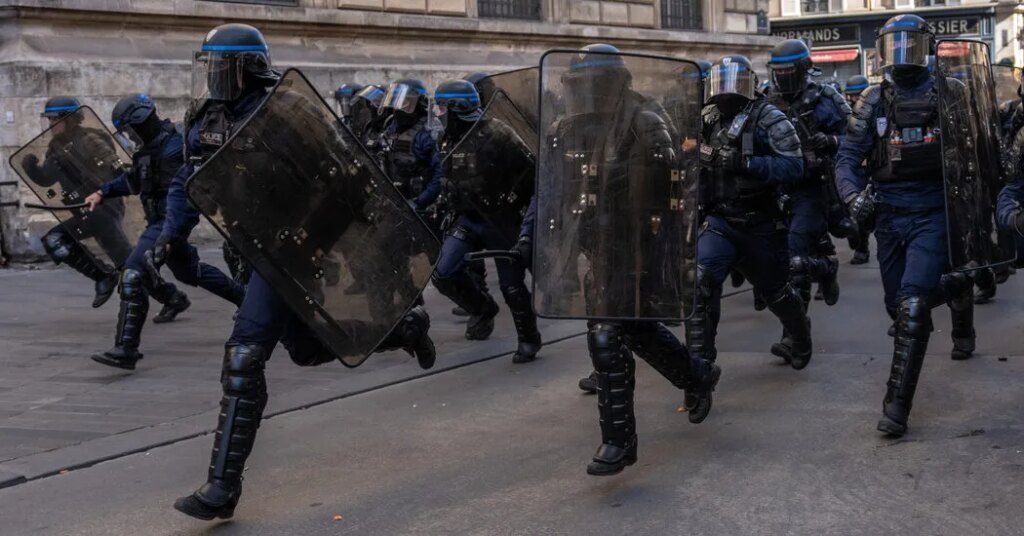
The curfews were the clearest signs that the government was trying to reassert control in the face of fierce criticism that it had been woefully unprepared to deal with widespread violence and looting that broke out this weekend on the sidelines of large, organized protests.
France’s interior minister, Laurent Nuñez, offered a mea culpa on national radio on Monday, saying that the police had not been ready for the scale of the riots that spun off from the mostly peaceful protests held across the country. Mr. Nuñez said he had offered his resignation to President Emmanuel Macron but that it had not been accepted.
The justice minister, Gérald Darmanin, also acknowledged that the authorities had “undeniably failed” in the face of the violence — the biggest unrest to hit France in years — and said on French television that there had been “a failure in intelligence.”
Prime Minister Sébastien Lecornu struck a different tone on Monday, saying that the police had done a good job against a “shadowy network” of far-left instigators who he said were seeking to orchestrate “a profound disorder in the country leading up to the presidential election.”
“While we witnessed very difficult scenes involving violence against property, no one was killed, and that is a miracle,” Mr. Lecornu said after emerging from an emergency meeting of ministers on Monday afternoon.
He told reporters that a huge police operation was underway, with “practically” 200 investigators in Paris alone working to track down the looters. “My determination to restore order is absolute,” Mr. Lecornu said, vowing to use “whatever tools are at the government’s disposal.”
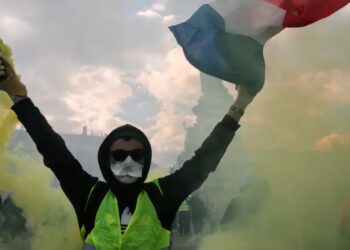
Students started protesting last month to express frustration with the condition of their high schools. Other groups like labor unions joined the student demonstrations in solidarity and to highlight their own grievances, like the cost of living and rising fuel prices. But nebulous groups took advantage of the demonstrations to attack government buildings, smash shops and loot on Saturday.
In Paris, the police prefecture ordered a curfew from 11 p.m. Monday to 6 a.m. Tuesday in two areas of the city — a shopping hub that was targeted by looters and the Place de la République, where much of the violence occurred over the weekend.
It also restricted gatherings starting from 8 p.m. Monday in more than a dozen areas of Paris, including around important government buildings like the presidential palace and the two chambers of Parliament, and at various train stations.
Curfews for minors, from 8 p.m. Monday to 6 a.m. Tuesday, were also put in place in districts of Lille and smaller cities in the north — Wattignies, Douai and Denain — local officials said.
The mayor of Nice, Eric Ciotti, announced a curfew for minors in the central part of the Mediterranean city, starting at 9 p.m. Monday.
The government estimated that at least 3,000 businesses across the country had been pillaged over the weekend, double the figure given on Sunday by the Federation of Commerce and Distribution.
Mr. Lecornu said that workers affected by the riots could get access to partial unemployment payments starting on Tuesday, and that the government was pushing insurance companies to speed up reimbursements.
“We must enable shopkeepers to get back on their feet very quickly,” he said.
It was unclear if those words would assure rattled citizens and furious mayors, many of whom demanded answers from the national government on Monday.
Benoît Payan, the mayor of Marseille, blamed the government and the police for “delivering” that city, France’s second-largest, to “looters and rioters.”
Speaking on French radio, he accused the region’s prefect of inflating the number of rioters who had attacked City Hall and local stores, and said that he was seeking “explanations” from the government and “the guarantee that this will not happen again.”
“I want compensation down to the last cent,” he said, adding, “You cannot let a country sink into a political crisis without an answer.”
After sporadic episodes of violence and looting persisted in several French cities on Sunday — including in Paris, where the police chief said 351 people had been arrested — several cities took measures to restoring calm on Monday.
The authorities in Marseille banned gatherings throughout the city from 12 to 8 p.m. that day, a local official said on social media.
The mayor of Coulaines, in western France, made his announcement after the prime minister’s call, saying his town would have a curfew for minors after 11 p.m.
“I think that at the state level, it would be necessary to implement similar measures,” he said in a video posted on social media. “And why not declare a state of emergency if the raids and looting continue?”
A senate committee said on Monday that it would initiate an investigation into the law enforcement and criminal justice response to the looting and violence over the weekend in order to establish “administrative, institutional, legal and political responsibilities.”
Amid calls for calm and order, there were questions about what would happen next.
The students who started the protest movement more than a month ago by blockading their schools to demand better conditions are now on a two-week vacation. Other groups, however, seemed determined to keep the movement going.
On Monday morning, a group of university students blocked entrances to the Louvre Museum and prevented it from opening. Students also blockaded the Paris campus of Sciences Po, one of France’s most prestigious universities. The police were called to the scene, according to student unions and a university spokeswoman.
Some protesters who took part in the huge weekend demonstrations have called for another mass action next weekend.
On Monday, Mr. Nuñez said that police numbers would be reinforced across the country, “particularly this weekend.”
The post France Imposes Curfews in Parts of Paris and Other Cities After Nationwide Rioting appeared first on New York Times.