Novri Putra graduated from college in Jakarta last year with a degree in information technology and a modest ambition: a stable job.
He had every reason to believe that he was on track. When he entered college in 2018, Indonesia’s economy was flourishing. Its tech sector was booming and demand for software engineers was surging.
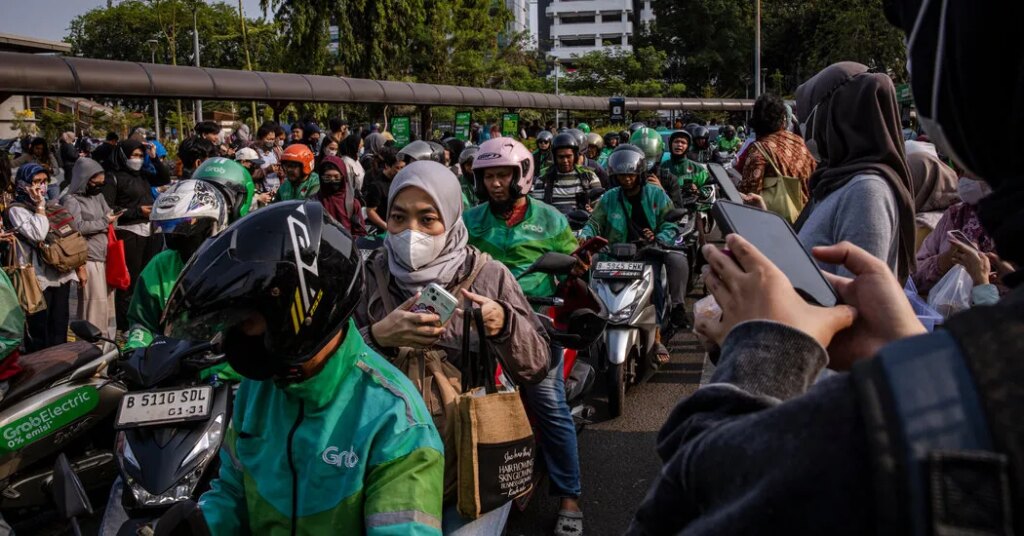
Those days are over. Today, Mr. Novri, 28, works for a tech company — not as a web developer, as he had hoped, but as a motorcycle taxi driver making about $220 a month.
“My parents scold me almost every day,” Mr. Novri said. “Honestly, they probably feel a sense of shame that their child went to college and ended up as a motorcycle taxi driver.”
Mr. Novri’s predicament speaks to a greater malaise in Indonesia, where an economy once known for its stability is showing alarming signs of strain.
Like its Southeast Asian neighbors, Indonesia is struggling with the fallout from the war in Iran and American tariffs. Inflation is rising and fuel shortages are spreading across multiple cities. But government policies under President Prabowo Subianto are compounding its troubles, weakening institutions and raising doubts about the country’s economic management.
On Friday, the country was roiled after MSCI, an influential index provider, warned it could drop Indonesia from its benchmark indexes, which guide investment decisions by fund managers worldwide. The country’s stocks suffered their biggest one-day plunge since the 1998 Asian financial crisis, falling by more than 11 percent. On Monday, the selling continued with a nearly 4 percent decline.
A decade ago, this country of nearly 290 million people was seen as a reliable safe haven as other emerging markets battled currency collapses and hyperinflation. Although it still reports strong economic growth, other indicators tell a different story.
The number of people considered middle class has shrunk by about 19 percent from its peak. Lower-class savings rates have plummeted. Youth unemployment hovers around 17 percent, among the highest rates in Asia.
Experts now warn that Indonesia is facing its most combustible moment since 1998, when an economic collapse forced the ouster of the former dictator Suharto.
“It is a ticking time bomb,” said Ferry Latuhihin, the former chief economist at Bank International Indonesia who served on an expert council advising Mr. Prabowo before his administration took office.
“No one predicted in 1997 that Suharto would fall because of the malfunction of the economy,” he said. “The same story, I believe, might happen to this government.”
Experts do not expect the market turmoil to spread to regional neighbors. Phillip Wool, head of research and portfolio management at Rayliant, an investment firm based in California that manages $17 billion in assets, said MSCI’s concerns were specific to Indonesia, which accounts for a small share of most emerging-markets investors’ portfolios.
“It’s a risk that’s really isolated to Indonesia,” he said.
But the economic ripple effects may extend further. Indonesia is the world’s largest producer of palm oil, nickel and Barbie dolls and a major exporter of thermal coal, copper and natural gas. An economic crash could disrupt electric-vehicle production and drive up global prices for food, consumer goods and energy.
A study in July led by Indonesia’s former finance minister found that the erosion of the middle class correlates with more frequent protests. In August 2025, demonstrations erupted nationwide over the death of a ride-sharing driver at a protest and rising unemployment and inflation.
Thomas Lembong, Indonesia’s former trade minister, warned that too many things are going wrong at once.
“We’re getting closer and closer to the edge of the abyss,” he said.
Stock Rout
Indonesia’s economic turmoil has revealed weaknesses that Mr. Prabowo’s policies have done little to address.
High oil prices and rising U.S. interest rates have drained dollars from Indonesia and put pressure on its currency, the rupiah. Indonesia is highly exposed because it relies heavily on imports of essential goods.
Yet Mr. Prabowo is doubling down on populist programs that are straining Indonesia’s budget and alarming investors. One example is a free-meal program for more than 80 million students, estimated to cost up to $30 billion a year.
Harris Turino, an opposition lawmaker, said that suspending the program for just three days would free up enough money to pay college fees for 20,000 students for a decade.
Investors are also questioning the Prabowo government’s transparency. A former general and Suharto’s former son-in-law, Mr. Prabowo has moved to nationalize assets and use a newly established sovereign wealth fund to advance his agenda.
MSCI cited “a lack of meaningful enforcement” against market manipulation for its warning on Thursday. The index provider said it had started consultations on whether to downgrade Indonesia’s market classification to the same category as countries facing international sanctions or prolonged economic turmoil.
The message was clear: Indonesia was now considered an unreliable investment.
The MSCI announcement came after two credit ratings agencies, Moody’s and Fitch, downgraded Indonesia’s outlook to negative from stable earlier this year. Indonesia’s exchange has lost nearly 40 percent of its value this year, making it one of the world’s worst-performing stock markets. On Friday, the rupiah breached the psychologically important threshold of 18,000 to the dollar.
Last month, Mr. Prabowo bristled when reporters pressed him about the credit downgrades.
“Are we really supposed to let a few people determine our rating? I mean, shouldn’t we be the ones deciding?” he said. “We are a sovereign country. How can people sitting far away, who know nothing about us, give us a rating?”
Sudden Departures
Until the pandemic, international investors praised Indonesia for adhering to a strict fiscal deficit ceiling that kept government debt at around 30 percent of its economy. Its central bank was also regarded as independent and stable.
The sudden departures of key policymakers who helped build Indonesia’s reputation have unnerved investors. In September 2025, Mr. Prabowo removed Sri Mulyani, the finance minister seen as a steady hand under former President Joko Widodo. In July, the widely respected central bank governor abruptly resigned.
Economists are also questioning the reliability of Indonesia’s official statistics.
Capital Economics, an independent research firm, said faster growth in last year’s fourth quarter was “hard to square” with other data showing a weakening economy.
On the ground, many Indonesians say the economy already feels as if it is in recession.
Muhammad Fajar, a 21-year-old street vendor in downtown Jakarta, said he has applied for jobs at more than 100 companies with no response. He graduated three years ago from a vocational high school specializing in motorcycle engineering and said he was willing to take almost any job.
“I do feel I’ve moved down a class,” said Mr. Fajar, as he flipped meatball skewers on his grill.
Reinita Hariyanti, founder of an organization that helps professionals navigate job displacement, said layoffs once confined to tech start-ups have spread to other sectors. Formal jobs are shrinking, she said, even as more people look for work.
Even the employed are looking to cut back.
Cut Erika Ananda Fatimah, a 52-year-old university lecturer who makes about $820 a month, said she had given up many of the things she once enjoyed: Starbucks coffees, trips to Malaysia, shopping for clothes and going to the gym. Such cutbacks spell trouble for an economy that relies heavily on consumer spending.
“I hope things will get better and that the middle class can once again feel that there is a possibility of moving up,” she said.
On a recent Friday, Purbaya Yudhi Sadewa, Indonesia’s finance minister, attributed the middle class’s plight to previous officials who, he said, had been content with economic growth of just 5 percent.
He said Moody’s and Fitch were swayed by “negative sentiment promoted by nongovernment parties,” rather than focusing on Indonesia’s growth and debt levels. He noted that S&P Global and a Chinese rating agency both gave Indonesia a stable outlook.
Mr. Purbaya said he met with MSCI officials in March. It was “useless, they didn’t believe me,” he said.
“Not many people really understand what is happening in the economy, including those economists who used to criticize me,” he added. “The most important thing is that I can rebuff them by the real economic result.”
He never got the chance. Three days after the interview, he was fired by phone without explanation. Hours later, Mr. Prabowo swore in Indonesia’s third finance minister in two years.
Muktita Suhartono contributed reporting.
The post ‘A Ticking Time Bomb’: An Economic Crisis Looms in Indonesia appeared first on New York Times.