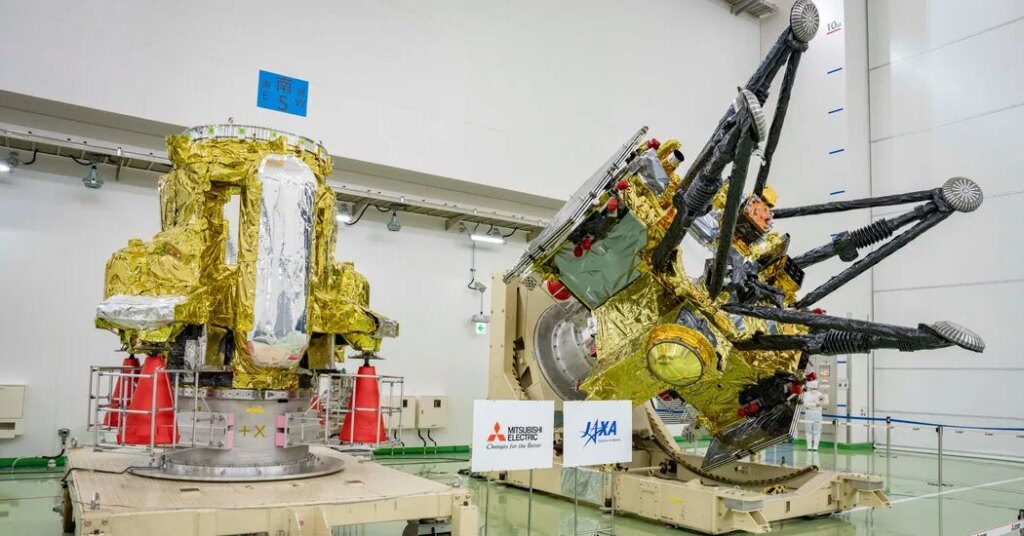
A Japanese spacecraft is set to launch to Mars on Monday, but its objective is not to study Mars.
Rather, JAXA, the Japanese space agency, is taking aim at Phobos, the larger of the two Martian moons. If all goes well, the spacecraft will eventually land on Phobos, pick up a bit of rock and dirt, and drop off the samples on Earth for scientists to study.
“This will be the most important unexplored body within the solar system,” Yasuhiro Kawakatsu, the mission project manager, said in translated remarks during a JAXA prelaunch news conference on Sunday.
The mission seeks to answer two key questions about Phobos and Mars’s smaller moon, Deimos: How did they form, and how did they end up around the red planet?
JAXA is in charge of the mission, known simply as Martian Moons Exploration, or MMX, and it developed and built the spacecraft for about $350 million. But other pieces came from around the world.
NASA’s contributions, valued at $87 million over 14 years, include an instrument for identifying elements in the minerals on Phobos, as well as one of the two devices for collecting samples. The European Space Agency contributed communications equipment. France and Germany also collaborated to build a small rover that the spacecraft will drop onto Phobos.
When is the launch, and how can I watch it?
The MMX spacecraft, which is about the size of a small bus, is scheduled to launch at 3:41 p.m. Eastern time on Monday on top of an H3 rocket. That translates to 4:41 a.m. Tuesday at the launch site on the island of Tanegashima in southern Japan.
JAXA will provide coverage on YouTube in Japanese and English beginning about 55 minutes before liftoff until about 75 minutes after the launch.
In case of weather or technical delays, the mission has additional launch opportunities through the first week of November; after that, Earth and Mars will move too far out of alignment for about the next 26 months. MMX missed the previous launch window in 2024 because of problems with the H3 rocket.
What happens after launch?
The MMX spacecraft will take about a year to reach Mars. It will enter the planet’s orbit in August 2027, following an orbital path close to Phobos’s. That will allow MMX to make observations of the surface of Phobos and identify potential landing sites.
MMX will then descend toward the surface of Phobos twice.
The first time, in late 2028 or early 2029, it will drop the small French-German rover — named Idefix after the dog in the comic “Asterix” — from a height of about 130 feet. Because Phobos is small, its gravitational pull is less than a thousandth that of Earth’s. That means the rover will hit the surface at a speed of about 2 miles per hour and bounce around for about 15 minutes before coming to a stop.
If it ends up on its side or upside down, Idefix has the ability to push itself into an upright orientation.
The main body of the four-wheeled rover is essentially a box roughly 9 inches by 15 inches by 16 inches. It will be larger after it unfolds its solar panels. On Earth, it weighs about 55 pounds, but in the minuscule gravity of Phobos, it will weigh about half an ounce.
Idefix will explore Phobos for about 100 days, gathering data with its instruments and cameras that the MMX spacecraft will relay to Earth. It will not get very far or go very fast, trundling at a speed of about 12 feet per hour.
In 2030, MMX will descend a second time toward Phobos and land there for about 2.5 hours. During that brief stay, its goal is to collect at least 10 grams, or about a third of an ounce, of material.
“This will be a first-time activity, which is very complex,” said Dr. Kawakatsu of JAXA.
A hop to a second location on Phobos is a possibility.
After that, MMX will depart Phobos, fly by Deimos and then head back toward Earth. In 2031, as it passes by, it will drop off a capsule containing the collected samples of Phobos, which will parachute to a landing in Australia.
Why study the Martian moons?
Phobos and Deimos look like lumpy potatoes. Phobos is 17 miles at its widest part and orbits about 3,700 miles above the surface of Mars; Deimos at its widest is about nine miles and it orbits more than 14,500 miles from Mars.
One thought is that both moons are asteroids that Mars captured with its gravitational pull. Or perhaps they are two parts of one asteroid that broke apart as it was drawn in. Because the moons are dark with a reddish tint, they resemble what are known as D-type asteroids that are typically found in the outer part of the asteroid belt between Mars and Jupiter.
Captured asteroids would most likely have elliptical orbits skewed at random angles. Yet both Phobos and Deimos travel in circular orbits above the equator of Mars.
Their circular paths instead suggest that they formed after something like the giant impact that created Earth’s moon. In this scenario, debris from such a wallop would coalesce into a disk and then clump together, forming the moons.
“There’s two totally different lines of evidence that point in two different directions,” Tom Statler, the program executive for NASA’s portion of the MMX mission, said during a news conference last Thursday. “That’s what makes it an interesting puzzle.”
MMX might even bring back a few bits of Mars itself. Because Phobos orbits so close to the planet, asteroids slamming into it could have kicked up debris that settled on Phobos.
“The general consensus is there is a very good chance that there is a tiny fraction of a percentage of Mars material mixed in” with the Phobos dirt, Dr. Statler said.
The post A Japanese Spacecraft Aims to Bring Back a Bit of a Martian Moon appeared first on New York Times.