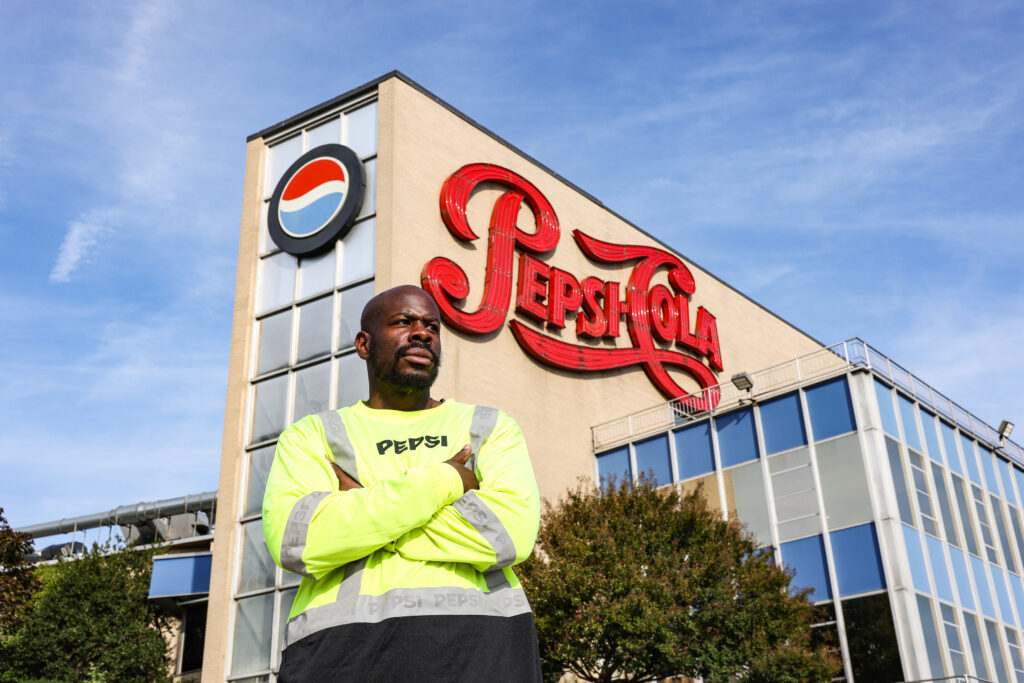
James McPherson still wakes up at 1 a.m. as if he were getting ready to head to 2611 Pepsi Place.
That’s the address for the PepsiCo plant in Cheverly, Maryland, where McPherson celebrated 21 years as an employee last month.
Then on Sept. 14, a day after his work anniversary, PepsiCo shuttered most of its operations at the plant. More than 100 workers were told their jobs were being eliminated — including McPherson.
He went numb. He recalled thinking, “I have to figure out what my life is now,” said McPherson, 42.
Situated on a hill overlooking the Baltimore-Washington Parkway, the plant has existed as a landmark in Prince George’s County for more than 60 years. It’s the largest employer and taxpayer in the roughly 6,000-person town of Cheverly, according to area officials.
In a statement, PepsiCo Beverages U.S. called the decision to shut down manufacturing and warehouse operations at the Cheverly facility difficult.
“This decision was not made lightly,” the company said in the statement. “As consumer demand, technology and our operating network continue to evolve, we must continue optimizing and modernizing our network to best serve customers and consumers.”
The sales and delivery teams continue to operate at the facility, according to the company.
But the cuts mark the end of an era for the local community and has left town and county officials trying to make sense of what comes next. Some were stunned to learn of the layoffs, saying they had no inkling that job cuts were on the horizon.
“I wish they would have reached out to us sooner,” Cheverly town administrator Dylan Galloway said.
A place to grow
McPherson always knew he wanted to be a truck driver.
His father, his “hero,” drove for a construction company. McPherson recalled moments sitting in his dad’s truck and shifting the gears, the Sunday evening drives back to the yard to drop off his truck.
He also dreamed of wearing a uniform, just like his dad. PepsiCo offered him both.
The Cheverly production plant was all-in-one: making and bottling sodas, transporting them to other warehouses and delivering cases to stores.
McPherson spent his first few years making deliveries across Northern Virginia, including to Arlington, Fairfax and Crystal City.
Despite having to wake up before dawn, being met with occasional attitudes on the road and getting robbed twice while on the clock, McPherson said he took pride in the work.
“It was like a badge of honor on me that I can do this, and everybody couldn’t do it,” he said. The work also helped him learn how to better engage with people and be more confident.
McPherson made his way to the PepsiCo plant’s transport side, where he began to drive tractor trailers to different warehouses.
Each shift covered 500 miles and averaged about 12 hours, McPherson said. The trips took him as far north as New Jersey and as far south as southern Virginia.
Along the way, he met Anthony Wilson.
Wilson, 52, started at PepsiCo just 10 days after McPherson.
Wilson, too, started in delivery and then transferred to transport. The team was often called the “retirement job,” as many of its workers stayed for decades, transporting sodas from facility to facility.
Wilson and McPherson became like brothers, they said. They talked each morning and found out about each other’s fervor for football. They would go on to coach a youth football team side by side.
This year, they both began noticing changes at work. During the winter, business usually slowed down before picking up as the weather started warming up. In normal years, employees typically prepared for what was known as “100 days of summer,” the plant’s all-hands-on-deck answer to soda’s busiest season from May through July. But this summer, that effort wasn’t mentioned, McPherson said.
Wilson said he suspected the transport department might be shut down when work began to slow and he was only transporting loads to certain plants. McPherson said he kept hope that things would improve, just as they always had.
Then employees were told to report to the plant at 9 a.m. on a Monday last month. They learned the company would cancel most of its operations, including fleet, transport, manufacturing and warehouse at the Cheverly location — and it was happening that day.
In a letter, laid-off employees were told they were placed on paid leave and not expected to perform their job going forward, according to a copy obtained by The Washington Post.
William Davis, president of Teamsters Local 639, which represents workers at the plant, said he was shocked by the cuts. The union had just negotiated a new contract for the employees late last year, giving them a raise, Davis said.
Davis said the union is used to getting notice of layoffs 60 days in advance of a plant shutting down. Records show PepsiCo alerted the state of the mass layoffs, the same day it announced it would permanently shut down production.
In its statement, PepsiCo said the 143 laid-off employees would receive pay and benefits through Nov. 13, and have access to counseling and other resources to help them “through this transition with care and respect.” Eligible employees will receive severance, PepsiCo said. The union has negotiated severance terms for the employees it represents.
Wilson had just returned from vacation to attend the mandatory meeting. He said he gathered with others in the parking lot.
The conversation ranged. “One door closes, another one will open … it may be a blessing,” Wilson said he recalled saying.
“What are you going to tell your wife?” someone asked.
McPherson said he walked to his truck to empty it out — removing some bags, maps and directions.
He left his two PepsiCo jackets inside.
Stagnant times
Kristoffer Inton, a senior equity analyst for Morningstar, a data and ratings company, said PepsiCo likely faced a choice: either maintain production and distribution at a “very high-cost facility” or close it and rely on other modern facilities nearby.
Converting an older plant isn’t easy, he said, and the decision to shut it down isn’t either. It’s usually cheaper to keep it running than to build a new one.
PepsiCo did not comment on specific infrastructure issues at the Cheverly plant, though the facility is more than half a century old. As recent as 2024, the company closed a 60-year-old bottling plant in Chicago.
Inton said PepsiCo’s most recent earnings report shows international growth is strong while North American growth remains stagnant. Recently, the company has been encouraged to refranchise its bottling operations, which means it could turn to third-party partners, a similar strategy to Coca-Cola, Inton added.
The consumer wallet has also been stretched, Inton said, with gas prices rising amid the Iran war.
Companies like PepsiCo have been facing poor consumer demand amid guidance to stay away from sugary foods and drinks, said Susan Houseman, senior economist for the Upjohn Institute. That can lead to scaling back, including plant closures.
“That doesn’t mean that it’s not going to have a significant impact on that town,” Houseman said. “And on the families that are laid off.”
Houseman said older workers laid off from manufacturing jobs often have a harder time finding new employment and don’t earn as much as before.
‘Rapid response’
Galloway, who has been Cheverly’s administrator for more than seven years, said the town received an email from PepsiCo about the layoffs approximately eight minutes before the company’s meeting with employees.
He said that had officials known about impending layoffs, the town and county could have advocated for funding from the federal government or state to help improve infrastructure at the plant.
A PepsiCo spokesperson said in a statement that the company “prioritized sharing the news with our employees and their union representatives first, as they are the ones most impacted by this news and we want them to hear from us directly.” The spokesperson said the company connected with local officials that same morning and “have stayed in close contact with them to help support their community.”
Galloway said while he has been in touch with PepsiCo, he is not sure what the company plans to do going forward, including whether it will eventually sell the building.
PepsiCo must continue to pay taxes as long as it owns the building. But Galloway said the town could start feeling a financial hit “in the next two to three years,” especially if equipment is removed from the site.
“Everything inside of the building gets taxed” and that money was feeding back to local government, Galloway said.
For the next budget cycle, he said the town will have to prepare as if PepsiCo — and its revenue — is no longer going to be there. The plant generated north of $200,000 in yearly, taxable revenue, he said.
“It’s a harsh reality that we have to abide by right now,” said Galloway, who worked a summer job for PepsiCo in college in North Carolina. “But the town is resilient, the employees that work there are resilient.”
Jolene Ivey, an at-large member on the Prince George’s County Council, has lived in Cheverly for more than 30 years. PepsiCo would host employee appreciation events, one of which she attended.
The plant, she said, can’t be missed. Its mega sign lights up the road and guides people on their commute home.
“It’s definitely a sad time for people in the region,” Ivey said. “It’s just a landmark that you tell people, ‘Oh and then you turn right after the PepsiCo plant.’”
The county has rallied to support the laid-off employees. Galloway said he has heard from Coca-Cola about job prospects for affected employees and hopes to host a job fair at the community center.
LaTara T. Harris, president and chief executive officer of Employ Prince George’s, said the county went into “rapid response” mode to help workers when the news of layoffs hit. It coordinated multiple job fairs with area companies, including one held Friday with the Washington Metropolitan Transit Authority exclusively for employees laid off by PepsiCo, Harris said.
Wilson said he knows of other jobs at nearby PepsiCo facilities, but it’s a competitive process. Plus, he said that as an older driver, heading out to stack sodas and run to the stores isn’t an option anymore.
“I went from five weeks vacation and having a little seniority to having to start all over,” Wilson said.
Wilson has had a lawn-care business on the side, which has helped to keep him busy in the past month. But lawn season is almost over, he said.
One of his children just started college.
A new normal
McPherson still carries his timecard, fuel card and work ID badge in his wallet. On a recent afternoon as he stood at the PepsiCo plant, he noted how the warehouse used to be filled with trailers.
This time, there were only a few there.
It all hurts, McPherson said.
In recent weeks, he has filled out more than 20 job applications, mostly for truck driving, but some for warehouse work or at department stores.
A father of an 11-year-old and 8-year-old, McPherson said he knows the holidays are right around the corner.
McPherson has also picked up jobs from Wilson’s lawn-care business. The “brothers” have been sticking together. Both attended Friday’s Employ Prince George’s job fair with the D.C. region’s public transit system and said they left feeling encouraged.
As he figures out his next route, McPherson said words from his mother have kept him going.
“She told me, ‘J.R., this is not your fault,’” McPherson said. “That pushes me every day.”
The post Pepsi was a small town’s biggest employer. Layoffs left it blindsided. appeared first on Washington Post.