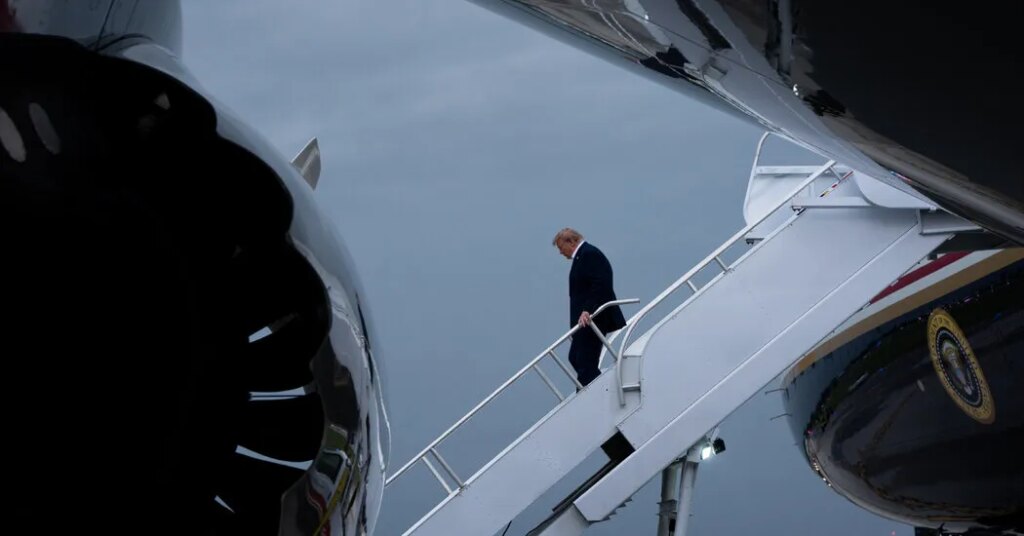
President Trump continued to sell himself as the Republican Party’s savior as he crisscrossed the country in recent days, making it clear in words and sheer presence that this midterm election is about him.
But back in the nation’s capital, Mr. Trump’s White House was consumed by dramas that reinforced why polls show that his presidency itself has become a drag on Republican tickets.
On Monday, Mr. Trump asked for the resignation of Kimberly Guilfoyle, his ambassador to Greece, after a string of embarrassing reports, including that she urged a donor to pay for her $100,000 credit card debt. The president on Thursday canceled the Pentagon’s planned livestream of an execution of the Army officer convicted in the 2009 Fort Hood mass shooting after bipartisan outrage. And on Friday, he ousted his press secretary of five days after her bumpy debut.
Meantime, the White House Counsel’s Office was investigating a dispute between two prominent Trump allies and former administration officials over claims one of them misallocated funds for the John F. Kennedy Center for the Performing Arts, a heated conflict stemming from a transaction from the Democratic Republic of Congo to a Texas defense company. And the administration deepened its standoff with the federal judge presiding over a lawsuit challenging the president’s plan for a golf course, pushing to disqualify her after she excoriated federal officials for ripping up hundreds of mature trees with little notice.
Together, the string of controversies invoked the chaos of Mr. Trump’s first term, when infighting among his aides regularly burst into public view. The week also encapsulated how Mr. Trump’s approval ratings have been dragged down by his administration’s policies and allegations of self-dealing that have shadowed much of his inner circle.
“It feels like late 2020,” said Alyssa Farah Griffin, who served in Mr. Trump’s White House during his first term. “There’s almost too much chaos. It’s drinking from the fire hose, and you can’t anticipate the next plot twist from this administration.”
She added: “You couldn’t dream up a worse week for the White House heading into the midterms.”
Mr. Trump’s approval rating sits around 37 percent, the lowest of his presidency, according to The New York Times average of polls. A Washington Post-ABC News-Ispos poll conducted Oct. 9-13 and released on Sunday shows his approval among Republicans dropped from 88 percent near the start of his term to 79 percent. The survey also found, for the first time in a decade, that voters trust Democrats more on the economy, and 66 percent of voters said Mr. Trump is using the presidency to enrich himself.
A Fox News poll from this month found that government corruption ranked first among voters’s concerns, followed by inflation, gas prices, government leadership and health care. Democrats are making the case that corruption is in fact a cause of higher prices.
“To the extent that Republicans are successful in keeping the Senate, it will be because of their success in distancing themselves from some of the president’s policies,” former Senator Jeff Flake, Republican of Arizona and longtime Trump critic who served as ambassador to Turkey in the Biden administration, said in an interview. “And that’s not a position you want to be in. And it’s not just the policies. It’s the weirdness of it. The crass and crude and vulgar language. It’s awful. It doesn’t help Republicans.”
On the road, Mr. Trump made no mention of the latest controversies. He held rallies in six different states, stretching from Alaska to Georgia, serving up a familiar message: His presidency has been an unbridled success, and Democratic victories next month threaten America’s future.
Inside the cosseted bubble of a Trump rally, composed largely of MAGA superfans, that message was met with hearty concurrence from the president’s adoring fans.
Tara Green, a front desk office administrator who attended the rally in Wasilla, Alaska, said seeing Mr. Trump was “an opportunity of a lifetime.”
“Trump has a vision, and it might take time, but it is fixing things,” she said. “I have every belief and trust in him.”
Still, there were signs of Mr. Trump’s eroding support, even inside his bubble. The president was interrupted by protesters at each of his rallies, once a rare occurrence. And swaths of the arenas, which Mr. Trump used to pack with ease, remained empty.
At a check-in desk for special guests on Saturday outside Truist Arena in Highland Heights, Ky., one volunteer asked a staffer for Mr. Trump how many people they were expecting at the rally. The staffer, outfitted in a “Team Trump” jacket, said they had expected a larger audience than was on hand. (The entire upper level of the arena remained empty during the rally.) The White House did not respond to a request for comment.
Mr. Trump’s closing message also was notably meandering, even for a man who boasts about “the weave,” his description of how he bounces from one topic to another without any discernible connection.
The president kicked off most rallies this week by praising the appearance of Republican male candidates. (He seemed particularly enthralled by the backside of Senator Jon Husted, Republican of Ohio, bringing it up at two different rallies this week.)
He recounted his own political successes and margins of victory in the states he was visiting, most of which are historically Republican strongholds and a sign of how much ground his party is defending this year.
And he reminded voters of the basket of incentives he’s offering if they elect Republicans, expanding it from cash bonuses to pardons and investments from the Pentagon.
But even the president downplayed the impact of his signature midterm giveaway: a controversial promise to give $5,000 for every American adult — which he calls the “Trump dividend” — if Republicans retain control of Congress.
Describing a hypothetical conversation about a couple looking to spend the money, “Let’s go to Palm Beach and join the president for lunch. Let’s have lunch at Mar-a-Lago, where for $5,000, you’ll get one hamburger and a small dessert,” he said, with a laugh. “I shouldn’t say that.”
That line in particular underscored how Mr. Trump has repeatedly seemed to minimize voter anxieties about rising costs, one reason Republicans have tried distancing themselves from the president.
Even among rally-goers, there seemed more wariness than in earlier elections, and loyalty to Mr. Trump seemed more important than concerns about policy or the turbulence in his administration.
Ustun Yuksel, a Trump supporter who has a Ph.D in political science and lives in Dawsonville, Ga., acknowledged that he needs to work on addressing cost of living issues.
“They can definitely do better,” he said, while waiting for Mr. Trump in Dalton, Ga.
But he said he likes Mr. Trump’s foreign policy. And he had no interest in discussing the latest headlines out of the White House.
“I don’t want to talk about it,” Mr. Yuksel, said just after the news broke that Katie Zacharia, the White House press secretary, was ousted. “I don’t want to say anything.”
A few hours later, as Amy Thomas, a bail bonds agent from Cleveland, Tennessee, waited in traffic to exit the rally, she jumped out of her car to capture Mr. Trump depart on Marine One. She said Mr. Trump was “getting the job done” and demurred when asked about the turmoil in the administration.
“My friend follows it more than I do,” she said of the firings and latest drama.
The post On the Campaign Trail, Trump Tries to Outrun a Bad Week in Washington appeared first on New York Times.