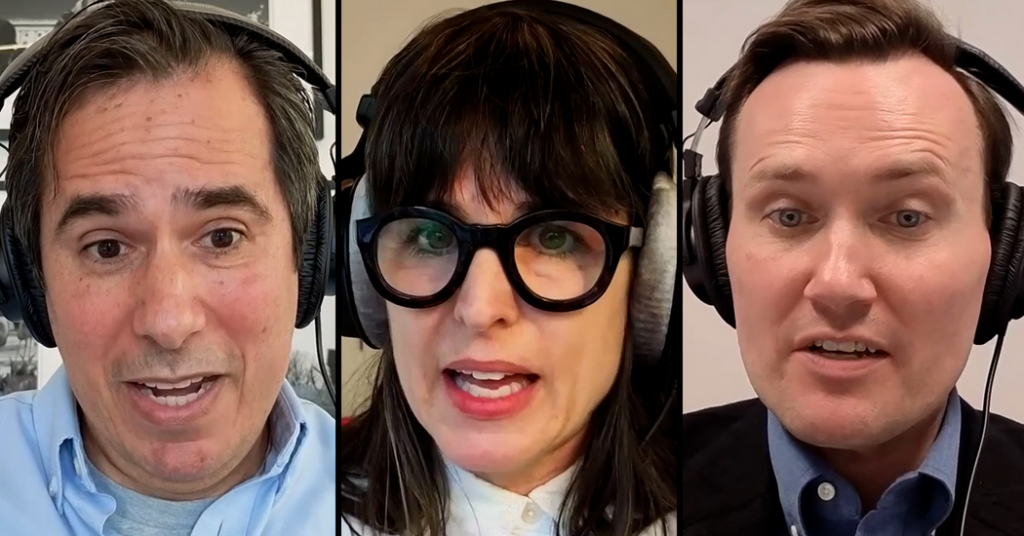
Advertisers are projected to spend more money on political ads in the 2026 midterms than in any previous election cycle. What are campaigns selling — and what do they think voters want? The Opinion editor Steve Stromberg examines the ads shaping these elections with the Opinion columnist Carlos Lozada and Emily Keegin, a photo editor and creative consultant.
Below is a transcript of an episode of “The Opinions.” We recommend listening to it in its original form for the full effect. You can do so using the player above or on the NYTimes app, Apple, Spotify, Amazon Music, YouTube, iHeartRadio or wherever you get your podcasts.
The transcript has been lightly edited for length and clarity.
Steve Stromberg: Just to get us started: I’m wondering, is there a political ad or a slogan that has really stuck with you? Maybe it’s the first one you remember or one that stood out, something that can really show how powerful these images, these words, these slogans can be when they really work. Carlos, why don’t you start?
Carlos Lozada: I think the one that I remember, from a young age, probably has to be Ronald Reagan’s “Morning in America” ad from 1984, from his re-election campaign.
Archival clip of “Morning in America”: It’s morning again in America. Today, more men and women will go to work …
And I think I remember it, in part, because my father just loved Reagan and I wasn’t so crazy about him. Not that I had strong, strong views at the time, but the ad was so optimistic. It kind of captures that very sunny Reagan vibe. The ad says, “It’s morning again in America,” and people are getting married and buying homes and raising the flag, and it’s like: Why would you want to go back to how things were four years ago? And, like, poor Jimmy Carter.
But I think that ad probably has stuck with me as one of the classic ads of just optimism. And that’s where the whole “Are you better off than you were four years ago” comes into it as well. The case was: Things are better. Stick with me.
Emily Keegin: The ad I go back to, over and over again, is the “Daisy” ad by Lyndon B. Johnson in 1964.
Archival clip of “Daisy” plays.
And the idea here is to play on fear and to say: Don’t you want someone you know will protect you and your family? And what’s interesting to me about this ad is that not only is it a horrifying ad to watch — it is incredibly effective — but that it’s then used over and over again in the ’70s. And then again during the 1984 re-election campaign, Walter Mondale used a very similar ad structure. And it’s the same concept. You use a child, and you place that child against the biggest fear that we have. This cycle, I think what’s interesting is how little fear we’re seeing in the advertisements that are becoming viral or that we see on the national stage.
Stromberg: In a headline, what’s the mood of this midterm election?
Lozada: I’m not one for vibe checks and mood checks and the like. But if we had to pick one, the mood of the midterms right now, to me, feels best captured by House Speaker Mike Johnson wondering aloud recently if maybe after the election he might have to move back to Louisiana and start a lawn care business. Those are not the musings of a confident man.
And meanwhile, on the Democratic side, you hear a lot about expanding the map, which is the term you always hear in elections when one side is just daring to dream and is so confident that it imagines blue spreading all over the place. So the expectations seem pretty cemented at this point for a big night for Democrats, so much so that I instinctively, in a contrarian way, I’m not trusting it. So we’ll have to wait for the vote.
Stromberg: With that, let’s start with our first ad. The Washington Post did an analysis of 8,000 midterm ads. The majority focused on the economy — affordability, housing, the cost of living. But the first ad we’re going to watch went in a different direction. It’s for Steve Hilton. He’s a Republican running for governor of California. Let’s watch.
Archival clip of “Just Try It, California,” plays.
What we just saw was a video of two young ladies on a bed, seemingly talking about one thing but then filling in an absentee ballot for Steve Hilton, the Republican running for governor. And then the ad ends by saying, “Steve Hilton for governor. Just try it.” Emily, you’re our California resident. What do you think?
Keegin: I think the reaction is just ick. It’s very, very icky. This one, because of its ick factor, I think, went viral. So at least we’re talking about it, I suppose. The question is: Does that make you want to vote for the man who created it? I’m not sure that you want to be sexualizing young women in 2026. I’m not sure that that’s going to inspire a lot of voters. Ugh, it’s just ick.
Stromberg: Carlos, what do you see here?
Lozada: Well, let’s just stipulate the creepiness and tackiness of the ad. I was just wondering, is this sort of like some older guy’s fantasy of what young lesbians are like? The Pride flag and the nose rings and the tattoos and the hair dye. Like, it was all a bit much. But that aside, two things really jumped out at me: One was the moment when the reluctant voter, who’s almost being coerced into voting for Hilton here, says, “What if my dad finds out?”
It reminded me immediately of the ads in 2024 when you have these progressive suburban women, married to Trumpy guys, who are secretly voting for Kamala Harris and they don’t want their husbands to know. Now, instead of keeping your vote secret from your conservative husband, it’s keeping it secret from your progressive parents. But it kind of paints voting, for one side, as this thing that you’re kind of forced to do, whereas voting for the other side is this thing that you’re free to do. It’s like this kind of liberation.
The only other thing I’ll say is that I don’t necessarily have a problem with ads that feature sex or imply sex. Sex has, for better or for worse, always been a political issue in the United States. This ad — the Hilton ad — it just uses sex to try to get us interested in the candidate without any substance to it. To me, that’s why it’s a fail. Not because it’s salacious but because it’s salacious with no other purpose except for being salacious.
Stromberg: Let’s stay on the West Coast and head far to the north, to Alaska, where I recently spent some time reporting on Mary Peltola’s Senate campaign. She is a Democrat, but you might not necessarily know that from this ad.
Archival clip of Mary Peltola ad plays.
Emily, what do you make of this? Peltola isn’t the most polished candidate, but she has a lot of “Alaska first” authenticity. Does that come through convincingly? Can you unpack some of the images that she uses?
Keegin: I don’t think this is a hugely successful ad, insofar as it’s pretty standard. I think we’ve seen this type of political ad a lot. And I, to be perfectly candid, don’t think that advertisements alone get a candidate elected, in the same way that I don’t think you bought the shoes on your feet because of an advertisement.
There’s a lot that goes into what we choose to buy or who we choose to vote for. Most often it’s about our relationship to the brand or our relationship to the party long term or who our friends and family members are supporting or what they’re buying on the shelves. I guess if you do look at all presidential campaign ads — say, starting in 1952 — you do notice that the winners tend to do a handful of things over and over again. And you do notice that the losers have a tendency to make certain choices over and over again.
To talk about good ads: Whether you’re a shoe brand or you’re a politician, you want to see the same principles that you use in classic propaganda, really, which is that you want a simple image and a simple slogan that, when seen together, inspire in the viewer a big and kind of complicated feeling. And that feeling can be hope. It can be optimism. It could be fear.
But look at classic 20th-century propaganda. Look at Rosie the Riveter. Simple image: arm up, eyes facing forward. Simple slogan: “We can do it!” And that together inspires in you some hope, some optimism. Or my personal favorite, Smokey Bear. Simple image: bear in a hat, pointing at you. And the text, “Only you” — so romantic, so powerful. “Only you can prevent wildfires.” And we want the same principles in advertising. You see it all the time. “Think different” is a classic example. If you’re speeding down the highway, you want to be able to engage with it and understand it easily and quickly.
If you’re scrolling, same. What Peltola’s doing here is something that doomed candidates have a tendency to do, which is that they center themselves in the ad, they focus on their biography and their accomplishments, and they show themselves politicking. And one of the biggest things that I think politicians do — a mistake that politicians make — is that they think they are more charismatic than they are and so they put themselves in their ads and clip pieces of speeches. And it’s just not as compelling as they think they are. You really want to create an advertisement that is Smokey Bear: Bear in hat says great slogan. And the best ads, the most popular ads, and the ones that stick have that.
And frankly, Hilton’s ad is terrible in comparison. We’ve just spoken about that. But it is something that sticks because it’s a simple image with a simple piece of text attached to it.
Stromberg: Carlos, what did you make of Peltola’s pitch here?
Lozada: You joked at the beginning that it might be hard to remember that she’s a Democrat from this ad. And to be honest, when I was going through these ads and I was watching them with my wife, I had to turn to her and be like, “Wait, she’s the Democrat in the race, right?” And she’s like, “Oh, of course she is. Right, right.” I just had a brain freeze for a second because of the ad. And I think that’s very deliberate. She literally says at the beginning, “Forget party, forget politics.” It’s trying to help voters forget that she’s the Democrat and all the baggage that label has.
What she doesn’t want you to forget is her N.R.A. rating, the fact that she stuck it to Joe Biden on the border, the fact that she’s pro-oil projects development. When she says something that seems vaguely critical of President Trump, she doesn’t even name him. She says, “I‘ve got no tolerance for any politician who uses their office to get rich.”
Stromberg: It could be even just a generalized attack on D.C.
Lozada: Yeah, exactly. It’s very anti-conventional politician. Like, “they’re all corrupt,” “pox on both your houses” kind of thing. It’s a smart move when you’re running in a state that Donald Trump won by 13 percentage points last time around. You recently wrote about Peltola, so I’d be interested in your thoughts on this.
There’s a moment in your piece, I believe — and correct me if I’m getting it wrong — where you’re talking to her and trying to get her to engage on, like, what a broader centrist or center-left vision would be like for the party on a national level. And she just doesn’t engage.
Stromberg: Totally.
She’s either not willing or not able to. And that comes across in this ad. It doesn’t feel like a pose. It feels like this is who she is. Alaska first, Alaska always, completely parochial, in kind of the smartest way.
Stromberg: That’s exactly right. It does come off as authentic. And as you point out, there are just a ton of Republican-coded issues highlighted in this ad. But one thing that did strike me is that, even though she emphasizes how Alaska-focused she is, she highlights a national issue, and that national issue is securing the border. And she’s a candidate, remember, in Alaska, which is as far north of the southern border as you can get and doesn’t have a huge undocumented population. It sort of shows the extent to which immigration has become a cultural issue that defines people’s political identity.
Lozada: And it’s not just saying that she favors securing the border: She says that she opposed Biden’s border policies. It’s also a sign of how she realizes that the Biden brand is not a strong one for the Democrats, and so she’s creating distance there.
Stromberg: Right. And she was in Congress during the Biden administration, and so she has to come back and say: Well, I wasn’t for all that. And this is one way that she does that. I mean, one way to look at the ad is that Alaska Democrats don’t need to worry too much about keeping the left on side and can go really hard for disgruntled Trump voters. And there are a lot of those in Alaska. And some of these other red to purple states.
Let’s move on to our next ad. This one is from Sarah Huckabee Sanders. She is running for re-election as governor of Arkansas. Unlike Peltola, her party affiliation is pretty clear in this spot. Let’s take a look.
Archival clip of “Work” plays.
What we just saw, for the listeners out there, is a young white man, in a dark room, playing video games and munching on chips and various other bad-for-you things. At the end, though, he puts on a tie and is presumably employed. So, Carlos, Huckabee Sanders is basically a shoo-in to get re-elected, but this spot drew a lot of backlash, with some MAGA guys calling it anti-white and anti-men. What do you see here?
Lozada: It’s an aggressive ad, to be sure. I mean, most welfare recipients in Arkansas are white, so I don’t quite grasp the racial complaint here. The gender one, I think, is more interesting. There’s a long history of personalizing political rhetoric around specific kinds of welfare recipients, casting them as lazy or as fraudsters. Reagan in the ’70s was quite good at this.
Sarah Huckabee Sanders, I think, is trying to have it both ways. First, she does blame Brad, when she introduces him: “Meet Brad. Brad has turned relaxing into a full-time profession.” And she stresses the word “choose,” that Brad has chosen to behave this way, to do this — that he’s choosing not to work. But then she also suggests that it’s really a matter of incentives. It’s not just that Brad has terrible character. It’s that the system is set up in such a way that if you tweak it, you create this requirement: Brad will clean up, put on a tie and get to work. It’s both kind of blaming Brad and blaming the system writ large.
I think it’s also easier to criticize her because this ad could’ve been done with a kind of generic voice-over, kind of a faceless narrator. But instead, she puts herself forward. You see Sarah Huckabee ——
Stromberg: She’s on the TV screen.
Lozada: —— on the screen, right at the beginning, and she says, “That’s why I launched a welfare-to-work requirement.” She’s very much taking full ownership of it in a way that these ads sometimes don’t do. One little detail that I find interesting in this ad is that there’s a sense in which she’s telling it with a bit of a wink. If you hear her voice at the very beginning, she’s not just saying, “Meet Brad”; she’s kind of laughing. There’s this little undercurrent of laughter as she’s saying it, and she’s like, “Brad has turned relaxing into a full-time profession.” There’s, like, a little smirk there.
What is that? Is that her mocking Brad a little bit, or is that her acknowledging that, look, this is a caricature? This is a little bit of a joke. It’s a little bit funny, because Brad does look funny. He’s throwing the cheese puffs in the air. They’re falling on his face. He’s way too into the video game. I mean, clearly that was a choice. I’m sure they shot this many times, and choosing to have her laugh a little bit when she’s saying those things is something very deliberate. When people inject that undercurrent of laughter into something they’re saying, they’re creating some distance from the point they’re making. They’re trying to say: Look, this is not exactly an attack. I don’t fully stand by this, but I’m just going to put it out there anyway.
The last thing I thought of is that, when I think of Brad as a character, I immediately thought of other fictional characters that are created in political ads, and I thought of Pajama Boy. If you remember Pajama Boy ——
Stromberg: Obama’s Pajama Boy.
Lozada: It’s this guy in this holiday onesie, drinking hot chocolate, talking about how you’ve got to sign up for Obamacare. And it also made me think of Julia. I don’t know if you remember “The Life of Julia.” It was this slide show that the Obama administration put out, showing all the ways that women are cared for by the state throughout their lives, from Head Start to health care. And that got some criticism because it had a nanny-state vibe. But I just imagined — I wonder what Brad and Pajama Boy and Julia would say to each other if they could sit down and talk about the role of government in their lives.
Stromberg: Emily, I would love to hear from you. What did you make of the laugh, if anything? What did you make of the imagery?
Keegin: Well I think the strangest part, for me, is that she put herself on the TV, and I understand this in the narrative of the story on it, but that’s not something that most candidates do. They usually put their opponent on the TV, and there are a lot of those ads. That’s a trope that’s been going on since the ’60s, really.
You put your opponent on the TV, and you talk, and you show the opponent flip-flopping or saying something that you think you disagree with. And the reason you put the opponent on the TV is that the TV kind of acts as a barrier and a remove from everyday life — from the concerns of the Everyman, and it isolates the candidate. So when I see her on the TV, there’s this Big Brother vibe, a little bit. It’s an interesting choice. I think it’s probably fine. It works fine for the ad, but it’s something most candidates don’t do — put themselves on the TV like that.
Stromberg: And it also does sort of feel like: Well, this is the state government that’s going to drop in and make you shape up and put on that tie.
It feels a little bit like an attempt to play into the alpha male/beta male thinking on the right. She’s making alpha males out of beta males like Brad, and maybe that chuckle is that we all kind of know a Brad in our lives. In the process, she gets to make the old “welfare queen” attack lines seem new and sort of less race-oriented. But to me, this all still feels a little bit like a throwback. Like an old, different era of Republican politics. Even the lazy-kid-living-in-the-basement thing feels pretty last decade. Does this work?
Lozada: Well, it’s also, weirdly, one of the more substantive ads I’ve seen in this campaign. It’s not just biographical. It’s not just shock value, like the Hilton ad. It’s engaging on a policy issue, and that feels like a throwback to me. Like maybe being substantive is a luxury you have when you are very likely to win re-election.
Stromberg: Or you have a record that has substance behind it, which not everyone, not every politician, can claim. OK. Let’s get to our next ad, our final ad. We’re looking at an ad out of Michigan from the Democratic Senate candidate, Abdul El-Sayed.
Archival clip of “Jan & Judy” plays.
For the listeners out there, we saw an elderly couple on a sofa discussing their grandson, Abdul El-Sayed. There are some images of El-Sayed campaigning with Bernie Sanders. At the very end, he emerges, gives the grandparents a hug. Carlos, this ad reminds me of when President Barack Obama referred to himself as a “skinny kid with a funny name” when he came to national attention in 2004. And Obama followed that up by talking about how his family’s from Kansas, his grandfather fought in Patton’s army. Is that what El-Sayed is channeling here?
Lozada: This ad, and in some ways this campaign, has given me a lot of Obama flashbacks to that period. There’s been efforts to paint Abdul El-Sayed as something of an outsider — just the way that the grandmother says it, like, “Where did Abdul El-Sayed come from?” She’s channeling that feeling. People have often used his full name, in a very unsubtle way, to depict him as sort of distant and foreign and untrustworthy — Abdulrahman Mohammed El-Sayed. And that’s just like Barack Hussein Obama, right? It’s a very similar kind of approach.
The opening of the ad, where you have the grandmother seemingly playing into that ominous, suspicious tone, before pivoting to the lovely “Here! We’re his grandparents!” It reminded me — it’s another Obama moment, but it’s actually about Obama’s opponent in 2008, John McCain. And there was that famous instance where it’s a McCain rally and an elderly white woman has the mic and she’s asking McCain a question.
Archival clip of John McCain rally, October 2008, plays.
And when I saw this ad, I felt like that face that the grandmother is making — where she’s pretending to be suspicious of him — that could have been the face of that woman that you never see at the McCain rally.
And finally, like Obama also, El-Sayed is relying on these lovely, white grandparents to vouch for him: Look, if you worry about me — worry about my name or something — look at Judy. Look at Jan. They’re harmless, they’re sweet, and they love me.
And that was not just the way that, I think, Obama felt compelled to use that part of his biography, but it’s also, in a weird way, how he picked Biden — this avuncular guy who you all know, who’s been there forever, who will be with me when I’m in the White House if you don’t quite know me or don’t quite trust me.
Stromberg: Emily, what do you see in this ad?
Keegin: Can I be a photo nerd for a minute? Can I talk about aesthetics just for a minute? Because I find there’s this really kind of beautiful overlap between how politicians want to present themselves either as the adult in the room — part of the establishment, having a long history of success — versus being an outsider, being of the people, being just like you and me. These two directions.
And if we look at photography, photography really could be split into two: One is photography that’s made by professionals. This is the kind of photography that traditionally you see in magazines, television. And by photography, I mean photography and film. And this kind of photography is made by professionals with high-quality cameras, and the results are kind of a clean lighting and flat, even horizon lines and bold colors, and there’s never grain, and there’s never fingerprints, and there’s never dust — and this is establishment photography.
And then there’s the kind of photography that’s made by amateurs. This is the kind of photography that you and I know really well, because this is what we make, and it’s made with disposable cameras and your iPhone, and it’s made with cheap, consumer-grade equipment. And so it looks like a mess. It often is not slick. In video think of, like, a camcorder or Super 8. You see dust flying across the screen.
And the other important part of amateur photography is that because we have used cheaper equipment, we often see grain or digital noise in that imagery. Those are the hallmarks of these two types of photography, and people in advertising pick different pieces of those two types to communicate with us silently. They don’t have to say anything. We know immediately how we should be interacting with the content because of the quality of the film and the choices that are made by that photographer or by that advertiser.
The same is happening in this advertisement. He’s using the aesthetics of amateur photography — the photography that we understand — and it comes from our own background and our own homes. The imagery that he’s showing is full of grain. We have sprockets on some of them. It’s full of mistakes. There’s some light leaks. It looks like there’s some Super 8 kind of vibes happening. It looks like things that we understand to be of the home, of ourselves and of the popular. It’s a populist look at this point.
If the sound was off, if you never heard anything that was said in this ad, you would know where he stands. You would know what he comes from and what he believes in, because he’s not using establishment photography. He’s using the photography of the Everyman, of the citizen. And his opponent’s doing the same thing, as it turns out.
Stromberg: And this is something that you might think would die out with generational change and technological change. But do you find that it’s not, because people use Instagram filters and they manipulate their digital images to convey precisely those sorts of messages?
Keegin: Right. It just compounds. The more we use photography, the more we understand all of those small details. And we are photographers, too, and advertisers will use the language — the vernacular that we are the most familiar with — which is your iPhone, to connect with you.
Stromberg: You mentioned an ad from El-Sayed’s opponent, Mike Rogers. We do have that, so why don’t we quickly watch that, and then we can compare and contrast?
Archival clip of “Where I Came From” plays.
The ad is titled “Where I Came From.” There are a lot of politics of identity in this ad also. The ad shows Mike Rogers in a button-up shirt but with no tie, and he’s talking about his neighborhood, which you see, and you see “Michigan values” sort of stamped. Emily, can you do a compare and contrast for us?
Keegin: Right. I think one of the things that’s also interesting about both of these campaigns is that they’re using a lot of collage animation and typography that has a sense of texture to it, which we’re seeing across the culture outside politics. But part of the reason that we’re seeing this is this backlash to A.I. and backlash to technology. And using both those kinds of amateur photography aesthetic, plus this kind of cut-and-paste feel to the text and the type, is to show an interest in the human hand and an interest in something that’s authentic and tactile. Which is, if we think about what that means politically, it means that the politician is anti-establishment, anti-tech and trying to feel grass roots, trying to feel human.
Stromberg: I think the big, if not the dominant, theme this year is that candidates recognize that this is an anti-establishment environment. They’re trying various strategies to deal with it. People hate the parties. Hilton runs away from his party label and mentions almost nothing of substance. Peltola goes hard on local issues. Huckabee Sanders reverts to this sort of old-school Republican message. El-Sayed associates himself with this sort of insurgent anti-establishment left. He’s hugging Bernie Sanders in his ad. Mike Rogers claims he has always been a working-class populist.
They’re appealing to different constituencies, many of these candidates, but you can see they’re all trying to do the same thing. What’s your read on what’s working the best here? Emily, why don’t you start?
Keegin: Well, I think the best advertisements, now and forever, are advertisements that have a strong, simple visual and strong, simple language that together inspire something powerful in the viewer. I think what we’re seeing right now are candidates that want to seem human and real and warm, and that’s actually happening across all branding. I think we’re having a Captcha moment — you know: Prove you’re not a robot. And I think both parties are taking some aesthetic risks to communicate this. They’re using different types of film stock, and they’re using different types of typography just to get the point across that they are authentic and they believe in the human spirit.
And I think it’s interesting, in the time of Trump, that Democrats themselves — I would expect them to portray themselves as the serious, competent alternative, right? We look at what’s happening in Washington, and maybe we want an adult in the room. But instead, I think we’re seeing a lot of Democrats specifically go for something that’s warmer and kinder and human and humorous. There’s lots of humor happening in these ads. And I wasn’t expecting to see that this time around.
Stromberg: Carlos, what do you make of the populist moment and the political advertising we’re seeing?
Lozada: It’s hard to distill the essence of the parties out of a handful of ads, but let me give it a shot. If you look at the two Democratic ads, they’re both efforts at reassurance. Peltola is saying: Look, I’m not that loony left you might be worried about. Like: I’m N.R.A., and the border and oil, and I’m Alaska above all, you know?
And Abdul El-Sayed — that ad is explicitly acknowledging the criticisms and concerns that he has raised through his campaign at the very beginning. And then he says: But look, I’m Michigan. I’ve got these people vouching for me. If you’re a little concerned about me, look at my adorable grandparents. They both seem to be saying: I’m safe. I’m normal. I’m of this place. I’m just like you. And therefore you can vote for me. I’m not Woke 1. I’m something else.
On the Republican side, I feel they’re a little bit more scattered. The Hilton ad just feels like the desperation shot at the buzzer, when you’re down by way more than three points, actually. What’s interesting to me about Sarah Huckabee Sanders and that ad is not just that it’s far more substantive than any of the ones that we’ve talked about, as I mentioned earlier, but that she’s someone who’s so associated with the Trump administration, certainly the first term.
And yet she seems to be creating distance from that. Both these ads are disregarding Trump’s request that you should vote like “I’m on the ballot.” There’s nothing about Trump being on the ballot in these ads that we’ve discussed. If I squint really hard, I see Sarah Huckabee Sanders kind of distancing herself from the tough-guy, masculinity, Hegseth vibe of the second Trump term, by kind of poking fun at someone like Brad.
And I don’t have to squint at all to see the Hilton ad leaning into the sexualized language of the Trump era in general. This ad seems very risqué and controversial, but when you have a president who campaigned talking about the size of Arnold Palmer’s anatomy — and recently talked about Jon Husted’s body and having a great butt or something like that — then the Hilton ad seems like less of a big deal to me or certainly in keeping with that kind of discourse.
Thoughts? Email us at [email protected].
This episode of “The Opinions” was produced by Jillian Weinberger. It was edited by Alison Bruzek and Kaari Piktin. Mixing by Gautam Srikishan. Video editing by Brandon Belk-Yee and Britt Shacham Bernstein. The postproduction manager is Mike Puretz. Original music by Pat McCusker. Fact-checking by Mary Marge Locker. Audience strategy by Shannon Busta, Kristina Samulewski and Ali Baluch. The director of Opinion Video is Jonah M. Kessel. The director of audio engineering is Isaac Jones. The deputy director of Opinion Shows is Alison Bruzek. The director of Opinion Shows is Annie-Rose Strasser.
The Times is committed to publishing a diversity of letters to the editor. We’d like to hear what you think about this or any of our articles. Here are some tips. And here’s our email: [email protected].
Follow the New York Times Opinion section on Facebook, Instagram, TikTok, Bluesky, WhatsApp and Threads.
The post The Cringiest and Craftiest 2026 Midterm Ads appeared first on New York Times.