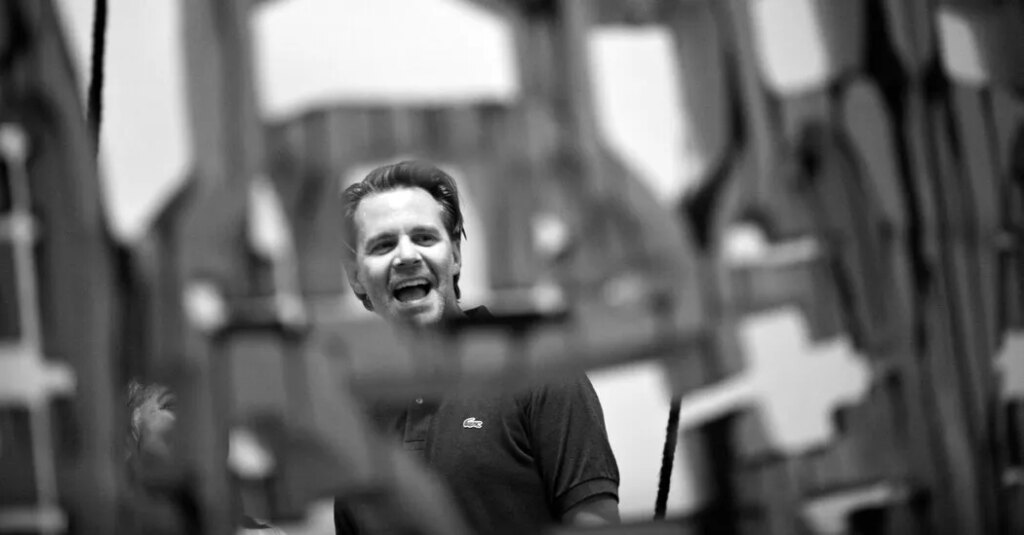
Peter Nagy, a prescient artist turned canny art dealer who brought the New York gallery system to India and contemporary Indian art to the world, died on Oct. 13 at his home in New Delhi. He was 66.
He had been under treatment for colon cancer, his brother, Paul N. Nagy, said.
Mr. Nagy’s twin careers were driven by a fascination with information — how it is encoded, how it travels, how it survives and, not least, what it’s worth.
Coming into the art world in the early 1980s, Mr. Nagy (pronounced NAG-y) found himself drawn to the frequently biting art of figures like Louise Lawler, who exhibited lightly altered photographs of other people’s art and other such works of appropriation, and to the larger cohort of artists known, after the title of an influential show, as the Pictures Generation. And while living in the East Village, he encountered plenty of pasted-up handbills for punk shows and other ersatz forms of mass communication.
In 1982, he and a friend, the artist Alan Belcher, founded a gallery in the East Village called Nature Morte. (They liked to pronounce the name, jokingly borrowed from the French term for a still life, with an exaggerated American accent.)
It was one of the earliest artist-run galleries in what became a vibrant and influential neighborhood scene. It was also one of the few, in an era of hyperbolic painting and exuberant graffiti art, to exhibit more conceptual work. Before it closed in 1988, Nature Morte had shown Ms. Lawler, Cady Noland, Gretchen Bender, Keith Sonnier, and Jennifer Bolande, among others.
After that, Mr. Nagy concentrated on his own flourishing art career.
One of his most notable early works was a black-and-white sequence of artistic movements that he constructed with thumbnail-size reproductions of artworks.
“What I was fascinated by,” he said in a 2017 interview, was that “it still read: You could take the Andy Warhol or the Picasso painting and you could shrink it down to just three centimeters high, and it still communicated what it was.”
In “Entertainment Erases History,” another early piece that provided a title for both a 2014 monograph on his work by Robert Milazzo and a retrospective exhibit at Jeffrey Deitch’s gallery in SoHo in 2020, Mr. Nagy adapted a timeline from an art history textbook, this time substituting images of media technology like tape recorders and televisions for the artworks.
It was a provocative but equivocal statement about how images were produced and disseminated in the late 20th century — cutting, but also self-deprecating. It expressed the precociously urbane view of an observer under no illusions either about the world or about his own position in it.
“International Survey Condominiums” (1985), which overlays the floor plans of the 1984 renovation of New York’s Museum of Modern Art with plans for the luxury condo tower built above it, is considered a landmark in the self-reflexive, politically pointed conceptual art movement known as institutional critique.
Reproduced and distributed in unlimited editions as Xerox copies, pieces like these demonstrated Mr. Nagy’s acute attention to the material conditions of art-making — and selling.
“I didn’t have any money to make art,” he explained in 2017. “I did sell them, and I could make a black-and-white photocopy for 5 cents, and I was selling it for $5. Well, that was a great markup!”
Mr. Nagy also tested the boundaries of how patterns carry information with large paintings, predominantly in black and white, of blurred logos, diagrams and appropriated sections of architectural ornamentation.
Then, in 1992, he took a short trip to India and fell in love with the country and its art. Soon he had moved there for good and, in 1997, he reopened Nature Morte in New Delhi.
Working over the years with various business partners, he showed a new generation of Indian and South Asian artists, including Subodh Gupta, Bharti Kher, Dayanita Singh, Jitish Kallat and Salman Toor. He took their work to art fairs, found collaborators to show their work in New York and opened a second space in Mumbai.
“Artists have to have solo shows,” he said in 2017. “I don’t think a work of art is finished until it’s exhibited to the public. And if you don’t have the infrastructure to make that happen, you’re going to be stuck; the system is not going to work.”
As much as anyone, he helped to build that system in New Delhi and, by connecting artists with international buyers, to support the work of those artists across the subcontinent.
As Mr. Deitch, the art dealer, observed in an interview, “Peter Nagy is one of the most significant people in the world of art in the past 50 years. He’s a model of a very contemporary way to be in the art world — to make a contribution to art.”
Peter Allen Nagy was born on Nov. 11, 1959, in Bridgeport, Conn., to Paul L. Nagy, a high school history teacher who had retired from the Coast Guard, and Kathleen (Furdon) Nagy, a nurse.
Growing up in Fairfield, Conn., he felt a strong connection to the cultural attractions of nearby New York City. In high school, his brother said, Peter used to slip away from home after dinner, race down to Manhattan on the commuter train and be back again before curfew.
As soon as he graduated, he moved to the city.
After earning a B.F.A. from Parsons School of Design in 1981, he worked as a typesetter at Betatron, a graphics studio on 57th Street, where he met Mr. Belcher, who was a graphic designer there. Together, they visited nearby galleries.
When they spotted an available storefront in the East Village, their first thought was of a shared studio — but from sharing a studio, the idea evolved into sharing the work of their friends, including Parsons classmates Steven Parrino and Joel Otterson.
Mr. Nagy’s move to India followed a downturn in the art market. He did genuinely fall in love, but he also recognized an opportunity, noting that “the middle class of India is bigger than the entire population of the United States,” his brother recalled, “and they buy a lot of art.”
Moving to Asia before the advent of email made it difficult to work with European or American galleries as an artist.
He did continue producing and showing work intermittently and, when the artists Olivia Smith, Chris Dorland and David Deutsch founded Magenta Plains, a gallery on the Lower East Side, they made Mr. Nagy a central part of their program.
Writing on Instagram, Mr. Dorland remembered his “playful and tender relationship” with Mr. Nagy, which “largely consisted of me twisting Peter’s arm to show his work.”
Mr. Nagy’s art was collected by the Metropolitan Museum, the Whitney Museum of American Art and the Brooklyn Museum in New York, as well as the Menil Collection in Houston, among others.
Informed on a recent trip to New York that no further treatment for his cancer was possible, Mr. Nagy rushed home, wanting to be in New Delhi when he died. A traditional Hindu cremation took place on Oct. 14. In addition to his brother, he is survived by his partner, Martin Timmie, who also works in art.
Despite his interest in, and talent for, the business of art, Mr. Nagy never forgot that the work came first.
“I didn’t worry about the market,” he said. “You start with the art, and you just feel that if the art is good enough, things will catch up with you.”
The post Peter Nagy, Visionary Artist Turned Art Dealer, Dies at 66 appeared first on New York Times.