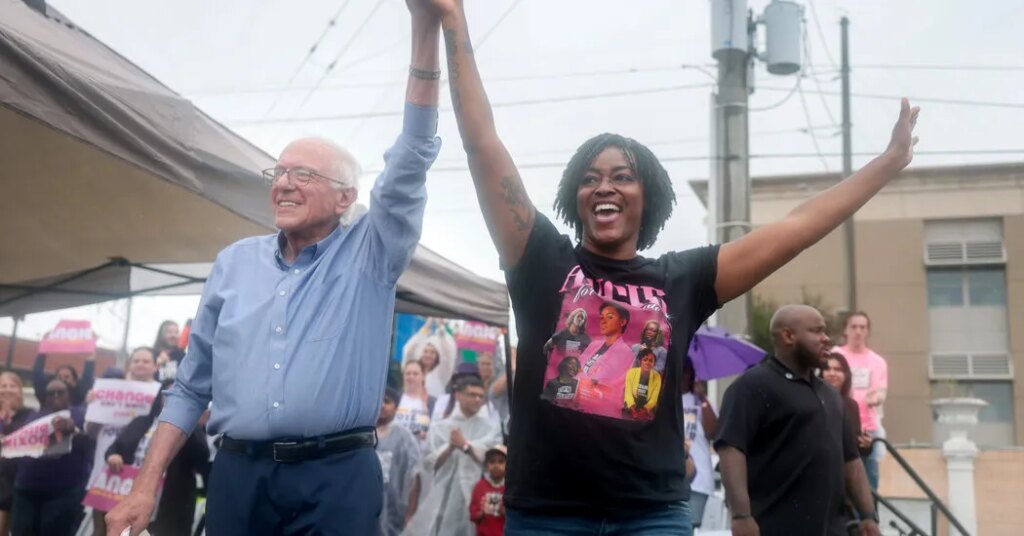
Senator Bernie Sanders looked out over the soggy crowd gathered under the persistent rain on Saturday afternoon and recognized just how unusual it was that they were all there — campaigning in Florida, just 17 days before the midterm elections.
“I was told that Florida is a red state,” he told the cheering mass of ponchos and umbrellas in Tampa. “Well, from here, that doesn’t look like that’s the case!”
With a fellow progressive, Angie Nixon, on the Senate ballot, Mr. Sanders made a rare return to Florida, a state that did not much warm to him when he ran for president in 2016 and 2020. The state was still a battleground then and has since become only more Republican.
But Mr. Sanders, an independent from Vermont, and other progressives have found voters even in red states sounding more receptive of their message about taking money out of politics and getting the economy to work for working people.
“Nobody thought that Angie could win the primary,” Mr. Sanders said at the rally on Saturday in Tampa’s historic Ybor City district. “People think she can’t win the general election. Let me tell you, they’re wrong.”
Mr. Sanders, a self-described democratic socialist, drew rebukes from Cuban Americans and other Hispanics, including Democrats, during his presidential runs for praising for aspects of Cuba’s Communist government. Mr. Sanders is notably not visiting South Florida, the heart of the state’s Cuban exile community, in his two-day swing through the state.
But Ms. Nixon’s surprise grass-roots win in the Democratic primary in August over Alex Vindman, an establishment candidate who had raised far more campaign money than her, jolted Florida politics and seemed to excite Democrats after several sleepy elections. Organizers said the Tampa rally on Saturday drew more than 2,000 people.
Mr. Sanders has made a point to invest in Republican-leaning states, arguing that his populist economic message appeals across partisan lines. Ms. Nixon worked as the deputy field director for national Black outreach for Mr. Sanders’s 2016 presidential campaign.
“People are tired,” Ms. Nixon told the crowd, many of them dressed in her campaign’s signature pink. “We’re tired of the corruption. We are tired of working harder and having less to show for it. We’re tired of going to the grocery store and spending $100 just to walk out with only two bags of groceries.”
Republicans remain favored in Florida this year, though some polls have suggested closer than expected races for Senate and governor. President Trump is scheduled to rally in Fort Myers on Friday, a signal that he wants to make sure MAGA voters turn out for the Republican ticket.
Ms. Nixon’s opponent, Senator Ashley Moody, a Republican, was appointed to the seat last year by Gov. Ron DeSantis, and has run a quieter, more restrained campaign than Ms. Nixon.
“I am running against a self-proclaimed card-carrying socialist,” Ms. Moody, the state’s former attorney general, told supporters in South Florida on Friday, casting Ms. Nixon as too far left to represent the state. “Can you imagine if she is elected?” she added. “She would be the most radical, extreme senator to ever set foot on the Senate floor.”
On Saturday, Ms. Nixon blasted Ms. Moody for declining to debate her and directly addressed the senator’s characterizing her as “radical.”
“If believing that a mother working two jobs should earn enough to put food on the table is radical, then call me radical,” Ms. Nixon began, saying her positions amounted to nothing more than “decency.”
Ms. Nixon identifies as a progressive but also joined the Democratic Socialists of America in June. She is betting that the way for Democrats to claw their way back to relevance in Republican-leaning Florida is by running not as a moderate but as a progressive.
It is a risky approach: The last Florida Democrat to run statewide as a progressive was Andrew Gillum, who narrowly lost the 2018 governor’s race. Mr. Sanders campaigned for him, too.
Back then, national Democrats were still investing in Florida, an expensive state to campaign in. The party has largely abandoned the state as the Republicans have become much more dominant; G.O.P. voters in the state now outnumber Democratic ones by about 1.5 million. Mr. Trump won Florida by 13 percentage points in 2024.
In a brief interview before the rally, Ms. Nixon said Mr. Sanders called her after the upset primary victory and asked how he could help. “I said, ‘You can come down, you can help me raise money and you can help me win,’” she recalled.
In 2020, Mr. Sanders was pilloried in a Democratic presidential debate for complimenting Cuban literacy programs enacted by Fidel Castro during an appearance on the news program “60 Minutes.” (He also denounced authoritarianism.)
Polls suggest that some of his signature issues, including single-payer health care, have grown only more popular — both in Florida and nationwide — since he ran for president.
And with the cost of living in Florida rising, Mr. Sanders and Ms. Nixon could have an opening to appeal to working-class Floridians who swung toward Mr. Trump and other Republicans in recent elections. Mr. Sanders and Ms. Nixon were also scheduled on Saturday to visit Melbourne, a city on Florida’s Atlantic Coast that leans Republican.
Chris Dell’Aquila, 38, an insurance adjuster from nearby Riverview, Fla., said at the Tampa rally that he was an independent voter who supported the single-payer health care system Medicare for all — especially as a recent thyroid cancer survivor. “Just seeing the expenses that have come from that and how easy it was to rack up,” he said. “That’s ridiculous.”
Mr. Dell’Aquila said he planned to vote for Ms. Nixon and “anyone else that’s not MAGA associated.” But he acknowledged that Mr. Sanders “doesn’t fare too well” in Florida, citing a friend who is “dead set” against single-payer health care.
“I feel a lot of Floridians have that same kind of mentality,” Mr. Dell’Aquila said. “They don’t really accept the socialism aspects of it and don’t want to pay more taxes to help other people, even though they’re probably going to be better off themselves.”
On Sunday, Mr. Sanders and Ms. Nixon are scheduled to travel to Gainesville, home to the University of Florida, and to Tallahassee, the city of Florida State University, to motivate young people to volunteer for Ms. Nixon’s campaign and vote. In-person early voting begins on Monday in some Florida counties.
Ms. Nixon said in the interview that she was hoping Mr. Sanders would draw out younger people “who have felt disenfranchised and left behind by some of the more establishment candidates,” as well as “people who are frustrated with having to choose between whether or not they put food on the table or put gas in their car.”
Mr. Sanders speaks to working families, Ms. Nixon said.
“If you work hard,” she said, “you should be able to afford to live in this country.”
The post Drawn by Nixon’s Surprise Surge, Sanders Makes Rare Florida Trip appeared first on New York Times.