We normally distinguish sculpture from painting by saying that sculpture occupies three dimensions while painting focuses on two. Torkwase Dyson plays havoc with that distinction. The 53-year-old artist, who was born in Chicago and now lives in Beacon, N.Y., studied painting at Yale with the text painting pioneer Mel Bochner, but is best known for her thoughtful installations of black metal boxes and arcs.
But these, though three-dimensional, look less like conventional sculpture than like architectural drawings come to life. Her paintings, on the other hand, have unmistakable physical depth even before she adorns them with the various little doodads that make them look, at first glance, like wall-mounted sculptures.
Don’t be fooled. With her latest show at Pace Gallery, Dyson confirms that whatever form her work may seem to take, her imagination is trained on the bottomless, hypothetical, infinitely thin two-dimensional plane we call a picture. In other words, she is and has always been a painter.
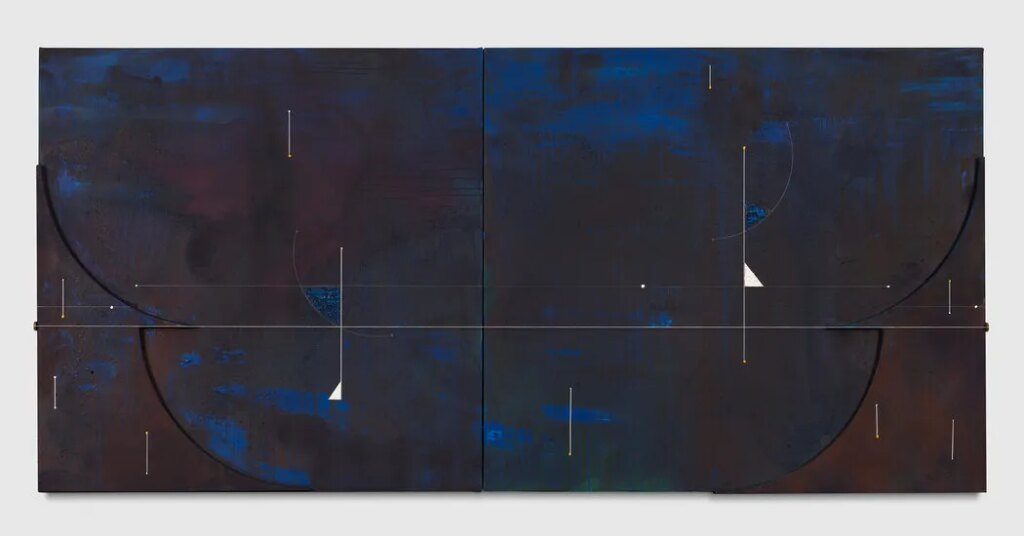
There are 13 paintings in the exhibition, titled “Seeing in Blue,” including one diptych and one triptych. On them, using layer after layer of extremely diluted acrylic paint poured on like a stain, Dyson creates ghostly, cloudlike fields of color that tend toward black. (The easiest way to identify the red, blue or green undertones of a specific field, short of turning up the gallery’s lights, is to check the brightly colored drips on a given painting’s edges.)
Over these fields, using palette knives and brushes as well as Sharpie markers and No. 2 pencils, Dyson applies geometric lines and curves; thickly impastoed circles and circle sections; little flaglike white triangles; a taller blue triangle or two; and tiny peaked dots of white or yellow paint that evoke stars.
Affixed to the sides of each canvas are two flat, doorway-shaped objects, usually brass or bronze, that Dyson calls “hardware,” and between which she attaches taut white or black cotton string, stretching it taut. Some of these strings sit an inch above a painting’s surface; others angle down to meet the corner.
In two cases Dyson adds on layers of plywood, cut into jagged arcs; painted to match the canvas, they can be hard to notice until you see the shadows they cast. Two circular canvases, divided between shiny and matte black portions straight across their centers, are like porthole views of the horizon.
All 13 pieces are recognizably built from the same abstract visual elements, with their variations serving as much to emphasize the range those elements can have as to differentiate one canvas from another. Stars can be many or few; an arc can turn this way or that; black can be red or green. It’s hard, too, to know quite what any would look like alone — say, hanging in a bright hallway or over someone’s bed. At the same time, the paintings differ just enough that they don’t quite fuse into a single work.
Associations also flicker and cross from one painting to the next. The circular canvases evoke portholes not only with their shape, or the horizon line that seems to cross them, but because Dyson places a metal sill with a slight overhang on top of each one.
But once you notice that, you’ll see nautical references everywhere: the pennant shapes, the lines and arcs like diagrams on charts of the sea, even the brass and bronze hardware on other paintings, which could have been pried off a sailboat in the harbor.
On the other hand, those lines and arcs could also come from star maps, and the cloudy red fields of “Hand to Hand, Heart to Heart (Unknown of Us 2)” resemble nothing so much as a photograph of outer space. Likewise the shimmering green galaxy of “Hand to Hand, Heart to Heart (Unknown of Us 1).” The strings that Dyson stretches across each painting bring to mind plumb lines, levels and other tools of applied geometry.
None of this means that Dyson is making literal depictions of outer space or of the sea. But what these allusions do — along with the strings and the hardware — is to prime you, consciously or not, to look at the paintings’ surfaces in a particular way.
She achieves an impressive depth and translucency with acrylic paint, a shimmer and ambiguity that can really hold your attention. And because of those nautical and astronomical cues, you know that you’re not looking at the surface but peering into it, the way you do at the night sky, or at the glittering surface of the sea.
Torkwase Dyson: Seeing in Blue
Through Oct. 24. Pace Gallery, 540 West 25th Street, Manhattan; 212-421-3292, pacegallery.com.
The post Blurring the Line Between 3 Dimensions and 2 appeared first on New York Times.