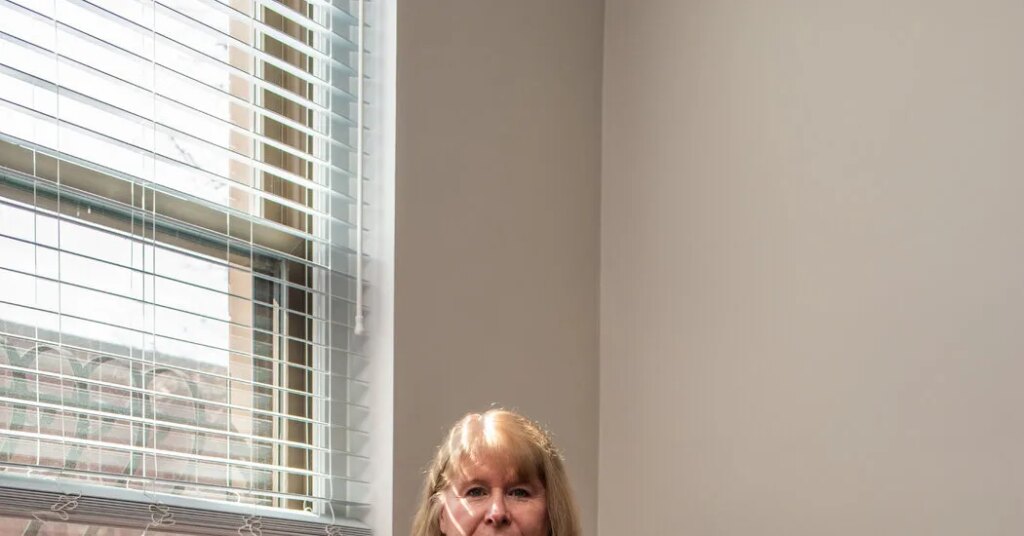
Helen Branswell, a leading reporter on infectious diseases who wrote with foresight, urgency and clarity about the emerging danger of the Covid-19 pandemic, ahead of the vast majority of journalists and even many medical experts, died on Tuesday in Ottawa. She was 69.
Her death, in a hospital, was from complications of a recurrence of breast cancer, her sister, Brenda Branswell, said.
Ms. Branswell “saw the pandemic coming well before anyone was paying attention,” Dr. Ashish K. Jha, the White House Covid-19 response coordinator in 2022 and 2023, posted on social media after her death.
Reporting at the time for STAT, the medical and science news site, she posted on Twitter on New Year’s Eve 2019 about a report of “unexplained pneumonia” in China, saying, “Hopefully this is nothing out of the ordinary.” Two days later, she posted a South China Morning Post article about the outbreak and wrote, with more concern, “Not liking the looks of this.”
On Jan. 4, STAT published her first article on the “growing cluster” of unexplained pneumonia cases, in which she noted the possibility of “a new virus and perhaps even a new coronavirus.” By the end of March, Ms. Branswell had written about 50 articles about the pandemic.
That February, Ms. Branswell moderated a panel in Washington that included Dr. Anthony S. Fauci, the longtime director of the National Institute of Allergy and Infectious Diseases. At that point, there had only been 13 confirmed cases of Covid in the United States, and Dr. Fauci said that the risk of the coronavirus spreading seemed “relatively low.”
Ms. Branswell, clearly skeptical, replied: “Explain to me why the risk is low, somebody. Because to me, when I look at this virus spreading, it’s spreading very efficiently.”
She continued: “Like, there’s no force field around China. It’s not going to stop there.”
This drew a blunter response from Dr. Fauci: “Is there a risk that this is going to turn into a global pandemic? Absolutely, yes.”
That was not the only time Ms. Branswell challenged the response of public health officials to the outbreak.
In an interview two months later with Dr. Robert R. Redfield, then the director of the Centers for Disease Control and Prevention, she asked why the agency had not held a public briefing in a month.
“You’re invisible now, sir,” she told Dr. Redfield. “Your agency is invisible.”
Rick Berke, the executive editor of STAT and a former reporter and editor at The New York Times, said in an interview that Ms. Branswell’s coverage “was the definition of authoritative and meticulous.”
She won a 2020 George Polk Award, the prestigious journalism prize, and was cited by the judges for her “relentless coverage of all aspects of the pandemic that became must reading for the medical community and the general public.”
She and two colleagues at STAT were named finalists for the 2021 Pulitzer Prize in breaking news reporting for their “prescient, expert and accessible” work.
“She was the best in the business of covering public health and communicable and infectious diseases,” Dr. Lawrence K. Altman, a physician and former medical reporter for The Times who befriended Ms. Branswell when both were covering the SARS epidemic of 2002 and 2003, said in an interview.
“I was always struck by how penetrating her questions were,” Dr. Altman added. “She had the ability to cut through the fog and B.S. to get to the heart of whatever was being discussed. She asked questions that often surprised scientists, questions about issues that the scientists hadn’t thought about.”
Mary Helen Branswell was born on May 19, 1957, in Sherbrooke, Quebec, roughly 100 miles east of Montreal. Her father, John Branswell, taught high school English and history. Her mother, Margaret (Steele) Branswell, ran a household of six children and later did clerical work.
Helen received a bachelor’s degree in English literature in 1978 from St. Thomas University in Fredericton, New Brunswick. Wanting to be a writer, she fell into journalism as a freelance reporter and then as a staff writer at The Daily Gleaner, a newspaper in Fredericton.
In 1986, Ms. Branswell joined The Canadian Press, serving in the news agency’s bureaus in several Canadian cities, and in London as its European correspondent. She covered politics, foreign affairs, health and sports. She was hired by STAT at its start in 2015.
Her interest in covering infectious diseases was spurred by the SARS epidemic, which began when she was reporting in Toronto.
At first, she found it stressful to wade through the dense jargon of scientific studies, but “she quickly got up to speed,” her sister said, adding that a three-month fellowship at the C.D.C. in 2004 was “career-altering” for Ms. Branswell.
She went on to cover Ebola, Zika and other outbreaks, as well as polio and influenza, and became known for her nuanced, evidence-based writing.
Ms. Branswell’s reporting was so vital during the coronavirus pandemic that William Hanage, a professor of epidemiology at the Harvard’s T.H. Chan School of Public Health, called her a “godlike figure to people who are infectious-disease epidemiologists” in a March 2020 interview with The Times.
Her understanding of the science, history and politics of the outbreaks she covered made her “a journalist who knew more than most of the experts she interviewed,” Dr. Jha, the former Covid response coordinator, wrote.
In addition to her sister, Ms. Branswell is survived by four brothers, Kevin, Larry, Rick and Jack Branswell.
Tedros Adhanom Ghebreyesus, the director-general of the World Health Organization, wrote in a tribute that Ms. Branswell demonstrated “an unwavering commitment to evidence, science and truth.”
At a time “when misinformation competes with facts,” he added, “her reporting was a trusted source of clarity, honesty and insight.”
The post A Reporter Who Saw Covid Coming Has Died appeared first on New York Times.