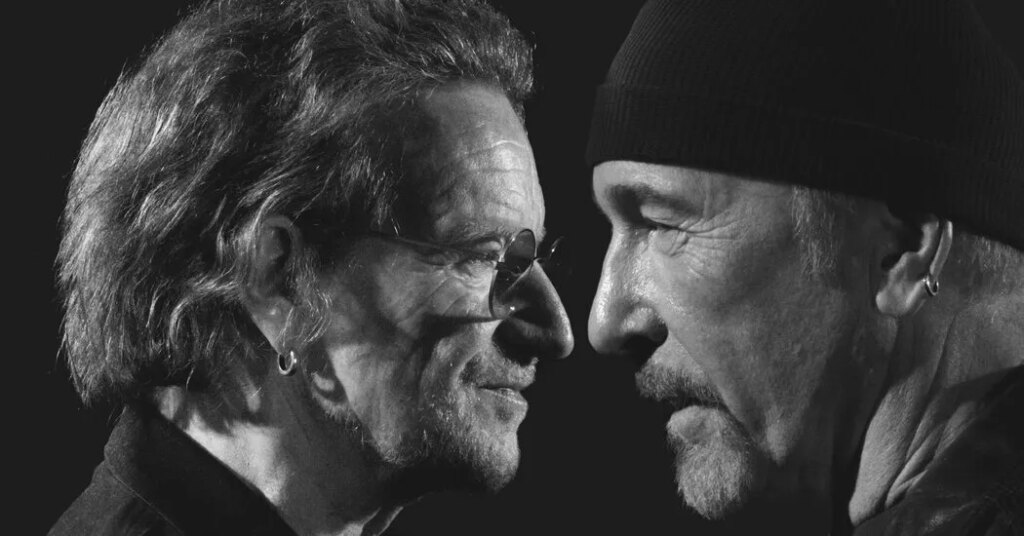
U2, as I’m sure you’re well aware, is one of the biggest bands of all time. The Irish quartet has released iconic albums like “The Joshua Tree” (1987), “Achtung Baby” (1991) and “All That You Can’t Leave Behind” (2000); staged some of the highest-grossing and most innovative tours ever; and won 22 Grammys, among myriad other achievements. Still, there are other rock artists on that level. Not many, but a few. Where U2 may truly be unparalleled is that all that success was earned by the same four guys.
The four members of the band — Bono on lead vocals, the Edge on guitar, Larry Mullen Jr. on drums and Adam Clayton on bass — still occupy the same positions they did when they first played together in suburban Dublin in September 1976 — 50 years ago this fall. (And from what I understand, they all still like one another, too.) Especially in the tempestuous world of rock ’n’ roll, that longevity and stability is to be celebrated.
Which is exactly what the band has done. On Sept. 25, U2 celebrated its golden anniversary with performances in front of giddy students at Mount Temple Comprehensive School in Dublin, where the members first met, and then, as a surprise, from a balcony of a former rock club in front of an instant crowd of thousands in the city’s center. Next month, on Nov. 13, U2 will release “Carnaval De Luz,” the band’s first full-length album of new material since 2017. (It follows two EPs, “Days of Ash” and “Easter Lily,” both released this year.)
On the day after those commemorative events, I spoke with Bono and the Edge, the band’s two principal songwriters, about their long working relationship, friendship, and what U2 still means — both to them and to the world.
Subscribe: Apple Podcasts | Spotify | YouTube | Amazon | iHeart
I think of U2 as wanting to be the best and biggest band in the world. But it probably shouldn’t be the case that the best and biggest rock ’n’ roll band in the world is a band that’s been around for 50 years, comprising guys in their 60s.
Bono: That’s very, very hurtful, David.
The Edge: But fair.
So what do you think the purpose of U2 is right now? What should U2 be trying to be?
The Edge: We genuinely think that we might just write the best song we’ve ever written next week, or do the best show we’ve ever done next tour. When we talk about the best, we’re not thinking about rock ’n’ roll. We’re thinking about our favorite bands and what, if I’m in the audience at a show, would I want to see and hear. So it’s where rock ’n’ roll collides with activism, where rock ’n’ roll collides with ideas from fine arts. And I suppose a transcendent aspect as well. We’ve never thought it was necessary to hold back our own spiritual quests and questionings from our work. They are all expressed. And when we hit a song that has a transcendent quality, that’s the peak for me. I really think we’re in with a shout of the best songs we’ve ever written, the best tours we’ve done, still. That’s why I’m still in this band.
Bono: And therefore, the shout of the best songs anyone’s ever written. That’s where U2 gets really annoying. That grandiosity, which, by the way, is in all the artists that want to go there — the Beatles, Nirvana. I’m jealous when we’re left out of the pop charts. That’s a personality flaw, but deep down, it’s because I don’t want those ideas to be left out of the mainstream. My favorite artists stormed the mainstream. David Bowie, I think of his best work as being experimental and innovative, but even into his 40s, 50s, he could throw out a perfect pop song.
When you say there are ideas that you want to be in the mainstream, what are they?
Bono: The metaphysical thing, the gospel side of U2 — that was only allowed in rock ’n’ roll if you were Black. You can’t be white people talking about God, because generally white people who talk about God make our audience very nervous, you know? But not in the Black church in America. Coming to the United States, we’d just seen those televangelists, and we were like, Wow, these people are in deep trouble. Then you walk into a Black church and you hear the abandonment of the singing and that feeling — it’s fervor, but not freaky fervor. So being able to sing songs of faith and devotion and songs of doubt, to put the gospel with the blues, which is rock ’n’ roll. There’s nowhere you can’t go, including the pop charts. My constant argument is don’t cede the charts to just those pop mechanics. Hip-hop did it and got revolutionary ideas on the radio. But a lot of indie stuff just gave up. They weren’t even bothering.
You said that talking about God in your music can be a little uncomfortable for your audience, but I would argue that U2’s religious impulse is hugely important to your audience. It’s a big part of why people feel so connected to the band.
The Edge: I mean, yes, but we weren’t seeing it as a selling point. We were seeing it as the thing we have to speak about because it’s where we’re coming from. But people have said that we’re the band that people who don’t know that they believe in God like. It’s in the work in such a natural way. There’s no polemic there. It’s just our search, our inquiry. And it involves so much doubt. It has to, I think. Because if it’s not dogma, then it’s constantly in flux. I would say I’m agnostic about half of the week, and then the rest of the week I’ve got an incredibly strong faith. But it’s always changing, ready to be upgraded.
I want to ask about failure and success. Obviously, U2 had enormous successes. But there have been failures, too.
The Edge: A lot you wouldn’t even have seen or heard of.
So what does success or failure for the new album look like?
The Edge: I feel it’s already a success myself, because of the degree of time and effort and dedication to the work. I don’t really care that much what happens now because I know it’s really great.
Bono: I could say that, but I wouldn’t believe it. It’s a bit like you’re a comedian, you’ve got a routine, your punchline arrives, and if no one laughs, it’s not quite the same. Some of the songs, I would love to see even another artist take them somewhere. We were just talking about gospel music a minute ago. There is a song called “Glorify” on the album. We really ended up putting what’s like a demo on the album. It’s really minimal, the expression of the song. But that’s a screaming dance-floor hit. That’s how I imagine it. There’s a part of me that goes, [expletive], I want to do that version. I’m not sure we can. Somebody else should do that to help it cross over.
We’re speaking almost exactly 50 years ago to the day that you guys practiced for the first time in drummer Larry Mullen Jr.’s kitchen. Edge, in Bono’s memoir, “Surrender,” he writes that when you were teenagers, you and your brother, Dik, had a reputation as weirdos — pleasant weirdos but weirdos nonetheless. This was in reference to you and your brother blowing up your family’s garden shed?
The Edge: Quite likely.
Do you remember having any sense of Bono’s reputation before you all started playing together?
The Edge: First of all, that was an absolutely valid comment from Bono. Myself and my brother, there is some neurodivergence there of some sort. I’m not sure exactly what. A.D.H.D., autism, whatever. So socially speaking we were always a bit on the fringe. But, yeah, fascinated with explosives. I know way too much about how to blow things up than I ought to. But Bono’s reputation preceded him because one of my best friends growing up, Shane Fogarty, went to Mount Temple a year ahead of me, so I quizzed him about school, and he says, “It’s all right, you don’t have to wear uniforms, people are very nice, and there’s some fun heads there.” I said, “Like who?” He says: “This mad [expletive] head called Paul Hewson. He’s mental, but he’s good fun.” So even before I went, I’d heard about this character. I guess Bono’s always been that extrovert, exhibitionist performer, and he had that at age 13 already.
You guys have documented your career together in a bunch of different ways: in documentary films, in the “U2 by U2” book, in countless interviews. But are there ways in which your memories and understanding of how you came together has been superseded by the legend and the lore?
Bono: You’re suggesting we are not superheroes? [Laughs] I always saw us in some sort of mythological sense, if I’m honest. The names — think about it. We wished to escape suburbia and discover these other selves, and we gave those other selves names. The Ramones were key for us, and they are really well-drawn characters.
What you just said about coming up with the fictional names — this always killed me about the band. Bono! Edge! And then … Adam and Larry. Was there any discussion that they should have names too?
The Edge: We need to explain the whole name thing. We laughed a lot at that age. We would laugh at each other and ourselves and that was the deal. So the names were not necessarily designed for their heroic aspect. Bono’s very first name was in fact Steinrich Van Haitian Bang Bang Bang, and then I was Inchicore for a while before I became the Edge. Adam for a while was known as Mrs. Byrnes, and Larry for some reason was the Jam Jar. We were borrowing a lot from Monty Python.
Bono: It’s about inventing who you want to be rather than who you were given when you were born at a certain point, place and time.
Bono, when you and I spoke last, around the time of your book, you told me that U2 had been working on the album “Songs of Ascent,” but then thought you needed an album of “unreasonable” guitar music instead. Then I saw somewhere you, Edge, said that the band had been working on an album of “sci-fi Irish folk” with Brian Eno. And yet we’ve arrived at “Carnaval De Luz.” So in a practical way, can you describe when the concept for new music changes? Does Bono show up one day and say: “Guys, we’re scrapping sci-fi Irish folk. We’re doing ‘Carnaval’!”? How does that actually work?
The Edge: Really, the music tells you. As we were working on those projects, it was pure creative experimentation and exploration. There was no deadline, nothing booked or committed to. I had also spent the whole pandemic lockdown just working on music. So we had this beautiful opportunity to create with no agenda and just see where it took us. But what we had decided is that the album should be a countervailing mood to the times. The times are anxious, despondent. People are really a bit lost, and we were like, What is it that we can help with here? And we thought an album that’s a party, a celebration, a sort of bringing people together, a gathering around our common aspirations, would be the thing to do.
Bono: There’s a defiance to this, too. There’s a Dan Savage quote about when he was an AIDS activist in San Francisco in the middle of that crisis. He said: In the morning, we would bury our friends. In the afternoon, we’d go out to protest so we’d have less people to bury. Then, in the evenings, we would go out and dance, because the dance was what we were fighting for. I loved that so much. That is not surrendering to the melancholy. That’s the defiance. Sorry to do this as an Irish person, but again, if you go to the Black church during civil rights, they’re up. Sly and the Family Stone, no minor chords. It’s like, wow, “Dance to the Music.” That’s “Carnaval.” Defiant joy is the thing we were looking for.
Where’s the line between the defiance you’re describing and fiddling while Rome burns?
Bono: What do you think, Nero?
The Edge: Well, one is to be in denial, and one is to be fully aware, to stare darkness in the face and to still choose joy. That’s the difference. I think technology’s a big problem right now. Social media — people are in their heads too much. They’re in their part of the echo chamber of their own algorithm. What’s really important is the reset. We are so much more capable than we are led to believe, and by being isolated and by allowing the wave of negativity to go on unchallenged, people are feeling disempowered and dejected. They don’t understand that they can be part of something great. That’s what’s really positive about rock ’n’ roll shows and festivals. It gives people that sense of agency again.
Bono: Can I just say, rage is part of this. Rage is part of the right response. Anger is OK. To surrender to the melancholy is what we’re trying to avoid.
One could almost think of “Carnaval De Luz” as a protest album, but it’s a protest album without proper nouns. You’re not saying who you’re protesting against or naming anyone explicitly. And I’m thinking of this in the context of some of your peers at the top of the rock ’n’ roll pyramid. Bruce Springsteen was out on the road this year giving speeches railing against Trump and his administration and its policies. On the other side, I spoke to Mick Jagger earlier this year, and I asked him a question about the function of rock stars, and he basically said, Hey, I’m here to help you have a good time. Nobody wants to be lectured. And I wondered if making an album, like you did, of politically galvanizing, defiantly joyful protest music without actually mentioning politics, was your way of trying to walk a middle path there.
Bono: No. It’s picking the fight with the author of all of this mess. I found believing in God — or that God is love — unusually easy in my life. But the concept of evil was tricky for me. It wasn’t as easy to digest. So in the new song “If the World Is at War We Better Not Be,” the line goes:
I wanna speak to the spirit You can feel it, but you can’t fear it Be ye kings or queens or emperors of despair We’re not arguing the toss We got some words for your boss We’re speaking to who speaks through you To the prince of the power of the air All these shimmers and these glimmers, mirrors that must crack, all the neon fizzing flickers, we’re grateful for some of that The fiction of a nation, the stories we don’t tell We need the light of illumination so you can go right back to hell If the world is at war, we better not be.
That’s what this album’s about. We should be grateful that evil is out in the open. And on [the band’s February EP] “Days of Ash,” we name names. You know, I spoke to Renee Good’s family.
The woman killed by ICE in Minnesota.
Bono: We wrote a song about it a week later, and we had this line, “America will rise up against the people of the lie.” Edge had given me this book 30 years ago by M. Scott Peck called “People of the Lie.” It’s about the nature of evil, and a study of malignant narcissism. Anyway, I was explaining to the family, before we used the lyric, asking them for permission. They’re on Zoom, and when I get to the bit about “America will rise against the people of the lie,” the father said, “I have the book ‘People of the Lie’ right here.” I said, “The book Edge gave me 30 years ago?” He says: “Yeah, it’s right here. Just a month ago, I took it out to explain some of what’s going on to my son.” So with those songs in “Days of Ash,” we did go to names. But for “Carnaval De Luz,” we didn’t want to. There’s a line in the song “Midnight Sunshine” that goes: “Catastrophizing is the glamorizing of the world’s pain. If you don’t want to make a devil bigger, stop repeating his name.” Can I go on here for just a second?
You’ve never stopped before.
Bono: [Laughs] I know. I’m so sorry about that. But if you can separate a discussion about this administration from a discussion about the left and the right and conservatives and liberals, then I’m fine to go ahead with it. Because I think this is the most extraordinary moment. I mean, this is the greatest heist in the history of the world: stealing America. And it’s not a caper movie. It’s real, and it’s happening. I don’t want to put off good people who vote conservative, who vote Republican. Their party’s been hijacked, and it’s an aggressive takeover. I want to invite them back. I want them to return. People vote conservative for all kinds of reasons that are OK. So if we can talk about it without getting to the usual loggerheads — but this is a serious problem and I have serious personal dealings with this because of 25 years of work in development.
That development work has been decimated by DOGE and, by proxy, Elon Musk, and the Trump administration. Do you see evil in that?
Bono: For general clues on evil, look at the abuse of children. That’s always a clue. I don’t know how many fatalities will eventually be attributed to the DOGE cuts. There are many different estimates. If you go to, say, The Lancet, they suggest, I think, up to 2030, maybe five million children under 5. And let’s say they’re half wrong. What Christian household, what Catholic household, what Jewish household, anyone of faith, in fact anyone of conscience, would allow the hemorrhaging of human life that is going to happen as a result of these DOGE cuts? It’s unconscionable.
Well, here’s the test-of-faith question. I was listening just this morning to “Glorify,” and there’s a line that goes, “You spit in my eye, you’re a barefaced lie, and there’s nothing you can do to keep me from loving you.” It’s the idea of having love for your enemies. Do you have love for the people doing the things that you’re calling unconscionable?
Bono: Yeah, I love these people because I believe God loves them and Christianity calls us not only to love our neighbor but to love our enemies. But what’s going on with the man whose name shall not be mentioned is something way bigger than the man. It’s going on all over the world. This greatest heist in the history of the world? It’s the crown jewels. It’s freedom. It’s democracy. It’s like the [expletive] Enlightenment. Anyway, that’s it. Edge is just sitting here looking at me.
Edge, you have had the experience many times of being in situations like this and having Bono field questions of the kind that I’m asking. What is that like for you?
The Edge: I mean, look, we don’t mind getting deep and serious, but you want to keep some balance as well. That is why U2 pivoted so heavily after “Joshua Tree” and “Rattle and Hum” to “Achtung Baby,” because we realized we were being robbed of aspects of who we were. It just wasn’t reflected in the work and therefore in people’s understanding and perception of us. So the thing to remember about us is, yes, we can get very heavy and very deep, but actually we have a lot of fun, and when we’re together working, we laugh a lot and we fail a lot and we’re happy that we’re comfortable with failure. So, yeah, I share a lot of Bono’s views on these things and we feel a responsibility, I suppose, to address what we see going wrong with the world, but you can’t do it incessantly. So on our album we touch on it lightly, and then, as you say, we’re not mentioning names because we don’t want to get into finger wagging. What we want to do is draw attention to something that’s a kind of antidote, something that is better. And I think that’s the way people operate. You tell somebody they shouldn’t do something, it’s going to be a struggle. If you show somebody a better path, they’re going to go there.
So when you’re in the studio with Adam and Larry — you guys have known each other for 50 years — there have got to be things that make the rhythm section look at the front-line guys and go, “This drives me nuts!” What are they?
The Edge: Bands are weird things, let’s be honest. We are brothers in arms, for sure, but we don’t agree on everything by any means. We end up making decisions by consensus because we’ve learned over the years that if we’re arguing about something, there’s a problem. When everybody just goes, “That’s it!” we know we’re onto it. So we do argue, but generally speaking, it’s when something’s not quite right. And then it’s just a difference of opinion, like what road we take. So, yeah, I’m sure I’m very annoying at times.
Bono: I don’t think Edge is — and that’s annoying, by the way — because he’s a person of great reason. I would have the annoying gene the most. But it’s a thing about performers. The same portal that you open up to fit a whole stadium inside is maybe not a portal you can close enough in time to protect yourself from the outside world. You think about stadium-sized egos like myself, and you think about self-aggrandizement and much worse, but what happens is the opposite. It’s the collapse of the ego. Singing itself is a vulnerability if you’re any good.
I was reading the trades, as I do, and I saw an item not that long ago about you guys hiring a woman named Sulinna Ong as part of your management team. She had previously been at Spotify doing global curation. And Jeff Azoff, who manages Harry Styles, is one of your managers now. When U2 starts working with new management, presumably those people make an argument for what their value to you is. So what did they tell you that you didn’t already know about how U2 can find new listeners or move forward at this point in the band’s career?
Bono: You must have had surveillance on us, because just in the last couple of weeks we’ve been sitting around listening to people tell us to do things that we hadn’t thought of. Sulinna said it is almost impossible, the way people live now and listen now in their separate communities, to do something that everyone will be aware of. The amount of advertising you would have to spend, the amount of concerts you would play in every college town or around the world — people still might not know that you’ve put out a new album. So you should turn up in unexpected places. And they were suggesting some of them. Some of them were not things that we would have considered. And we were laughing, the four of us, and going, Are we still going to have to break into the charts? Nothing’s changed since we were kids. We were sitting around with Larry, who doesn’t normally like to do this kind of thing, and I was saying: “Are we ready to go out and meet people that may not know who we are? I’m used to it as an activist, but are we as a band?” I was surprised that all four of us were like, OK, give us another suggestion. Including Larry, who was like: “I’m listening. I’m suspicious, but I’m listening.” I thought that was good. For us, it’s still something we have to prove.
Maybe it feels gauche to get into the specifics, but are they suggesting licensing a song in a show you hadn’t thought of? Are they suggesting you play a pop-up at a Raising Cane’s?
The Edge: That’s a great idea! I’m going to write that down.
Bono: You’re going to get on very well at the corporation. You had some very good ideas during the interview. [Laughs]
The Edge: I think also this album, and where we’re going to take the tour, lends itself to some almost Dada-like opportunities to play around with the absurd, to do some crazy stuff no one was expecting. I’m looking forward to that. It’s hard to surprise yourselves as much as your audience, having done it so many times before.
I’ve always been curious about what your old manager Paul McGuinness said to you after the whole iTunes mess, where you put the then-new album [“Songs of Innocence” (2014)] on people’s iTunes without asking. Paul must have had something to say about that.
Bono: He said pretty much the same thing that Tim Cook said when I pitched him the idea, which is: You spent your whole life getting people to pay for music. Why would you want to give something away for free? I mean, we were experimenting. We wanted to see if we could get Apple or another company to pay for our music and then they distribute it. And look, it’s going to take some experimentation to fix the music [business]. It’s astonishing how little other musicians are paid and it’s frightening. But yeah, that was all on me.
Was it a reputational error for you?
Bono: I went too far on that one.
The Edge: We take risks. We have to. So you fail, you fall on your face at times. That’s part of the gig.
Edge, you alluded to playing live. Are there plans to go on tour next year?
The Edge: There are.
Your tours are always conceptual in some way. What is the new concept?
Bono: Well, the album title’s a clue.
The Edge: We can’t go too much into it because the plans are still forming, but we are interested in this intersection between shamanism and show business. All of the great showmen have, to some extent, to pull off a magic trick, which gets into a mysterious place. And it works both ways: The great politicians of this moment, who unfortunately in a lot of cases are supremely dangerous, are very shamanistic. They are dazzling people with an act. It’s the snake oil salesman aspect. And we’re living in a post-truth era because, unfortunately, there are so many opportunities to put fake narratives out there, and that’s being taken advantage of. Our buttons can easily be pushed, particularly when fear is the weapon that you’re taking advantage of. So we’re exploring these things in a good way and a bad way. The lyric of the song “Silencio” [from “Carnaval De Luz”] encapsulates those two extremes. The two types of silence. Contemplative, meditative, reflective silence is a beautiful thing. But the other kind of silence is when you are cowed and you’re afraid to speak because if you say the wrong thing, you will be punished, you might go to jail, you’ll be ostracized, and that’s super dangerous.
Bono: There’s a poem by Michael Leunig. [Pulls out his phone to read the poem] “There are only two feelings, love and fear. There are only two languages, love and fear. There are only two activities, love and fear. There are only two motives, two procedures, two frameworks, two results, love and fear. Love and fear.” There’s a lot of love at our shows, and it’s not an “up with people,” “let’s all give each other a hug” type of love. I think there’s a level of depth at a U2 show where people who genuinely don’t normally agree with each other’s politics feel safe. I’m very proud of that. If they’re in America, we want people to feel really good about their choice to probably pay too much to see us. But we are going to challenge them.
Presumably you have some say in the ticket prices.
Bono: Well, the whole problem with the live business is, very little. But what we do in our band is we take the best seats in the house and make sure that they’re often the most affordable. We also have no problem separating rich people from their money.
Let me wrap up with a holistic question. Even just in the course of this conversation, it’s obvious that U2 thinks about the story that we’re all living in and what the band can offer to that story. But you’ve been around for 50 years. This doesn’t go on forever. So where is U2 in its own story right now, and do you have some sense of how you want that story to end?
The Edge: We’re still creatively extremely inspired and active, and there are lots of songs that have yet to be released, yet to be finished. So I can’t see that ending anytime soon.
Bono: Edge, I think he might be interested in your speech to the band the other day about if you had to find another band.
The Edge: That’s the other thing about why I’m still in U2. Occasionally early on I would think, This is too difficult, I should really get out of this band, and I would start the inner dialogue. [Talking to himself] “So, what do you want to do with your life?” And I would say, “Well, I’m a creative person, and music is kind of my main thing, so I’d stay in music.” “OK, do you want to sing?” And I’m like: “I really don’t want to be the singer. I’m happy being a guitar player.” “So who’s the singer you most like to work with?” And I’d be like, “Well, clearly Bono.” So, OK, I’ll be doing a solo thing but Bono will be the singer. So then, “What’s the best rhythm section for you guys?” I’d be like, “That’s Adam and Larry, isn’t it?” OK, so it’s going to be a solo band with Bono on vocals, I’ll be the guitar player, and Adam and Larry will be the rhythm section. I basically would redesign U2. So yeah, there’s no doubt about it. This is where I belong.
Bono: More likely, I think, is that people tire of you and that we tire of going the distance to meet them, resulting in them tiring of you. I think if we keep playing live till we drop, there will always be people. But we have one problem in this regard, which is that we pledged to each other when we were 18, 17, 16, that we would never, ever walk onto a stage without it being everything. We haven’t betrayed that yet. We’ve had fistfights onstage, we’ve had them backstage, we’ve had madness, but we’ve never betrayed that.
The Edge: Yeah, it never was entertainment to us, ever. It was always something with a lot more importance and meaning. Some of the early shows we saw were the Clash on their first tour, the Buzzcocks, the Jam and Talking Heads. So when you’re around that kind of sense of urgency and the ideological aspect, it’s like you can’t take this stuff lightly. It’s way more than just entertainment.
Bono: It’s the thing they say about football: It’s not a matter of life and death. It’s something much more serious than that.
This interview has been edited and condensed. Listen to and follow “The Interview” on Apple Podcasts, Spotify, YouTube, iHeartRadio or Amazon Music. Follow us on Instagram and TikTok.
Director of photography (video): Benjamin Breading
The post 50 Years In, What’s the Point of U2? Bono and the Edge Have Answers. appeared first on New York Times.