The air-raid alarm went off at 3:11 a.m. but offered little warning. Within three minutes, the missiles started to hit, almost 10 teeth-rattling booms that jolted Nikita Horskyi and Alona Horska awake.
The couple launched into what has become a familiar ritual in recent weeks. Mr. Horskyi scooped up their two children. Ms. Horska assembled makeshift beds in the hallway. Their 16-story apartment building has no shelter, and they knew that two walls offered more protection than the exterior wall alone.
Mark, their 10-year-old, thought, “God, help us,” as he said he does after every explosion. He hugged his stuffed goose and curled up in the hallway on a thin mat and a pillow resembling a smiling green monster. Arina, 5, lay down on a blowup bed with sheets of pastel bunnies and hedgehogs.
The family fell back asleep, accustomed to this particular nightmare, until the next missiles hit, two of them nearby, including one that killed a pair of security guards. Mark woke to the sound of glass shattering outside. He fell asleep for a bit longer, then he and his sister got up for school. Soon the jet-powered drones would arrive.
“Of course, it affects my mental state and my nerves,” Mark said. “I have to come up with things to calm myself down.”
This is the story of the Ukrainian capital, Kyiv, on a recent Wednesday, and how life here has deteriorated. The Russian missiles come more often now, not just at night but all day.
In August, new Russian drones, powered by jet engines and capable of going up to 375 miles an hour, began streaking into cities in exponentially larger numbers. They hit almost without warning. Ukraine has not figured out how to consistently intercept them.
President Trump has recently lifted sanctions on Russian diesel sales, pressured Ukraine to stop attacking Russian oil refineries and suggested that Ukraine get a new president. He has said nothing about what Russia is doing to Kyiv. Moscow is killing more civilians in Ukraine than at any time since the beginning of the full-scale invasion.
This Wednesday would be an average day. Not too quiet, not too loud. The air-raid alarm would go on and off seven times, keeping Kyiv under alert a total of about 10½ hours. Parts of the city would lose power and running water. Six people would die.
In the fifth year of war, Russia is trying to make the capital unlivable, drive people away and force Ukraine to capitulate. Kyiv, a city shaped like a heart, has become a new kind of battlefield far from the front in eastern Ukraine, where Russian forces have been unable to win the war.
Kyiv has given no indication that it will give up. But it will suffer.
People here once coped with major missile attacks every seven to 10 days and the occasional drone that made it past Kyiv’s defenses. Life was sometimes miserable, like during power cuts last winter. But it was often joyful, with “Blade Runner”-themed raves and pouty influencers parading down hipster streets with camera crews. That Kyiv has been muted. Life has become grayer.
Russia has threatened to knock out power, heat and water in Kyiv this winter. This month Moscow started trying to cut the city in two by hitting bridges over the Dnipro River, which divides the east, where rents are lower, from the west, where most people work.
Every decision, small or big, feels fraught with what-ifs that could be life-changing. People in Kyiv first decide where to sleep. A tent in a subway station. A car in an underground parking garage. A mattress in the hallway. A gamble in bed.
Shopping has turned into a Sisyphean task, because many larger stores make people leave when the sirens start. School is constantly interrupted, because children must go to the schools’ shelters for every alert.
Mark often finds himself in his school’s basement, which is rented out to a gym called the Shogun Fight Club.
There are punching bags, wrestling mats and concrete walls, but no desks or chairs. The children cannot study there. Some follow the paths of drones on apps.
Others play games, like one where a few boys pretend to be Ukrainian recruitment officers and then tackle other boys on the wrestling mats to send them to imaginary front lines. Or the one where the boys throw paper airplanes and paper drones at a burning building drawn on the gym wall in pencil, complete with people waving their hands for help.
The Decision
Anatoliy Kavunenko, 66, woke before dawn on Wednesday for his early shift. Despite the ongoing alert, he decided to go to his nearby job as a security guard. His wife, Antonina, packed him lunch: eggplant with garlic and buns stuffed with mushrooms. Mr. Kavunenko walked out the door.
About 5:12 a.m., the second round of ballistic missiles hit. Mrs. Kavunenko heard a thundering explosion and tried to call her husband. His phone rang and rang.
Every missile, every drone, changes a neighborhood’s life, a Russian roulette that has damaged thousands of buildings in Kyiv. When the alert ended at 7:05 a.m., people emerged into the acrid, smoky air that has blanketed Kyiv almost every morning for the past two months.
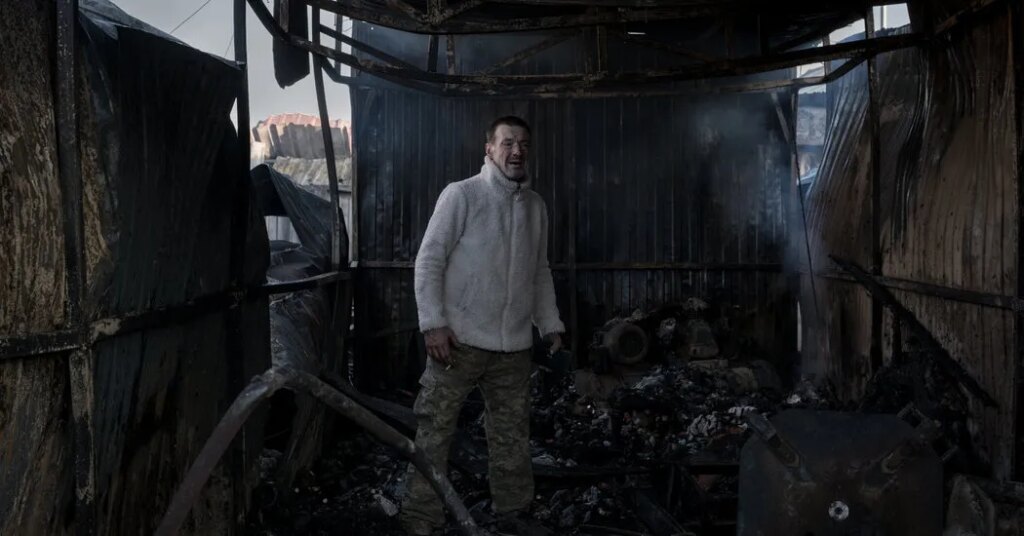
On the east side of the river, a missile set fire to garages over an area the size of a tennis court.
Mrs. Kavunenko, 64, ran there, still wearing her dark-green velvet pajama pants and a light black coat. Firefighters told her that one of the two burned corpses on the ground in front of her was the body of Anatoliy, her husband.
“My brain can’t accept that this black piece of coal is my Tolik,” she said, using his nickname. She held her hand over her heart and took a deep breath.
“Please help me. How can I find out if this is him?”
The Alarm
The Shogun Fight Club shelter doesn’t have room for all students during air-raid alerts, so they attend school in morning and afternoon shifts. Mark’s classes last from 8:30 a.m. until noon. Some days, he never leaves the basement.
Things were better on Wednesday. His fifth-grade class made it through math. In English, the children learned how to pronounce different rooms in a house. At 9:48 a.m., as students practiced the word “bedroom,” an alert went off. Some students cheered. Everyone packed their bags.
The rest of the morning was quiet. Mr. Horskyi, 36, risked driving his motorcycle over the bridge to his office in the frequently battered neighborhood of Lukianivka on the west side.
Mr. Horskyi’s office looks out at two buildings hit by jet-powered drones the week before. Moving trucks had shown up at one building. Mr. Horskyi, who has a business designing motorcycle clothing, had thought about moving, too.
“Sometimes I think that Kyiv is suffering even more than the cities located closer to Russia,” he said. “Right now, it’s like a tricky, tricky question, a tricky choice to leave or to stay. Because actually I love Kyiv.”
About 1 p.m., the air had cleared of smoke, and Oksana Stelmashchuk, 40, who lives a few blocks away, decided to go for a walk with her baby, Sophia. She looked up at an apartment building where pieces of window frames hung from blown-out windows, and stepped back.
Sophia was born into this reality, on Aug. 26, as drones hit a building next to the maternity hospital. Now, her baby was crying, so Ms. Stemaschchuk sat down on a bench in a nearby playground to feed her.
“All the playgrounds in our area are empty now,” she said. At 1:24 p.m., the air-raid alert sounded again. Ms. Stelmashchuk grabbed her phone to check what was flying: only one drone on the outskirts of Kyiv.
“It is still far away, my girl,” she told her baby.
The Jet Drones
At a nearby McDonald’s, which has been hit at least nine times, the menu was a shadow of its former self. All the attacks in recent months meant it had been stripped to the essentials — burgers and fries. There was no Coca-Cola.
At 3:29 p.m., the air-raid alert went off. Everyone inside the restaurant left for the nearby subway station, the customers hurriedly eating fries. Seventeen minutes later, the alarm ended. The workers filed back up the stairs.
Nearby, people waited for a tram. The air-raid alarm sounded again.
“We’re just so tired of it all,” said Heorhii Vasyliev, 52, who travels all over Kyiv for his construction job.
A drone hit in the distance, a low boom. “Oh,” he said, exhaling. “What can you call normal about any of this? Is this normal? Is war normal?”
On and off, off and on, the alerts continued. A drone on the west side of the river set fire to a Soviet-era, five-story apartment building, where mostly retired people lived. A charred piece of a balcony hung from a nearby tree. Firefighters rushed to put out the flames.
Inna Sadova, 68, who lives next door, was in her kitchen when the explosion shook her home. Her building has no shelter.
“The neighboring building has a basement, but a basement like that is more of a mass grave than a shelter,” she said.
The jet-powered drones kept coming, and the list of minor atrocities unknown almost anywhere else in the world continued. Two people died on the west side of the river when debris from a drone interception hit a parked car. Two more people would die on the east side after a drone hit a 12-floor apartment building about nine miles north of the Horskyi apartment.
The power went out in much of the city. The water, too, stopped working in parts of Kyiv. So did trams, trolley buses and parts of the subway on the west side. On the east, an entire district of high-rise apartment blocks blinked out, one after the other.
The Horskyi family made the best of it. They lost electricity for three hours, the first time in months, but it came back on, and they had water. In the early evening, they took their French bulldog, Marcy, for a walk, near a building that had been hit 10 days earlier by a drone, where Mark’s history teacher lives. Mark was fascinated that people still lived on the floor above the strike.
The children ate burgers for dinner. They brushed their teeth, put on their pajamas and climbed into their twin beds in their bedroom.
“I didn’t sleep very well last night,” Mark said. “I’ll probably fall asleep really quickly. I’ll just pass out.”
Still, it was a good day, all in all, the children said. Soon they turned off the lights.
Olha Konovalova and Constant Méheut contributed reporting.
The post What Life Is Like in Kyiv as Russia Tries to Make It Unlivable appeared first on New York Times.