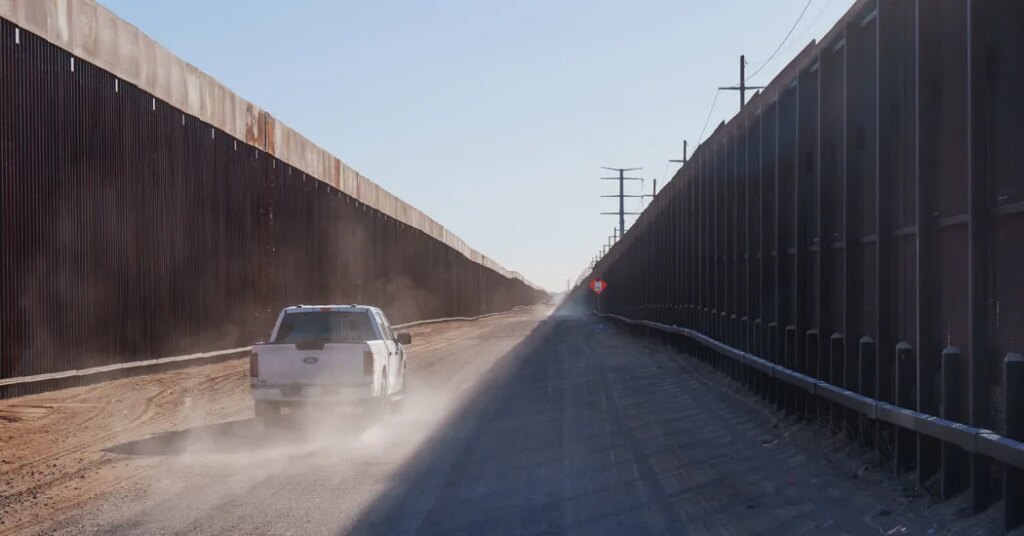
The Trump administration announced on Friday that it was banning unauthorized drone activity along the southern U.S. border with Mexico as part of efforts to curtail criminal cartel operations and other cross-border security threats.
The Federal Aviation Administration issued three temporary flight restriction notices announcing that U.S. skies within one nautical mile of the southern border and up to 400 feet in elevation would be designated as national defense airspace and closed to drones that do not have permission from homeland security officials to operate in the area. Drones that do not comply with the restrictions could be shot down, the notices warn, and their pilots could face civil or even criminal penalties.
The restrictions were set to take effect Monday evening, according to the F.A.A.’s published notices, and scheduled to stay in place for at least a year.
The restrictions, which were announced jointly by the Department of Transportation, the Department of Homeland Security and the Pentagon, come several months after the three agencies sparred over whether and how the Trump administration could use deadly weapons against suspected drone threats near the border.
But the departments’ latest cooperative venture could put a damper on other, nonthreatening drone activity, particularly in heavily populated areas that fall within the new restrictions.
The restrictions outline two mechanisms by which drone operators can seek a waiver from Customs and Border Protection, to send drones closer to the border. The first, a phone number, is reserved for emergency services and first responders who might have to send drones into border areas on short notice. The second is an email-based system, through which drone operators can request waivers from C.B.P. at least 48 hours before planned operations.
That is longer than it currently takes, in certain instances, to secure permission for operating nonemergency drones in sensitive border areas, such as for capturing news footage. The requirements would apply to all sections of the southern border, including urban areas like El Paso, according to government officials familiar with the restrictions.
The restrictions could also potentially affect future plans to expand commercial drone activity, such as deliveries, in populated border areas, according to government officials, who said drone operators would most likely have to seek and secure permission for each planned drone flight through the restricted area.
Representatives for C.B.P. did not immediately respond to a request to explain how they planned to consider requests for waivers, and whether exemptions would apply. A representative for the Commercial Drone Alliance, a nonprofit advocacy group, said the association does not take a position on measures that the administration takes to secure the border.
In a joint news release, Sean Duffy, the transportation secretary, Pete Hegseth, the defense secretary, and Markwayne Mullin, the homeland security secretary, extolled the restrictions as a way to close security gaps along the southern border.
“President Trump promised to secure the southern border, and he did,” Mr. Duffy, the transportation secretary, said in the announcement. “Now we’re doubling down on that promise by protecting our skies from cartel drone threats and other illicit activities.”
Last year, a homeland security official testified on Capitol Hill that in the second half of 2024, officials detected more than 27,000 drones flying within 500 meters of the southern border. Most of those, however, were flying above 400 feet, he told lawmakers — higher than the maximum altitude currently allowed for drones in the United States, and above the upper altitude limit of the new restrictions.
The post Trump Administration Restricts Drone Activity Along U.S.-Mexico Border appeared first on New York Times.