The ship may have sunk as the Great Pyramid of Giza rose, taking resin or wine to ancient sites like Troy before it slipped beneath the waves to be devoured by worms.
Or it could have sailed hundreds of years later, as the Minoans grew rich off trade and built palaces on Crete. Or during the centuries that followed, when Homer’s epics were set, or even long after those days of war and gods.
At least this is certain. The ceramic jars raised from the Mediterranean Sea and the viscous black residue inside them — whatever it is — are very, very old.
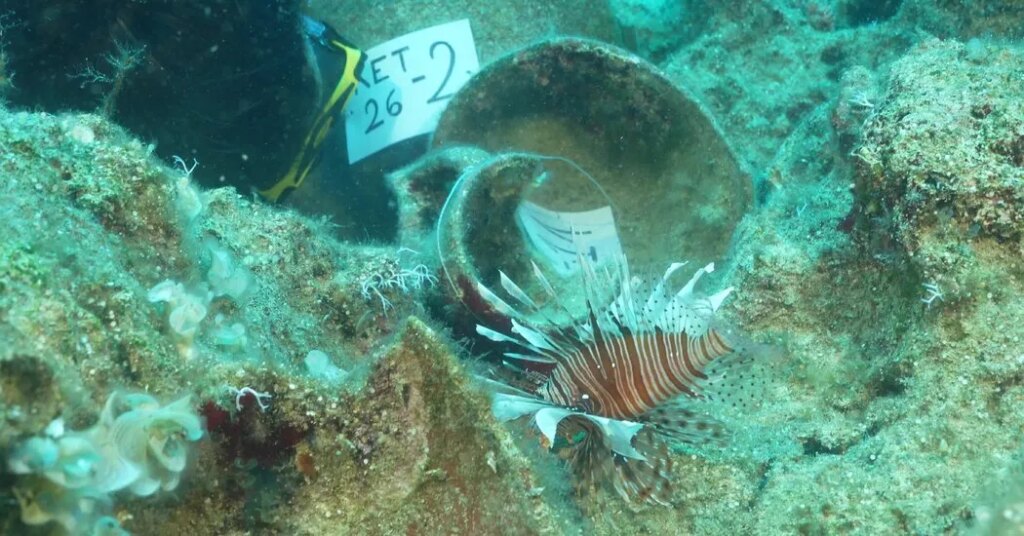
Turkey’s culture minister announced this week that the jars, more than a dozen of which were found off the Turkish island of Kekova, were recovered from “the world’s oldest shipwreck.” By analyzing the jars, called amphoras, researchers dated them to somewhere in the range of 2,400 to 2,700 B.C., the early Bronze Age era when the Great Pyramid was built.
“This is the oldest, definitely,” said Hakan Oniz, the lead archaeologist on the project. “Maybe two years later, we will find another shipwreck or some of our colleagues will from another country, but right now, this is the oldest trade ship.”
Archaeologists who were not involved expressed caution about the claim. “Is this the oldest? Maybe,” said Justin Leidwanger, an archaeologist at Stanford. “We’re all excited by ‘maybe,’ but the burden of proof is pretty high archaeologically.”
There are other Bronze Age wrecks in the same region, outside experts noted, and the evidence at this site is limited to the jars and three anchors. With no trace of the ship itself, at least so far, those are the only clues to the wreck’s age.
The scenarios laid out by the Turkish team — that this is what remains of the oldest shipwreck on record, from a vessel moving along long-distance trade routes of the very ancient world — are plausible, Dr. Leidwanger said. But there were many questions and other possibilities, he said.
“Not knowing is part of the fun, it makes the site all the more important,” he said. “What we don’t know is so much more tantalizing and makes this a great opportunity for more work.”
It is not unusual for nothing of the ship’s hull to survive — traces of wood and other organic material rarely do after thousands of years in the sea. Without pieces of hull for carbon dating, though, some experts raised the possibility that the amphoras could have fallen or been tossed overboard.
“You have to ask the question of whether this could be a jettison site, or did they just park the ship and it just kind of fell over the side as it got hit by a big wave?” said Sean Kingsley, a marine archaeologist.
Others, including Dr. Leidwanger, were confident that this was a wreck, and the Turkish team pointed to the discovery of calcium carbonate tubes, the telltale secretion of the shipworms that have bedeviled wooden vessels for millenniums. They also found three stone anchors — one with one hole, and two with three holes — but scientists said that it’s very difficult to date such anchors and that those designs cross many eras.
That left the jars. Each one has two handles, a raised ridge across the middle and a flat base. The Turkish team enlisted the help of Karin Sowada, an archaeologist who specializes in Bronze Age trade at Macquarie University in Australia, to help analyze the collection, which looked quite distinctive to her eyes.
“We’re reasonably confident that we are talking about an early Bronze Age ship,” she said. The team believes that the jars came from somewhere in the region of modern Lebanon, and Dr. Oniz hypothesized that the ship could have been sailing toward ancient Crete or Troy.
“This actually is a missing piece of the trade networks that we know were operating in the eastern Mediterranean,” Dr. Sowada said.
But debates about pottery are as foundational to archaeology as any excavation, and several outside experts said they wanted to see more research before they would be convinced of the amphoras’ age.
“This is the most important landscape for Bronze Age shipwrecks in the Mediterranean,” Dr. Kingsley said, noting several significant and well-studied wrecks in the region.
Those include two wrecks found in the 1980s that one expert said appeared to hold amphoras similar to those as the Kekova site, but which were estimated to be from somewhere in the 12th to 15th centuries B.C. Another expert suggested the jars from the Kekova site bear a strong resemblance to amphoras from a medieval shipwreck of the Byzantine era.
In response, Dr. Ozin called skepticism the rule in his field. He noted that the team recently published an article in a scientific journal, adding “we have more data now and we are sure for dating.”
All the scientists were eager about the prospect of more research, especially on the residue inside the jars, which Dr. Sowada described as a “black glossy coating.”
“It’s very exciting,” she said. “I was not expecting jars over 4,000 years old to have some of their contents left inside.”
She and other experts said that the substance could be the remains of any number of things, like tree resin, a kind of oil or even a concoction of different materials as the jars were emptied and refilled. “These jars represent a snapshot of trade commodities that are moving around the Mediterranean,” she said.
It is not clear if any of the remaining organic material can be carbon dated, but scientists are excited by what additional research might reveal. What were the lives of sailors like, or those conducting trade in an era before coins? What clues might there be about the aristocrats and kings sending or receiving gifts, or about the ways the goods, art and culture moved long distances across the ancient world?
“I suspect we’re seeing something new that we don’t know about and has never been seen before,” Dr. Leidwanger said. “Where exactly this thing was coming from — until we have more archaeology to complete the picture we’re somewhat in the realm of guesstimation.”
As for what is the world’s oldest shipwreck, if not this one, that too is a matter of debate.
In 2019, archaeologists found an extraordinarily preserved tall ship, about 500 years old, in the Baltic Sea. Five years later, Israeli authorities announced they had found what might be the oldest complete wreck, dating to around 1,300-1,400 B.C., the time of Tutankhamen. That is also around the time of a wreck found off Turkey and dating to the Bronze Age, called the Uluburun, in which a trove of artifacts was found.
As for incomplete sites, one was found in 1975 off the Greek island of Dokos that researchers dated to about 2,200 B.C., although some archaeologists now are unsure whether it is in fact a shipwreck, a sunken settlement or something else.
The post The World’s Oldest Shipwreck? Maybe, but ‘We’re All Excited by Maybe.’ appeared first on New York Times.