This article is part of Overlooked, a series of obituaries about remarkable people whose deaths, beginning in 1851, went unreported in The Times.
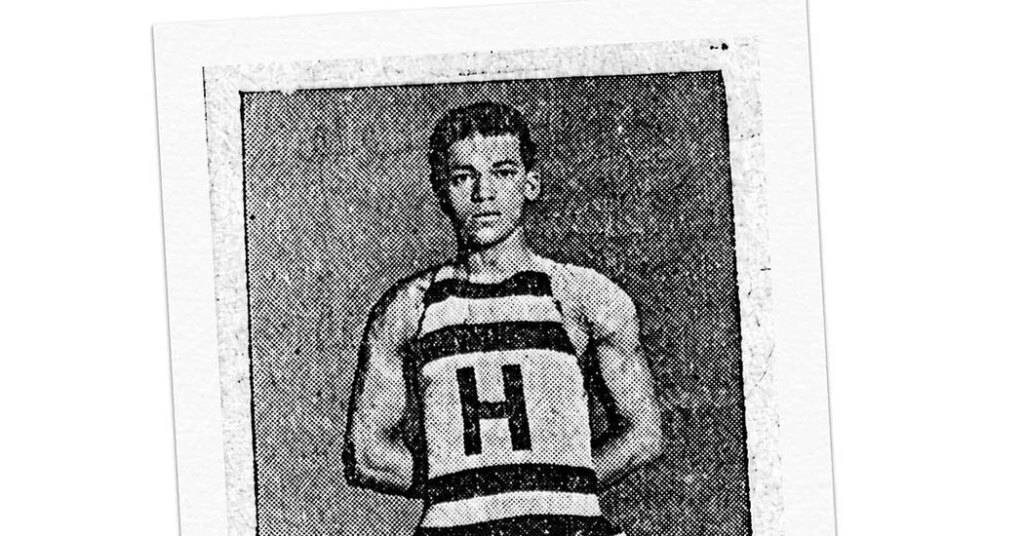
On the night he made history by stepping onto a basketball floor, Harry Lew never expected to leave the bench.
James Gray, the manager of the Pawtucketville Athletic Club in Lowell, Mass., had invited the 18-year-old Black amateur to travel with his all-white professional team in 1902 — but only after local newspapers had pressured him to give Lew a chance. Gray told Lew, who at 5-foot-8 was of average height for players at the time, he would be the team’s lone backup and spend its first game watching from the bench.
Even when a teammate was injured during that contest, in Marlborough, Mass., Gray initially refused to put Lew in, opting to play short-handed instead.
The decision provoked an uproar among the crowd that had traveled from Lowell to cheer for the visiting team.
“The fans got real mad and almost started a riot, screaming to let me play,” Lew, who went by Bucky, later recalled.
When Gray eventually relented, Lew became the first Black player to enter a professional basketball game, on Nov. 6, 1902.
Basketball was a young sport, invented only 11 years earlier by James Naismith in Springfield, Mass. The game was spreading rapidly, and newspapers were increasingly covering its contests and players.
Yet Lew’s breakthrough barely registered. He was scarcely mentioned in game recaps, though one newspaper noted that he played “well.”
His talent soon became harder to overlook. Fans noticed his defensive prowess, and Gray could no longer keep him out of the team’s lineup.
“Lew is a gentle little man to look at, but when the whistle blows, he becomes a whirlwind,” The Lowell Daily Courier wrote on Dec. 12, 1902. By the end of the season, another called him a “star.”
But even as Lew established himself on the court, he faced challenges in a sport that wasn’t ready to welcome him.
“All those things you read about Jackie Robinson, the abuse, the name-calling, extra effort to put him down … they’re all true,” Lew told The Springfield Union in 1958. “I got the same treatment and even worse.”
Harry Haskell Lew, known as Bucky since youth, was born on Jan. 4, 1884, in Lowell. His father, William, and his mother, Isabelle (Brown) Lew, ran a dry-cleaning business that also dyed fabrics for the city’s textile mills.
Some of Harry’s family members had played significant roles in history: His great-great-grandfather Barzillai Lew had served in the Revolutionary War as a soldier and fifer at the Battle of Bunker Hill in 1775. (The jazz bandleader Duke Ellington later named a song after him.) And Harry’s grandparents, Adrastus and Elizabeth Lew, had made their home a stop on the Underground Railroad in the mid-1800s.
Harry grew up in that house, on Mount Hope Street, the eldest of four children. He started playing basketball for the Lowell Y.M.C.A. team at 14. Four years later, Gray invited him to join one of Lowell’s two professional teams — begrudgingly.
“Some of the local papers put the pressure on by demanding that they give this little Negro from around the corner a chance to play,” Lew said in 1958.
The Pawtucketville Athletic Club belonged to the New England Basketball League, one of several leagues that popped up around the Northeast in the sport’s early years. The game looked a lot different in the pre-N.B.A. days. There were often no backboards, out-of-bounds lines or double-dribbling calls. Games were extremely physical, even violent, as teams scrapped for the ball. And the players were invariably white.
Though he took many elbows and knees from his white counterparts, Lew excelled, gaining the respect of many teammates and opponents alike. “I gave it right back,” he told The Springfield Union in 1958, adding that some of those foes “turned out to be among my best friends in the years that followed.”
After a year with the Pawtucketville Athletic Club, Lew signed with a new member of the league, in Haverhill, Mass., about 20 miles from his home. There, Lew swiftly became a fan favorite, often guarding the other team’s star.
But he still faced discrimination. In 1904, Harry Hough was widely considered to be the best basketball player in the world, and Lew quickly gained a reputation for defending him as well as anybody.
Some reports said that was why, during one game against Haverhill, Hough and his teammates on Natick refused to try if Lew was on the floor. The Newburyport Daily News reported that it was against Hough’s principles “to play against a colored man.” Lew sat out so that the game could continue, but the league later fined Natick. Lew completed the season and led Haverhill to the league championship, which it lost to Natick.
The league folded shortly after. For the next two decades, Lew played on squads that traveled around New England. He also coached a local college team and officiated games, breaking barriers in both of those professions. When he retired from basketball in his 40s, he turned his attention to managing his family’s dry-cleaning business full time.
He married Florence Smith in 1906 and, in the late 1920s, they moved with their four children to Springfield, where Lew spent the remainder of his life. On weekends, he watched boxing matches and listened to opera. He rarely talked about his basketball days, his granddaughter Wendy Johnson said in an interview. She said she only heard about them when she was picked on as a child.
“You’re not going to be able to please everybody,” he would tell her. “But you do your best. And in your heart, you know you’ve done your best.”
Decades after his historic moment, Lew’s daughters urged him to talk about his experience, which led to the interview with The Springfield Union.
Still, many hoops aficionados remain unaware of Lew.
“I was a lifelong basketball fan, and I didn’t know any of this history, even though it happened in my own backyard,” said Chris Boucher, an author from Lowell who went on to write “Harry ‘Bucky’ Lew: A Biography of Basketball’s First Black Professional” (2026).
Lew died of prostate cancer on Oct. 22, 1963, in a hospital in Springfield. He was 79. He was buried just a few miles from where the Naismith Basketball Hall of Fame opened five years later.
After years of advocacy by Lew’s daughters, with support from the Center for Lowell History, the Hall of Fame featured him in a 2001 exhibit on the game’s Black pioneers. In accompanying materials, the museum declared that although the N.B.A. stars Shaquille O’Neal, Kobe Bryant and David Robinson never met Lew, “the first African American to play professionally,” they “owe him a debt of gratitude.”
The Naismith Hall of Fame never inducted Lew. In August, he was inducted into a different institution, the American Basketball Hall of Fame, in Detroit. Johnson, his granddaughter, accepted the honor on his behalf, thanking Boucher, among others, for keeping her grandfather’s story alive.
“He is being remembered,” she said, “and I appreciate that with all my heart.”
The post Overlooked No More: Harry Lew, the Basketball Player Who Refused to Be Sidelined appeared first on New York Times.