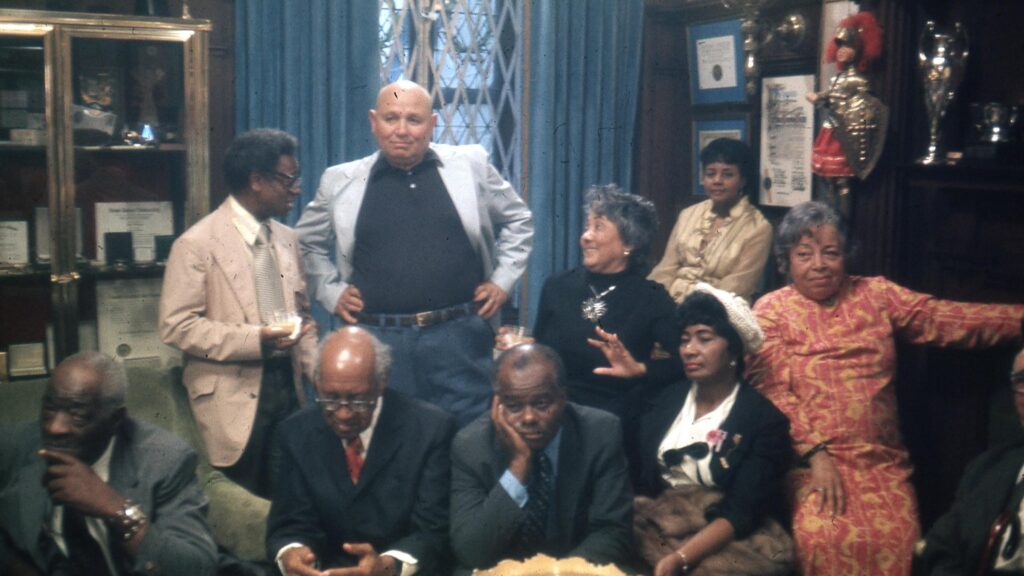
In 1972, filmmaker William Greaves arranged what we now know was one of the great parties of the 20th century: He commandeered the Harlem apartment of Duke Ellington and arranged for a special group of old friends and colleagues, many of whom had not seen one another in 50 years, to reconnect. The invitees were key figures of the Harlem Renaissance, including muralist Aaron Douglas, poet and novelist Arna Bontemps, society editor Gerri Major, jazz pianist and composer Eubie Blake, and many more. Greaves’ aim was to film the event—he appointed his son, David, as one of the cinematographers—and turn it into a documentary that would serve not just as a record of how these people lived and what they accomplished, but as a way of thinking about how we honor those who are a repository for our past. For a few hours in 1972 Harlem, it was circa 1925 again. This group of people laughing, arguing, and reminiscing about a great era of American history—and also about members of their cohort who were long gone—recaptured lightning in a bottle. And yet the resulting film, Once Upon a Time in Harlem, is one we almost didn’t see.
Greaves, who’d made a name for himself with experimental documentaries like Symbiopsychotaxiplasm: Take One (1968), as well as establishing the pioneering public television program Black Journal, considered his Harlem Renaissance film to be one of the most important projects of his life. But although he worked on it off and on for years, he wasn’t able to complete it before his death, in 2014. At last, the film he envisioned has been brought to life by David Greaves and his daughter—William’s granddaughter—producer Liani Greaves. Once Upon a Time in Harlem is one of the great documentaries of its era, and certainly of this year. It’s history that breathes.
_Gerri_Major_in_ONCE_UPON_A_TIME_IN_HARLEM_Courtesy_of_NEON_copy.jpg)
Ellington’s elegantly appointed flat fills up quickly; for the viewer, it’s like dropping into a party right in the middle, as clusters of beautifully dressed people greet one another, embracing, laughing, talking. (Ellington himself was ill and unable to attend.) The guests make themselves at home: Photographer James Van Der Zee, who took extraordinary portraits of the major “show people” of the 1920s, as well as everyday citizens of Harlem, steps up to Ellington’s piano and runs through a few graceful, rippling phrases. We learn that he was trained as a classical musician before turning to photography, just one reminder of the ways people in the arts often need to find a means to support themselves—and sometimes those means can leave us with a lasting record of an era, as we can see from Van Der Zee’s gorgeous, expressive portraits, which flash on the screen like a blessing. Painter and activist Richard Price Nugent, when asked what it was like to be a part of the Renaissance, can’t really say. “While you’re living it, it is the now,” he reflects. Actor Leigh Whipper, the first Black man to join Actors Equity and one of the oldest in the group, and publisher and bookseller Richard B. Moore, recite long poems and passages from the era by memory. Moore calls up Claude McKay’s brilliant, lacerating poem “If We Must Die” as if he’d just learned it yesterday, but you know he’s been living with it for years.
Conversations swell through the room in waves, often prompted by Greaves himself, who was not just a filmmaker but also a poet and sculptor, a man who acted and danced. (The film has been brilliantly edited by Anne DeMare and Lynn True.) Ida Mae Cullen, the peppery widow of poet Countee Cullen, pipes up to remind the group, vigorously, that the Harlem Renaissance really lasted for just one decade, the 1920s, though its ripples began years before and resonated for decades after. For this group, politics and art are so entwined as to be indistinguishable. At one point, a vigorous yet civil cross-talking argument breaks out over the principles and philosophy of Back-to-Africa activist Marcus Garvey: there’s mutual respect in this room, but no such thing as consensus. Among other things, Once Upon a Time in Harlem might make you yearn for an era when people, including intellectuals, really knew how to dress: society editor Major, resplendent in a bold, patterned dress, sports about 10 glittery bracelets on each wrist and pulls it off with aplomb.
_Aaron_Douglas_Jean_Blackwell_Hutson_Richard_Bruce_Nugent_Eubie_Blake_and_Irvin_C._Miller_i.jpeg)
What’s striking about Once Upon a Time in Harlem is the seemingly casual quality most of these captured conversations. But casual isn’t the same as insignificant. Regina Andrews, a regal woman decked out in a white lace dress and vivid turquoise earrings and necklace, speaks of the job she started as a young woman, as a librarian at the 135th Street branch of the New York Public Library. Shortly after she was hired, her superiors explained that certain poets and authors would often come to the library to work; they had special rooms reserved for them. She and her roommate became friendly with many of these luminaries, among them Cullen and Langston Hughes, and would often host little get-togethers in their apartment. The problem? They didn’t have enough dishes to go around. And so one New Year’s Day, when Andrews and her friends set out on a tour of the area’s Chinese restaurants, the men—unbeknownst to her—collected a few plates here and a few cups there. Suddenly, Andrews had enough dishes and cutlery for everybody, pieces she treasured for years.
Maybe that sounds like a minor thing, having enough dishes to entertain your friend group of poets and writers. But as Andrews tells that story, it feels anything but small. “It was just the joy of living and creating together,” she explains—as good a summation as any of what it must have been like to be alive in such a glorious time, a “now” that, thanks to Greaves and his family, becomes a part of our lives too.
The post Once Upon a Time in Harlem Is One of the Great Documentaries of the Year appeared first on TIME.