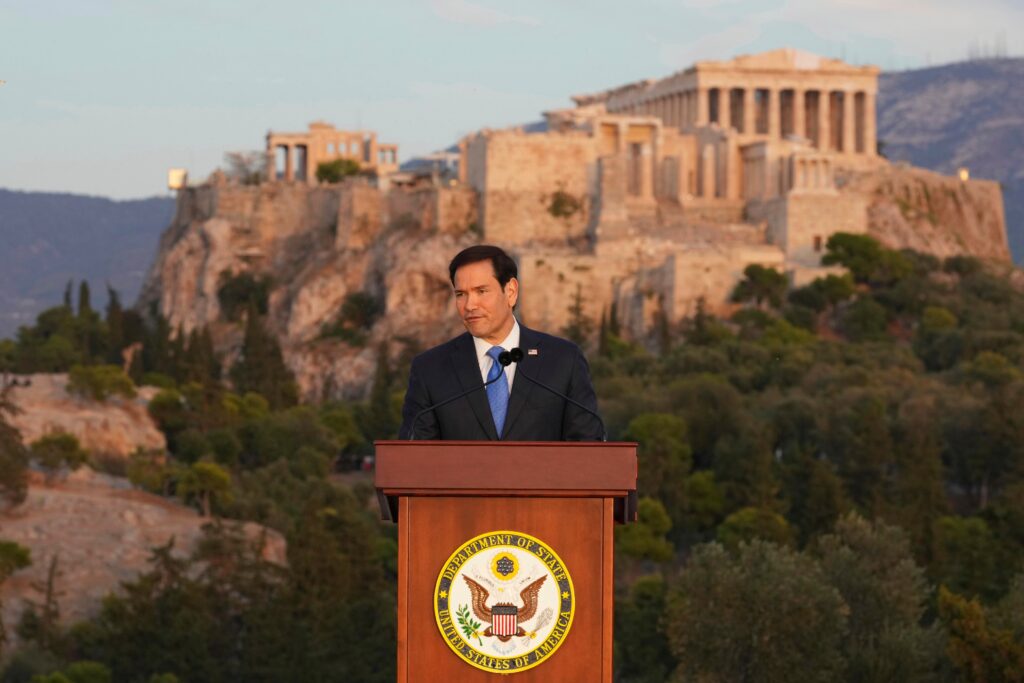
In a well-written speech last week delivered against the magnificent backdrop of the Acropolis in Athens, Secretary of State Marco Rubio urged the West to rediscover what makes it exceptional. He described the qualities that define Western civilization as “the fire of passion, strength, courage, pride,” and he celebrated its ambition, nationalism and relentless pursuit of excellence. He warned that the West has become ashamed of the very things that made it great.
Rubio is right that the West has sometimes lost confidence in its own traditions and ideals — and that it shouldn’t. But Rubio himself seems deeply confused about what makes the West exceptional.
Consider the qualities he celebrates: courage, strength, ambition and pride. Genghis Khan had all of these in abundance. So did Persian emperors, Russian czars and rulers of imperial China. Every great civilization has celebrated its warriors, glorified its conquests and believed in its own superiority.
What truly distinguishes Western civilization is not its military power or national pride, but its intellectual and political traditions. From Greek philosophy and Roman law through Christianity to the scientific revolution and the Enlightenment, the West developed a set of ideas that challenged the arbitrary exercise of power. Reason, scientific inquiry, individual liberty, democracy, the rule of law and universal human rights became central to Western civilization and set it apart.
Other cultures have traditions of morality, justice and human dignity. But in the West, these ideas evolved into revolutionary political propositions: that every human being possesses certain rights simply by virtue of being human, that governments exist to secure those rights and that no ruler or tradition is above scrutiny. The most radical feature of these tenets — inspired in part by Christianity — was that they were universal. They applied not just to Westerners but, in principle, to everyone.
Consider slavery. The West practiced slavery on a vast and brutal scale, as had virtually every major civilization in history. But the West also produced a powerful abolitionist movement, drawing on Christian beliefs, Enlightenment ideals and the struggles of enslaved people themselves. Western societies developed principles that could be used to condemn their own conduct.
Similarly, for centuries Western societies treated women and religious and racial minorities as second-class citizens, as did most other civilizations. But Western ideas about equality and individual rights helped generate movements for women’s suffrage, religious tolerance and civil rights. These movements did not reject the West’s highest ideals. They demanded that the West live up to them. The Rev. Martin Luther King Jr. appealed to the Declaration of Independence’s idea that “all men are created equal” precisely because its promise was universal, even if American society had repeatedly betrayed it.
This is also true of imperialism. Almost all great powers have sought to extend their dominion. The West was extraordinarily successful at it, and one can marvel at its enormous reach. But Western societies also ended up recognizing the rights of colonized peoples, questioning the morality of the conquest and acknowledging the brutality of colonial rule. This capacity for self-criticism is not a weakness. It is one of the West’s greatest strengths that it can push itself to live up to its own ideals. It is also, in part, the relentless use of reason that has made the West lead the world in science and discovery.
And this brings us to perhaps the most important point Rubio misses: The West’s extraordinary influence over the modern world has not come simply from military conquest or economic domination. It has come from the intellectual attraction of its ideas. Western power was often resented, resisted and ultimately expelled. Yet the ideals associated with the West have endured because people everywhere can claim them as their own.
The British ruled India for nearly two centuries, often through exploitation, repression and violence. Yet when Indians won their independence, they did not discard parliamentary democracy, constitutional government, an independent judiciary or the rule of law. They embraced these institutions, adapted them and combined them with their own traditions. India adopted universal adult suffrage from the birth of its republic, an extraordinary commitment to political equality in a poor, largely illiterate country. That is the remarkable power of the West’s formulation of “universal ideas”: Anyone can embrace them and gain power through them.
Rubio is right that the West should take pride in its history and achievements. But while the things that Rubio emphasizes — strength, courage and national glory — do make the West mighty, they are not what make it transformational. Its most enduring achievement is not that it conquered territory, built mighty armies and monuments or produced wealth. The Ottoman Empire did all these things.
What makes the West exceptional is its ability to transcend the narrow claims of tribe, nation and empire, and to develop ideas about freedom, equality and human dignity that could speak to all people, everywhere. The West conquered much of the world through force. But it changed the world through ideas. I wish that the secretary of state of the United States would celebrate these ideas — and that this administration would live up to them.
The post Marco Rubio misunderstands what makes the West great appeared first on Washington Post.