Baseball is an American pastime. So, too, is taking to social media with an opinion.
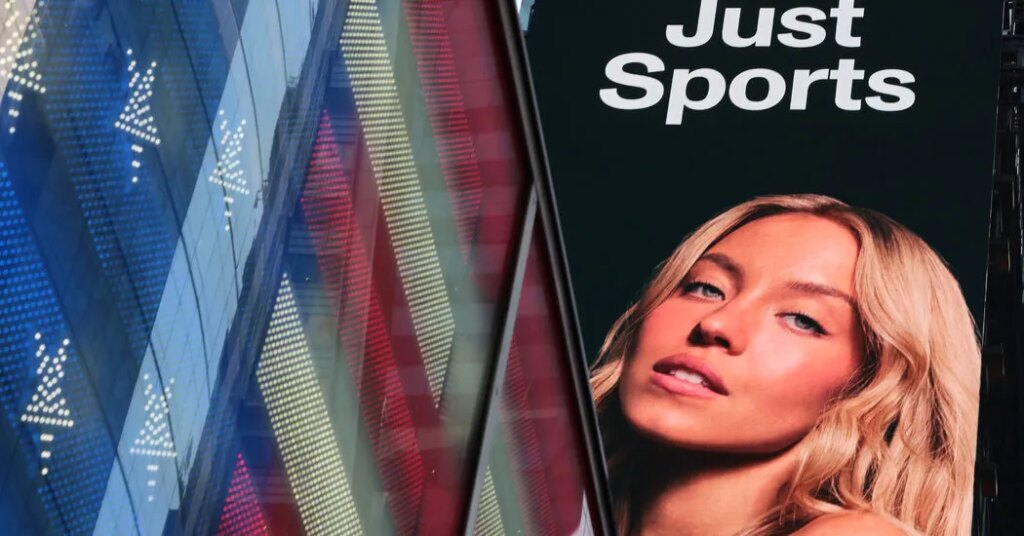
The two sandlots of democracy overlapped this week, as a series of steamy commercials aired ad nauseam during the Major League Baseball playoffs. Casual fans had much to say about sexualized ads featuring Sydney Sweeney promoting a gambling prediction market and Megan Fox endorsing a male enhancement product.
Then, on Wednesday, a player entered the fray.
“Can we please get the soft porn ads off playoff broadcasts,” Alex Call, a left fielder for the Los Angeles Dodgers who was not on the postseason roster, wrote on social media. (The Dodgers missed their chance at reaching another World Series after losing the National League Championship Series to the Milwaukee Brewers on Thursday.)
“My son wants to watch baseball with Dada,” but, he warned, “half-naked women could come on screen anytime.”
His post was a reply to one by Taylor Murphy, an entrepreneur who wrote that the commercials risked alienating children from the sport: “Just show baseball in a way I can leave on in my house.”
“It’s actually infuriating,” a mother wrote in reply to Mr. Call. “I had to explain to my 10 year old son that they are trying to exploit his young brain.”
The morality of the commercials is in the eye of the remote holder, but how an advertisement makes it to air is — mostly — up to the networks.
Here is how a commercial is cleared for broadcast, how it’s approved and who has the authority to yank it from the airwaves.
Who approves an ad?
First, a network has to earn the right to air M.L.B.’s much-watched playoff series. At one point last year, the league’s postseason averaged nearly 4.5 million viewers, the most since 2017. And those eyeballs largely stay glued to their screens as commercials churn between innings or breaks in play.
This year, Fox Sports and TNT Sports share the rights to air certain postseason games on television. In 2018, Fox extended its contract with M.L.B. through 2028 for $5.1 billion, according to people with knowledge of the deal. Fox Sports and TNT Sports did not respond to requests for comment.
Reached on Friday afternoon, M.L.B. did not comment. Novig did not respond to a request for comment, and Ro, the company whose product was promoted by Ms. Fox, did not immediately respond to a request.
The networks determine the slots for the ads, which industry experts say can range in the hundreds of thousands, and earn money from the sales to advertisers and their creative agencies, and then pay M.L.B. a fixed fee.
“The lawyers that would review the slot would be on the agency side or the client side, and then it gets shipped off to the networks,” said Kevin McTigue, a professor of marketing at the Kellogg School of Management of Northwestern University.
Sports rights spending in the United States has increased over the last decade to more than $30 billion annually, according to a 2026 report by AlixPartners. Its research also found that Fox held an estimated 13 percent of the total market value of sports media rights in the United States. Under Warner Bros. Discovery — now owned by Skydance — TNT Sports and HBO Max accounted for 3 percent.
There are no-nos, and fine print.
Each network has its set of standards for what’s acceptable for a broadcast, but professional sports programming adds a wrinkle.
M.L.B. outlines its “Advertising Standards & Rules for Baseball Programming.” It lists limitations on what can be aired; for example, tobacco or e-cigarette products are prohibited from being advertised during games.
But here’s where it gets tricky: M.L.B. also stipulates that commercial content may not include “sexual enhancement products” or sports-betting advertisements.
“Huh?” you might think as Ms. Sweeney and Ms. Fox pop up for the umpteenth time between innings. That’s understandable, but look closer at the fine print.
Such content is prohibited unless “approved in advance in writing by M.L.B.” And a clause notes that there is room for an “approved sports betting operator.” Novig, the prediction market that Ms. Sweeney promotes, is “M.L.B. authorized,” according to its site.
Marc Edelman, a professor of sports law at the Zicklin School of Business of Baruch College in New York, said that he was more taken aback by the league’s changing position on gambling than how it is advertised. Given professional baseball’s checkered past with game betting, the relatively recent reversal has been stunning.
“A red flag is not the content of the advertising but the underlying product,” Professor Edelman said.
In the past, players were not even allowed to endorse casinos, Professor Edelman said.
“It’s a colossal reversal of position,” he said.
When a commercial gets pulled from its slot.
Ads are rarely taken down after they air, Professor McTigue said, as they are first vetted by network lawyers. So even when a commercial generates controversy, there are legal guardrails established before broadcast.
“Back in the day, the major news networks, you’d have to send it to them ahead of time so they could preclear it,” he said. “Then they would say, ‘OK, that’s fine.’ For cable, you didn’t have to do that.”
Fox Broadcasting’s commercial broadcasting guidelines state that, if needed, two copies of an ad must be delivered at least five business days ahead of the air time.
But the league has the final say, according to its regulations. It “reserves the right to, in its sole judgment, reject or instruct any Baseball Programming Partner to cease the use of any advertising,” according to the standards document.
What other advertising controversies have there been?
When the original Novig ad aired last month, critics panned it as overly sexual in an attempt to appeal to male viewers. The commercial also sparked backlash from female athletes.
Last month, the shoe and apparel brand Converse removed an advertisement that critics said was evocative of Ku Klux Klan imagery. The company apologized and said it would remove the ad everywhere it was shown.
In 2024, a British advertising watchdog group ruled that posters for the Calvin Klein fashion brand, which depicted the singer FKA twigs with part of her breast exposed, could not be shown in Britain. The singer then pointed in a social media post to “double standards” in what many saw as a reference to another Calvin Klein ad, which featured the actor Jeremy Allen White in his underwear and remained up.
“When you talk about what’s OK, it’s so interesting how it varies by year and by culture,” Professor McTigue said.
But the advertisers largely have in mind the customer base they’re trying to reach, he said, and how they respond to the ads.
“I think we’re seeing a little bit more where people are trying to push buttons to gain more eyeballs,” he added. If the companies “know that the target they’re going after is not going to find it offensive, and it’s just bothering other people, then it really doesn’t have a negative impact.”
The post Foul Play? Racy Baseball Postseason Ads Are Drawing Pushback appeared first on New York Times.