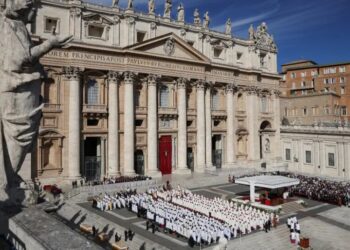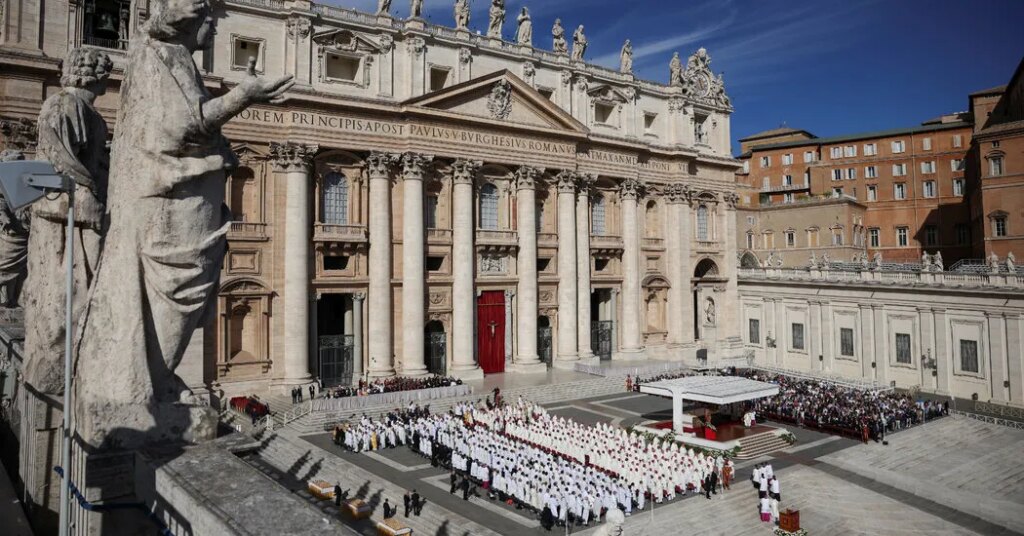
For at least 90 minutes on Tuesday, Pope Leo was unconscious under general anesthetic, raising the question of what happens when a pope is incapacitated and cannot lead the Catholic Church.
The short answer is nothing. The church has rules for some situations, like when a pope dies or resigns, or cannot freely govern (for example when a pope is imprisoned, as Pope Pius VI was by Napoleon, an unlikely scenario today). But it doesn’t have specific rules in cases in which the pope is seriously ill or, say, in a coma.
In the event of the pope’s temporary hospitalization, the Vatican’s sprawling administration runs on its own, a scenario that Vatican watchers experienced time and time again during the repeated hospitalizations of St. John Paul II and Pope Francis.
For decades now, a suite of rooms at Rome’s Gemelli Hospital have been outfitted for the pope. John Paul went so often he began to call it “the third Vatican.” (That suite is currently being renovated, so Leo is recovering in nearby rooms.)
Even there the pope remains in charge.
“There is no deputy pope,” said Alberto Melloni, a church historian. If there are decisions or appointments to be made, “they can be brought to the pope while he’s in the hospital.”
And from accounts so far, Leo’s recovery suggests that he will be back in the Vatican within a week, as the Vatican had anticipated.
Leo’s doctors said Wednesday that the pope’s recovery from surgery was progressing as expected. In a statement issued by the Vatican, his doctors said that Leo was doing respiratory exercises, had begun walking and ate both breakfast and lunch.
Matteo Bruni, the Vatican spokesman said the pope was in a “good mood,” without elaborating.
As it is, the daily running of the Vatican and the global church is delegated to a team of officials — headed by the secretary of state, Cardinal Piero Parolin — who ensure that its administration runs smoothly.
The Holy See is the central governing body of the Roman Catholic Church and includes dozens of distinct offices or departments that in turn oversee specific areas, like evangelization, the clergy, education or the economy. The Vatican’s Secreteriat of State alone is like a combination of a ministry of the interior and a ministry of foreign affairs, overseeing general management as well as relations with other states and the church’s embassies abroad.
“We know that day-to-day operations continue as usual — in the sense that no one is prevented by any rule from continuing to do what they do,” said Giovanni Maria Vian, a church expert and former editor of L’Osservatore Romano, the Vatican newspaper. “Let’s say it’s a machine that runs normally and automatically, so to speak.”
The Rev. Filippo Di Giacomo, a canonical expert and commentator, pointed out that the church has had centuries to fine tune its workings.
“The entire Vatican structure, and that of the clergy as well, has been constructed over the centuries in such a way that even when an ecclesiastical government is forced to slow down, it will never collapse,” he said. “The Church’s legal wisdom lies in the ‘deep state’ that keeps the Vatican afloat,” he added. It “doesn’t go into crisis just because the pope is ill.”
This is not to say that the question of what to do if a pope is physically incapacitated has not emerged, like with the papacy of John Paul II, who suffered for a decade from Parkinson’s disease and other health issues.
“One of the factors that certainly influenced Benedict XVI’s decision to renounce the papacy was the fact that he didn’t want that to happen to him,” said Mr. Vian of Benedict’s decision in 2013 to resign as his own health began to fail.
Last Sunday, Leo announced during his weekly prayer that doctors had found a growth on his lung, and that his doctors made the decision to operate, which they did two days later. The Vatican has not said when the nodule of the pope’s lung was first discovered, only that it emerged during routine checkups.
On Wednesday, Mr. Bruni said that the histological results of the tumor would “take time.” He also said the pope still hoped to travel to South America next month.
Some Vatican watchers have pointed to two recent appointments — important roles during the period of papal transition — as proof that the pope was putting his house in order ahead of the surgery.
Last week, Leo approved the appointment of Cardinal Luis Antonio Tagle, 69, as the new dean of the College of Cardinals, a key position during a papal transition.
He also appointed Archbishop Vittorio Viola as Archpriest of the Papal Basilica of St. Peter in the Vatican and Vicar General for Vatican City. While most cardinals lose their positions in the case of a papal death or resignation, these key roles remain in place.
The post While Leo Recovers From Lung Surgery, the Church Runs on Autopilot appeared first on New York Times.