Democracies are built on compromise. But sometimes a compromise can turn dangerous.
I see this dynamic at play in two democracies with which I closely identify: the United States and Israel. When I was a boy growing up behind the Iron Curtain, America was an icon of liberty to me. As a young Soviet with a Jewish father, I grew up to become a staunch supporter of Israel, an outpost of liberalism surrounded by illiberal, Moscow-backed Arab states.
While I rejected the anti-Americanism and anti-Zionism of the Communist regime under which I was raised, I also sought a textured understanding of the United States and Israel. I learned early on that the United States had reached a breaking point just 84 years after independence. America’s founders included men who owned slaves and men who did not. They could not both midwife the union and challenge the “peculiar institution.” This guaranteed the birth of the United States but cursed the young nation with an affliction that nearly caused a permanent rupture.
With elections just weeks away, Israelis find themselves at a similar juncture. Nearly eight decades ago, at the time of Israel’s establishment, the nation’s early leaders made a pact with the ultra-Orthodox, granting them special privileges. The pact haunted their descendants and today is sustained by a nationalist far right and an unscrupulous prime minister willing to bend the law to stay in power.
There is, of course, no moral equivalence between the Haredim, as the ultra-Orthodox are called in Israel, and slave owners. In the case of the United States, the compromise of allowing the evil of slavery was incompatible with a free society, whereas a religious lifestyle can coexist with democracy. In Israel today, however, ultra-Orthodox political power is corroding the social compact that holds the country together.
When Israeli voters head to the polls this month, one of the many choices they will face is whether the Jewish state leans in the direction of a secular Hebrew republic or a rigid rabbinical theocracy.
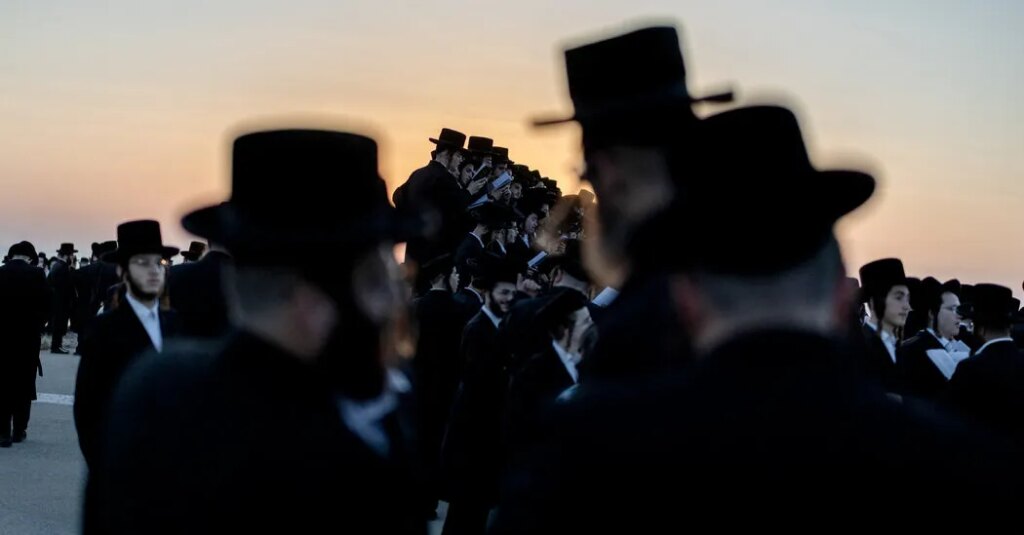
The ultra-Orthodox Haredim represent about 14 percent of Israel’s population. They nonetheless influence many aspects of daily life and benefit from generous public funding, exemptions from military service and disproportionate clout in the Knesset, the parliament.
The roots of this influence can be traced back to Israel’s earliest days. In the shadow of the Holocaust, David Ben-Gurion, the Jewish state’s first prime minister, made a deal with the ultra-Orthodox. The Haredim, whose communities had been devastated in the Nazi genocide, would not have to send a group of their sons to fight in the Israel Defense Forces. Further, the state would observe certain Jewish religious laws. In exchange, the non-Zionist ultra-Orthodox would buy into his state-building project. Many Haredim did not support the establishment of a secular Jewish state. They objected to the secular nationalism of Israel’s founders, and believed the messiah should return to Earth before Jews returned en masse to Palestine.
Israelis of Ben-Gurion’s generation may not have understood the kind of foundation they were laying. They may have presumed they were simply handing out draft exemptions to a few hundred young men. Many of the American founders similarly expected slavery to peter out over time.
Instead, slavery expanded significantly after 1776, just as religious influence in Israel exploded in the decades following 1948. The draft exemption became especially infuriating to secular Israeli Jews after Oct. 7 and the war in Gaza. And that’s not the only way ultra-Orthodox influence has grown toxic.
Life-cycle events for all Israelis, from marriages and divorces to funerals, are tightly controlled by the ultra-Orthodox rabbinate. For same-sex and interfaith ceremonies, or for Israelis whose Jewishness is simply not recognized by the rabbinate, weddings are often conducted in Europe. Israel’s temporal authorities recognize these marriages, but the fact that they must happen abroad is a severe imposition by the Jewish state’s religious leadership.
Access to many public services is restricted on Shabbat, the Jewish sabbath, even though millions of Israelis are not observant.
The ultra-Orthodox parties in the Knesset are so single-minded that it seems they will support anyone, no matter how clouded by accusations of misdeeds, who preserves their special privileges. This is how the Haredim have become indispensable accomplices and supporters to Prime Minister Benjamin Netanyahu’s far-right coalition.
In short: Without the ultra-Orthodox, Mr. Netanyahu would not have backing for many of his authoritarian endeavors, such as his effort to suppress judicial independence or fire the country’s independent attorney general. Without Mr. Netanyahu, the ultra-Orthodox would lose their protected status. The Haredim have few friends outside Netanyahu’s coalition, and even among the right they are losing support. Prominent members of the prime minister’s own party, like Yuli Edelstein, have left because they do not support aspects of the ultra-Orthodox monopoly. The center-right opposition is campaigning on lifting the military exemption of the Haredim once and for all.
Other democracies have found themselves afflicted by the compromises made by their early leaders. Canada’s British founders brought the Quebecois into the fold by making significant concessions on linguistic and religious freedom, only for the federal government to face recurring secession crises among independence-minded French speakers. In Bosnia, with its decentralized system of ethnic enclaves, a system created to end one war might lead to another.
When I was growing up in the Soviet Union, Communist thugs enforced atheism and suppressed Jewish culture. This is not what I want for Israel. I simply believe in equality before the law and an Israel that embodies its founders’ aspirations of being a “light unto the nations,” rather than an international pariah held back by far-right and religious special interests.
Just as Abraham Lincoln observed that the government could not persist “half slave and half free,” Israel cannot go on half theocratic and half secular. Americans resolved that contradiction over four years of brutal civil war. Israel’s election on Oct. 27 offers a bloodless way out of this morass.
Garry Kasparov is a former world chess champion and Russian political dissident. He is the chairman of the Renew Democracy Initiative and the publisher of The Next Move on Substack.
The Times is committed to publishing a diversity of letters to the editor. We’d like to hear what you think about this or any of our articles. Here are some tips. And here’s our email: [email protected].
Follow the New York Times Opinion section on Facebook, Instagram, TikTok, Bluesky, WhatsApp and Threads.
The post Theocracy Is Not What I Want for Israel appeared first on New York Times.