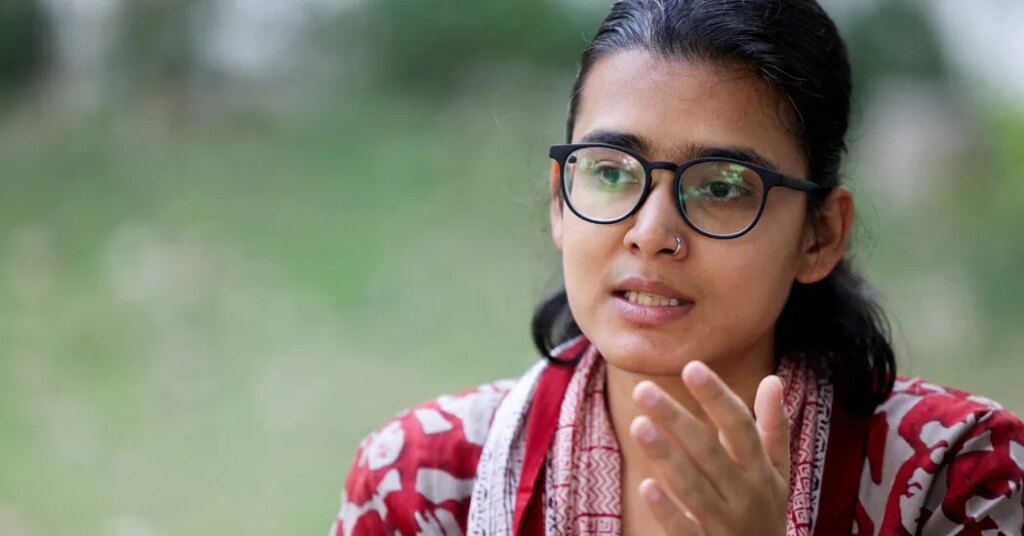
When India’s police violently rounded up thousands of protesters from New Delhi over the past week, Neha Bora became not just the face of the fight to remain on the streets, but also its legs.
Neha ran and ran, clambering over barricades and dodging the security forces flooding the capital. When officers dragged the 29-year-old onto a police bus, Neha rushed to the window to shout slogans. Once released from detention, Neha sprinted down another street, backpack strapped on, as police again gave chase.
The extraordinary flex of force by India’s prime minister, Narendra Modi, to suppress the demonstrations found its match in the tenacious, bespectacled student leader whose refusal to give up showed that the strongman’s grip was not so firm.
At a time when the leaders of India’s “Cockroach” youth movement were detained, and their plans for a big protest appeared to be unraveling, it was Neha and other members of leftist student groups who maintained the pressure on the streets, drawing from their long experience of eluding police crackdowns.
In a matter of days, viral online images helped catapult Neha — who uses they/them pronouns and usually goes by one name — to the top ranks of opposition leaders. Here was Neha at an opposition rally on Monday, swarmed by thousands. There was Neha at a news conference on Tuesday surrounded by dozens of mostly male leaders twice their age.
Long before Neha became an action hero of sorts, they were already emerging as an eloquent voice of India’s youth. And the young have a lot to be angry about: Repeated scandals in an education system that is failing a generation, a lack of jobs and the abysmal state of women’s safety on the country’s streets, particularly in its capital city. But in recent months, Gen Z’s fury has narrowed in on the lack of accountability in politics, which has failed to fix these problems.
Neha has combined a flair for public performance and a fearless language of grievance with a more fundamental political idea: Opening space for dissent is a first step toward accountability.
“People are not afraid of coming to the streets,” Neha said in an interview with The New York Times last week between rounds of detention. “And when that happens, we are rightfully seeing the government is truly on the back foot.”
The outpouring on the streets, Neha said, was a sign that Mr. Modi’s more than decade-long chokehold may be slipping. Over the years, Mr. Modi has cast the country in his strongman image, clamping down on dissent and jailing activists, many who have been behind bars for years without trial.
Neha, the president of the leftist student group All India Students’ Association is a reluctant face of the moment, and has spoken repeatedly against the “fetishization” of individuals who are part of larger movements.
Only 17 years old when Mr. Modi took power, Neha’s political education has been shaped in an environment of shrunken space for dissent. They bring a decade of activism learned from the leftist politics rooted in university campuses, one of the targets of Mr. Modi’s increasing pressure.
“They redrew the limits of democracy, redrew the limits of accountability, redrew the limit of dissent,” Neha said about Mr. Modi’s Bharatiya Janata Party, which has held power for 12 years. “Because they were changing definitions, it was taking us time to understand what was exactly happening — what exactly is the playbook that they are setting up for us.”
When youth groups across India called for their biggest demonstration yet against Mr. Modi last weekend, over accusations that his ruling party doctored the country’s voter roll to lock in an unfair electoral advantage, police cracked down. They declared the protests illegal, put the center of India’s capital under lockdown and rounded up organizers.
But leaders of leftist student groups like Neha’s were prepared: For days before the showdown, they tested the barricades and police responses as part of a strategy to give other, less experienced protesters the confidence to take to the streets.
“They saw how we tackled the barricades, how we tackled detention,” said N. Sai Balaji, who was Neha’s predecessor as the president of All India Students’ Association.
While the government managed to prevent a mass mobilization, smaller protests erupted in different corners of the city. The student groups leaned into social media to amplify each and maintain the air of widespread agitation.
“What they fail to understand is that, with the experience we have, we can make the disorganized protest into organized as well,” Mr. Balaji said, referring to the government. “We ensured to keep the momentum publicly.”
Neha grew up in a military household that supported Mr. Modi’s right-wing B.J.P., and their embrace of the political left when they enrolled in Delhi University in 2016 caused fractures with their family.
Soon after arriving in New Delhi, Neha joined a street theater group called Sangwari. Deesikha Singh, a senior member of the group, remembers Neha as “a young kid with zeal to learn.” Sangwari took plays to the streets and to underprivileged communities and invited professors and poets for discussions on social justice. With the group, Neha learned to sing and perform, and to absorb from the discussions.
On social media, there are glimpses of that younger Neha. There is a photograph of them a decade ago, in short hair and large spectacles, leading a group of children through a performance. There is a video of Neha five years ago, tea in hand, being interviewed at a farmers’ protest — clearly impatient with the patronizing tone of the reporter who repeatedly interrupts.
By the time Neha rose to the leadership of the student group, the government had already restricted protests in New Delhi. Access to the “designated protest site” in the capital city also required permission, which the government gave rarely and selectively.
The eruption by young people in recent months is taking such restrictions head on. But opening a crack for dissent, and breaking the status quo, have required many to put their bodies on the line.
When anger at an exam leak scandal grew earlier this year, many student leaders like Neha joined in a hunger strike announced by Sonam Wangchuk, a renowned Indian educator.
After 23 days, Neha had lost more than 15 pounds. The Delhi police first tried to disperse the large sit-in protest that had grown around the hunger strikers by force. When that didn’t work, Mr. Modi conceded and his education minister resigned. The youth movement, and Neha, won notice around the country.
Neha’s years in leftist student groups and street theater gave them another weapon: satire, which they have deployed irreverently to poke fun at the strongman whose own supporters have increasingly deified him.
“It’s very essential to create a spectacle of power — it is to instill fear in people,” Neha said. “But it is also true, and a historical fact, that you can only consolidate it to a certain extent.”
This satirical streak showed itself during Neha’s cat-and-mouse with the police over the weekend, which ended with the detainees packed into buses and driven about 20 miles out of the city to be held for hours in a banquet hall.
“Delhi Police, give detainees food, give detainees food!” Neha started to chant, with dozens of other detainees joining them, as seen in one video. “Delhi Police, give detainees chai, give detainees chai!”
The security forces could be seen breaking into smiles.
Then, Neha, ever the performer, improvised on the chant for the grinning officers.
“Delhi Police, feed yourself and feed us, too!”
The post The Tireless Activist Who Became the Face of India’s Young Protesters appeared first on New York Times.