Those in the stylish know often claim that the greatest party was Truman Capote’s Black and White Ball, a confab that took place in 1966 at the Plaza Hotel. A strong contender for that honor occurred six years later and some three miles uptown at Duke Ellington’s home. There, in a stately apartment at 106th Street and Riverside Drive, a delegation from the Harlem Renaissance convened for an afternoon cocktail party. The invitees came, drank, whispered and roared. Decades later, their reunion has been turned into the documentary “Once Upon a Time in Harlem,” a blissout and one of the events of this cinematic season.
The conceit was supremely simple. In August 1972, the influential, independent American filmmaker William Greaves sent invitations to some two dozen guests whom he described as the “living luminaries of the Harlem Renaissance.” Greaves, who planned to use the footage for a project about that thrilling period of artistic and cultural freedom, had been a songwriter, a dancer and an actor. By the time of the party, he had also directed films, including “Symbiopsychotaxiplasm: Take One” (1968), and he had won accolades for his work as an executive producer on the public television news program “Black Journal.” He had the genius and the bona fides to pull off the get-together, along with fantastic contacts.
Greaves ended up not using the material because it didn’t fit with his original project, which became the short archival film “From These Roots” (1974). He set the 1972 footage aside, intending to use it later, but died in 2014 at 87 before he could. This unfinished passion project subsequently became a family labor of love. Several years ago, his widow and longtime producer, the filmmaker Louise Archambault Greaves, began restoring the 16-millimeter film footage. After she died in 2023, the family continued with the project. Greaves’s son, David Greaves, a movie veteran, is credited as the director of “Once Upon a Time in Harlem.” David’s daughter, Liani Greaves, produced the movie with Anne de Mare, who’s one of the editors. She and her co-editor, Lynn True, help make the movie snap.
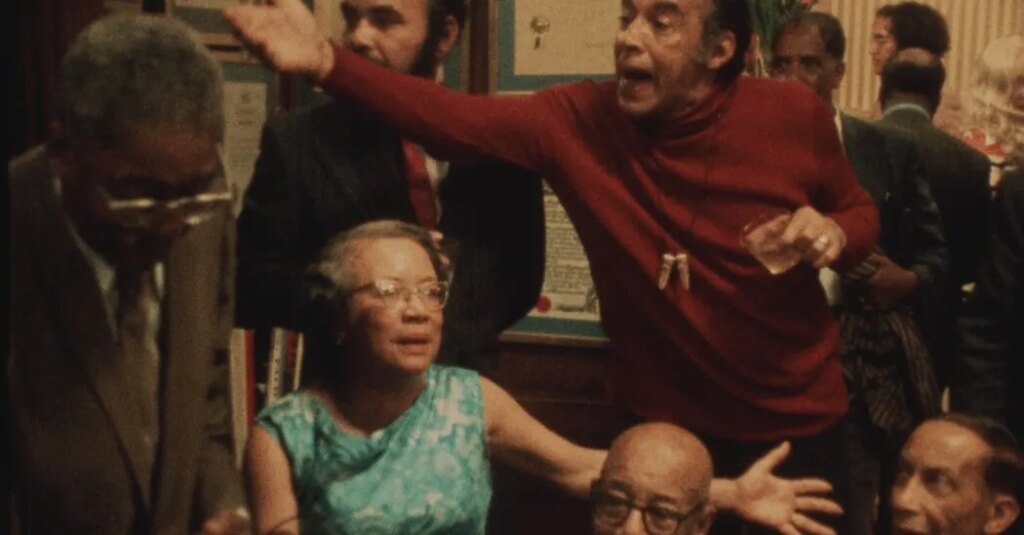
The documentary’s arc follows that of many parties and begins with warm, tentative smiles that grow more expansive as everyone slips into a shared groove. Early on, you catch a glimpse of William Greaves, dressed in a suit and tie, at the door greeting the invitees, who arrive on their own and in clusters, walking steadily, sometimes shakily and occasionally leaning on another’s helpful arm. With creased faces and bodies both stooped and ramrod straight, the congregants mingle in a compact warren of elegantly appointed rooms. Most of the guests appear to be dressed in their Sunday best, including the composer and musician Eubie Blake, who’s soon exchanging pecks on the cheek with the librarian Regina Andrews.
The guest list was extraordinary, heady and included archivists, historians, journalists, novelists and poets. Noble Sissle — Blake’s collaborator on the landmark 1921 all-Black Broadway musical “Shuffle Along” — was in attendance. So was Gerri Major (“society editor, ” as she’s identified onscreen), a bejeweled, loquacious vision in floral-print dress; Frank Horne (“poet/FDR’s Black cabinet”); Romare Bearden (“artist/author/songwriter”); the feisty Ida Mae Cullen (“widow of poet Countee Cullen”); and Richard Bruce Nugent (“painter/writer”). Dressed in a turtleneck, the voluble, vibrant Nugent was a close friend of Langston Hughes, who’s invoked along with other, already gone touchstones like Marcus Garvey and Zora Neale Hurston, all part of the gorgeous, complex memory quilt that the invitees communally piece together.
The movie flows beautifully, with a seamless mix of found and originally shot material. Working with a small crew — David Greaves was one of four original cameramen — William Greaves mapped the rooms thoroughly and from every conceivable angle, pulling back for wider views and pushing in on details. As the guests mingled, the camera caught subtle gestures and telling glances, along with images of one after another drink being poured. With the cigarette smoke curling and the jazz steadily playing — Ellington, who was apparently ill, isn’t in attendance but is on the soundtrack as well as on the wall in framed photos — the stories come quickly, soon taking the shape of a larger, intoxicating narrative about Black America.
The telling of that story here is fragmented, dynamic and necessarily elliptical. This isn’t a completist endeavor in the fashion of, say, a Ken Burns series. It is, rather, a deeply personal, collectively produced oral history of a specific moment of time as it was lived — and held in memory — by specific individuals. The past comes vibrantly alive in these rooms, but always circles back to the present and often points to the future. When the photographer James Van Der Zee sits down at a piano and begins to play, the filmmakers cut to some of his luminous images, including one shot of a New York crowd in the 1920s at a Garvey event, a large placard imprinted with the words “The New Negro Has No Fear” situated in the foreground.
The history of the Harlem Renaissance is, of course, also a history of the United States, which the documentary’s participants underscore. Neither history is settled, and one of the sustaining pleasures of this wonderful, spirit-lifting movie is that — even with many of its contributors now gone — it feels excitingly alive. Greaves, who was born in 1926 in the middle of the Renaissance, was an artist and activist who used film to understand the world and to bring understanding to others. The work that he did, including the material that he shot, and envisioned, for what became “Once Upon a Time in Harlem,” was a means of both artistic expression and political action, a way to turn stories into history, history into life.
Once Upon a Time in Harlem Rated PG-13. Running time: 1 hour 40 minutes. In theaters.
The post ‘Once Upon a Time in Harlem’ Review: A Renaissance of Their Own appeared first on New York Times.