The French have a phrase for it: “un engrenage,” a vicious spiral. That’s what France is in. Several crises have been long in the making; each now threatens to accelerate the others.
The first is a crisis of liberal democracy. Polls suggest that the far right may take power in the presidential election next spring. The second is a crisis of fiscal mismanagement. France’s public debt has reached a record $4 trillion, with the cost of new government borrowing surging above that of Italy and Greece. The third is a crisis of youth disaffection. French students, protesting against dilapidated schools and diminished life chances, have blocked nearly half of the country’s high schools in the past few weeks.
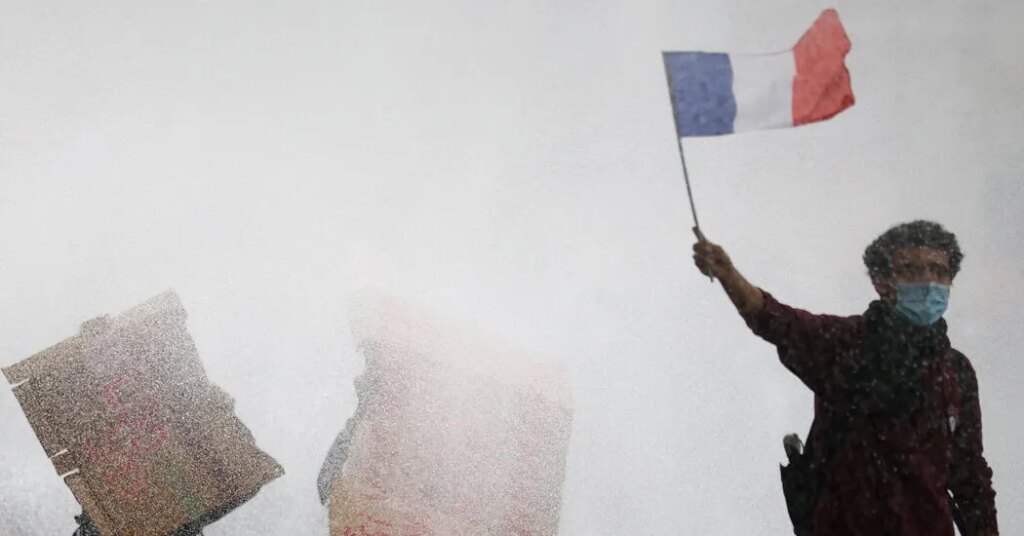
Clashing with police and bearing inspiring banners, the students have riveted the world’s attention. The protests are certainly dramatic and significant. So too is the rise of the far right. But the fiscal crisis is the most dangerous, underlying many of the country’s woes and threatening to bring it to ruin. France, truly, is on the brink.
The high school protests began in the poor suburbs of Paris in mid-September. They have spread to state-run schools in every region of the country, from big cities to provincial towns. The 15- to 18-year-olds are rebelling against long hours, large class sizes, frequent teacher absences and crumbling school buildings. They also worry about global warming, the rise of the far right and the A.I. threat to jobs for the young. At the center of their complaints is chronic underinvestment.
This is something of a conundrum. After all, the French state spends a great deal on education: around $100 billion a year, or 5.1 percent of gross domestic product, above the European Union average. So what’s going on? Crucially, more than a quarter of that money goes not to the young but to the old, paying the pensions of retired teachers. That points to one of the root causes of the country’s problems. About one-quarter of all state spending goes to pensions; another quarter goes on social services, from health care to unemployment benefits.
No French government has balanced its books for 52 years. Even so, the French debt pile, at 119 percent of gross domestic product, is lower than that of some other countries, including the United States. As recently as 2019, President Emmanuel Macron managed to bring the annual deficit within the E.U. target of 3 percent of G.D.P.
Then came the pandemic. Mr. Macron’s pledge to spend “whatever it takes” to keep the French economy alive during lockdown sent the deficit rocketing to 9.2 percent of G.D.P. in 2020. Accumulated debt rose by $335 billion in one year. France was then slower than other E.U. countries to ease its pandemic subsidies. The government spent another $95 billion to shelter France from rising energy prices after Russia invaded Ukraine in 2022.
After that, Mr. Macron lost control. He was re-elected in 2022 but failed to win a majority in the National Assembly. He imposed a modest pension reform in 2023, increasing the official retirement age gradually from 62 to 64. He argued, rightly, that France needed to work longer to afford its generous pensions and welfare system. Yet over 70 percent of French people disagreed, some violently.
In response, Mr. Macron called an ill-advised snap election in 2024, which further reduced the size of his centrist coalition. Since then, two prime ministers have proposed solutions to French overspending. Both were booted out by a majority of left-wing and far-right lawmakers in the National Assembly. The result has been a curious blend of stalemate and chaos.
Mr. Macron deserves some of the blame for the mess. So does the opposition, from the far-left France Unbowed to Marine Le Pen’s far-right National Rally. They have preferred to play political games rather than address the gathering fiscal disaster — especially the stifling weight of pensions and other social payments. In February, the center-left Socialists allowed a budget to pass for this year but only at the price of suspending Mr. Macron’s pension reform.
The current prime minister, Sébastien Lecornu, has proposed painful but scarcely punishing changes in the 2027 budget, which would bring the deficit down to 5 percent of G.D.P. He faces a first critical vote in the Assembly on Oct. 20. If his government fails to pass the budget, the cost of servicing French debt may explode. France could be forced to seek assistance from the International Monetary Fund and to pray for it from the European Central Bank — a humiliation for the world’s seventh-biggest economy.
France remains in many ways a robust and wealthy country. Yet market distrust of France is not so much economic as political. The markets doubt whether a poisonously splintered political system, increasingly dominated by extremes of right and left, will ever agree to the painful changes that are needed to get the public finances back on track. The country, they fear, is becoming socially volatile and institutionally paralyzed. That explains the withdrawal of confidence that has pushed France’s borrowing costs sky-high.
There is no easy way out. Whoever wins the presidential election in May will struggle to win a parliamentary majority in the legislative election that follows in June, setting up further political turmoil. What’s more, many doubt the willingness of Ms. Le Pen, the current front-runner, to confront the crisis honestly. She presented a five-year budget plan last week that was stuffed with ideological obsessions and creative accountancy.
On the other hand, Ms. Le Pen knows that the markets could make or break her presidency. She wants to prove that she is a stateswoman, not a wrecker. With that in mind, she will probably order her bloc of 139 deputies in the Assembly to abstain to allow the budget to pass. That may avert, for now, the kind of meltdown suffered by Greece after the financial crash. But France is no longer in control of its destiny.
“L’engrenage” — the vicious spiral — is here to stay.
Mujtaba Rahman is the managing director for Europe at Eurasia Group and a senior visiting fellow at the London School of Economics.
The Times is committed to publishing a diversity of letters to the editor. We’d like to hear what you think about this or any of our articles. Here are some tips. And here’s our email: [email protected].
Follow the New York Times Opinion section on Facebook, Instagram, TikTok, Bluesky, WhatsApp and Threads.
The post France Is on the Brink appeared first on New York Times.