It recently crossed my mind that “Butch Gardens” would be an appropriate rebrand name for the Pentagon. This was following the announcement of the cleaned-up, flower-of-manhood model — “No trannies. No beardos. No weirdos. No wimps. No radicals. Just warriors” — proposed for the U.S. military by the secretary of defense, Pete Hegseth.
But I admit that the history of the new name might be challenging.
It originated in the 1970s as the name of a scroungy, Latino-friendly Los Angeles gay bar. It was then adopted by a young Chicano artist, who frequented the bar, as a moniker for a free-floating, and largely fictional, L.G.B.T.Q. -intensive art collective, of which he was the inventor and central figure.
And now that artist and his collective are the subject of a lean, radical-trending traveling exhibition called “Teddy Sandoval and the Butch Gardens School of Art,” which is bivouacking at El Museo del Barrio, alongside a second, smaller show, “Octopus & Others: Acts of Collaboration & Poetics,” built around a single decidedly un-wimpy work of art that recently entered the museum’s holdings.
Teddy Sandoval (1949-1995) was an art world figure, prolific and well-networked, who was a nodal presence in a particular time, place and culture, but has been slow to find visibility in a larger history.
Born in Los Angeles to Mexican immigrant parents, Sandoval was an art multitasker from the get-go. He had a college degree in printmaking but a practice that embraced sculpture, painting, collage, photography, graphic design and performance. He came out early as queer, quickly got involved in the long-existing Chicano and more recently developing gay political movements and made them the dual focus of his work.
The exhibition, organized by Independent Curators International with the Vincent Price Art Museum in Los Angeles and the Williams College Museum of Art in Williamstown, Mass., keeps the overlap front of mind, but also gives the two themes separate attention.
In some cases, the emphasis falls on Sandoval’s attention to Latino, and specifically Chicano, culture. In a l970s collage he invents a mock-up page from a real Mexican crime tabloid, available in Spanish-speaking sections of Los Angeles, titled “Alarma!”
Combining clips from the magazine with mock-seductive photos of himself in female drag under the headline “Fue ‘ilegal’ y ya la deportaron!” (“She Was ‘Illegal’ and Has Already Been Deported!”), he promises both a luridly melodramatic story in the pages ahead and a reminder of a threatened experience of exile that perpetually hangs over undocumented immigrants in this country.
The first work I ever saw by Sandoval — in the seminal 1990 traveling show “CARA: Chicano Art: Resistance and Affirmation” — is here. Titled “Chili Chaps,” it’s a painted cardboard cutout of an item of leather cowboy gear, sewn with fake chili peppers, pinto beans, and pictures of snoozing men wearing sombreros. The image combo embodies both a vintage anti-Mexican slur and a newish homosexual one.
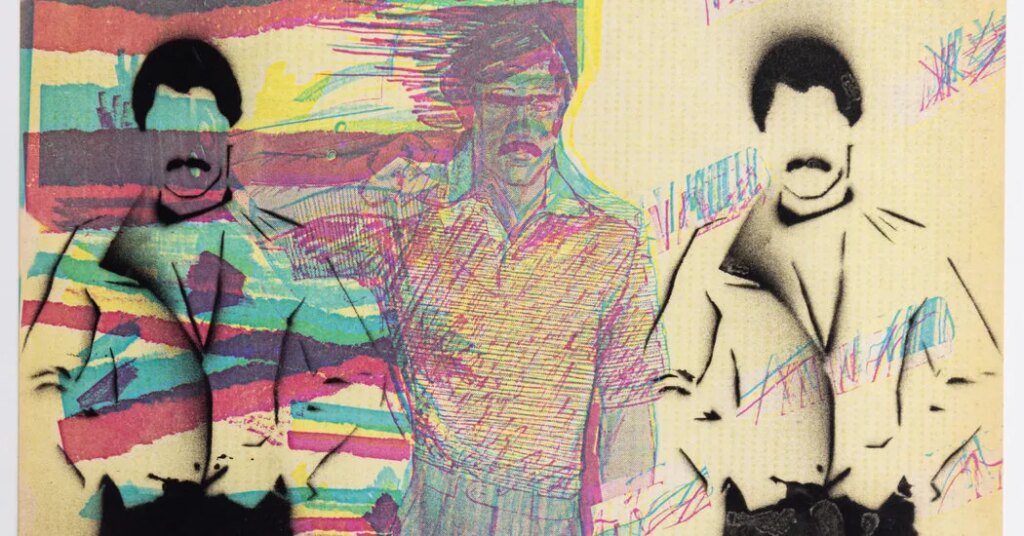
At the time the piece was made, in 1978, deep in the disco days, leather, along with boots, jeans and maybe a back-pocket hankie, was popular gay cruising attire. Post-Stonewall L.G.B.T.Q. culture is, in fact, the primary subject of much of Sandoval’s art, chiefly represented by variations on a single image: the pumped and mustached male figure that came to be known as the “clone.”
Fed by images of the Castro’s cowboys and bikers, it was a controversial concept, this image of gay hypermasculinity. For some critics, it marked the moment when gay liberation, in its broadest utopian sense, shut down, and the corporate market took over the movement.
Sandoval clearly saw the problem, and addressed it through the use of a simple graphic device: Many of his figures, while meeting “the highest male standards,” to quote the physical criterion specified by U.S. government’s new military requirements, have faces that are pale, featureless blanks, apart from their mustaches.
At a quick glance, these literally empty-headed figures seem to have been the primary ones produced by Sandoval under the Butch Gardens School of Art, a pseudo-institutional logo. But the curators of this show — C. Ondine Chavoya and David Evans Frantz, joined at El Museo by Lee Sessions — have taken pains to demonstrate the range of his output, and the network of other mostly Latino, mostly queer, mostly Southern California-based artists with whom he intersected and sometimes collaborated.
He trained as a printmaker, and its many forms stayed with him. Often working at postcard-size scale, he spearheaded what amounted to a SoCal version of the international mail art, or correspondence art, phenomenon, begun in the 1960s by East Coast figures like Ray Johnson. The movement was favored by artists, many gay, who felt compelled to operate outside potentially censored mainstream art world channels.
Sandoval also embraced the medium of performance with delight, on the evidence of photographs of a zany 1978 piece called “La Historia de Frida Kahlo,” staged in a studio by Sandoval (as an exuberant Frida) with the Chicano artist known as Gronk cast as an ahistorically hunky Diego Rivera.
His most versatile collaborator was the artist-activist Joey Terrill, a painter, a mail art practitioner, and creator of the short-lived machismo-bashing zine called “Homeboy Beautiful.”
Terrill is prominently featured in the show, as are several other artists influenced by Sandoval. They include the wonderful Chicana printmaker Ester Hernandez (her devotional valentine to both a female lover and the Virgin of Guadalupe is a highlight), and Álvaro Barrios, whose work pays homage to one of Sandoval’s chief heroes, the cross-dressing Marcel Duchamp.
Their presence attests to the generous reach and embrace of the Butch Gardens vibe, and turns an ostensible retrospective into a richly textured, community-themed group show.
The idea of community connection is ever-present, especially in one of Sandoval’s very last prints, made in 1995, the year he died, at 45, from AIDS.
Titled “Angel Baby,” it’s a picture of a young Latino boxer, wearing pink Everlast gloves and a heart-shaped bicep tattoo reading “Hope.” In Sandoval’s words he’s a guardian angel, encouraging us to end “violence, war, and discrimination of all kinds” and “live in peace and harmony.” A departure from the earlier clone images, the angel is posed in a defensive crouch, and his eyes look directly, and almost shyly, out at us.
Reassembling a Community
It was a smart idea on El Museo’s part to have their second current exhibition, homegrown and one quite different, be a tribute to community. Organized by Zuna Maza, an assistant curator, it centers on a single monumental work of public art, a multi-paneled wood sculpture in the form of a giant book, originally, in the museum’s courtyard. The piece — titled “Octopus: An Act of Sculpture” — was reassembled here for the first time in more than 40 years. It was conceptualized by the Puerto Rican artist Papo Colo — co-founder with Jeanette Ingberman of the much-missed alternative space Exit Art in Soho — and created by more than two dozen artists and poets, some still very much with us (Marcus Dimas, David Hammons, Tehching Hsieh, Catalina Para, Juan Sanchez), and others now gone (Vito Acconci, Amiri Baraka).
But “Octopus,” as seen here, is a fragment; only about half of the original panels are on view. Sculpturally, it’s rough, a set of plywood panels. Painting-wise, the same: color is black and white; finesse in application is not a goal. And the content is anarchic. Words and images mix, as on a graffiti-tagged subway wall. In a time when look-alike abstraction is everywhere, and polish is everything, democratic dishevelment comes as a relief.
So does the works that surround the piece in the gallery. Several are, like much of Sandoval’s art, collaborations. There’s also a nice parallel to the Butch Gardens “school” idea in a selection of artist headshot photos by Adál Maldonado (1948-2020) from his “Out of Focus Nuyoricans” from decades ago.
And there are entries from the past that hook into our present. One is a piece by the weirdo-beardo Puerto Rican-born poet Pedro Pietri (1944-2004). A Vietnam vet who joined the radical Young Lords and co-founded the Nuyorican Poets Café, his writing was anti-authoritarian to the core. In the show is his self-published book of poems. Its handmade plastic cover is studded with metal thumbtacks, their sharp points facing outward and framing the title, “Public Execution.”
Teddy Sandoval and the Butch Gardens School of Art Through Jan. 10, 2027, El Museo del Barrio, 1230 Fifth Avenue, East Harlem; (212) 831-7272, elmuseo.org.
The post Chicano, Gay and Still Inspiring Connections appeared first on New York Times.