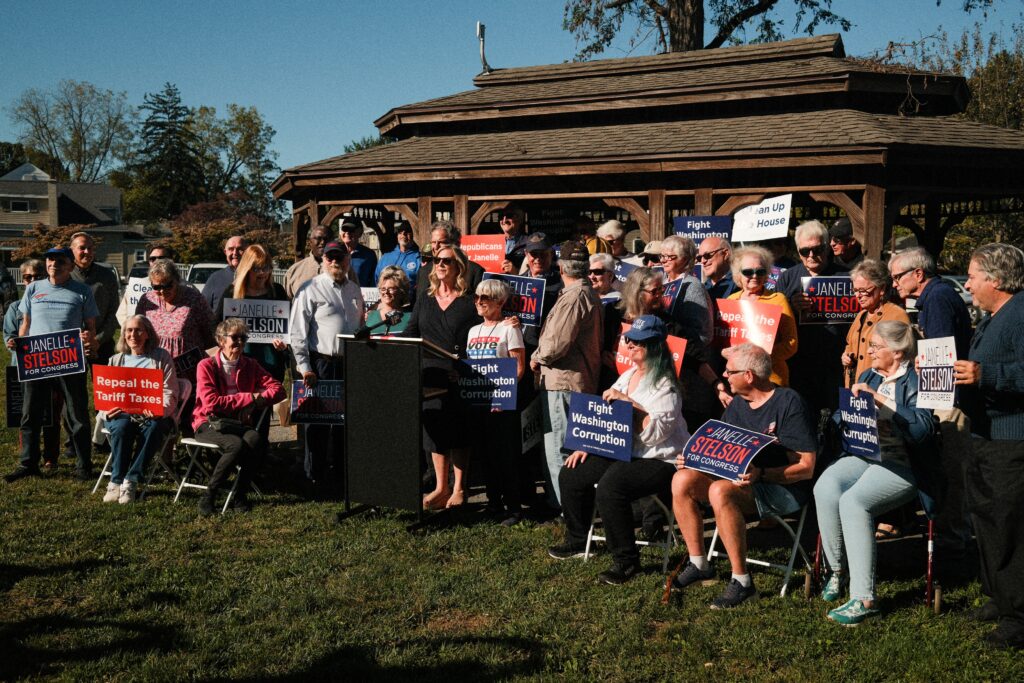
LEMOYNE, Pa. — At 78, Betty Fundalewicz still works a couple days a week as a hospice chaplain and lives comfortably enough that she’s able to give to charity. But she worries about the coming shortfall in Social Security, which could cut her benefits by nearly a quarter.
“I’m just waiting for somebody to come up with a good idea as to how we can supplement what is going to be taken away,” Fundalewicz said of the cuts forecast for 2032.
So on a recent morning, Fundalewicz joined several dozen other retirees in a grassy park in this borough across the Susquehanna River from Harrisburg to support Janelle Stelson, the Democrat challenging incumbent Rep. Scott Perry (R) in a critical midterm contest that could help determine control of Congress.
The candidacy of Stelson, a former local TV anchor who failed by a single percentage point to unseat Perry two years ago, is viewed as a strong opportunity for Democrats to flip a Republican seat in Pennsylvania. She has been running on a platform of lowering the cost of living and targeting political careerism in Washington.
But Stelson also has made a pledge to protect Social Security a centerpiece of her campaign. At the Lemoyne rally, she accused Perry of supporting “cutting your Social Security benefits, increasing your Social Security taxes, and increasing the retirement age to 69.”
Perry says he wants “to fortify Social Security for those who already earned it, and so that younger Americans compelled to pay for it can also rely on it.” In a statement, he accused Stelson and other Democrats of attacking “me and anyone else looking for answers — all in the name of scoring cheap political points.”
On top of the campaign trail rhetoric, the race is one of more than a dozen across the country where candidates and outside groups have spent more than $1 million on ads mentioning Social Security, according to a Washington Post analysis of more than 8,000 ads aired by Oct. 5 in 63 competitive races tracked by the ad-tracking firm AdImpact.
The Post analysis found that Social Security is one of the most frequently mentioned economic issues by Republicans in competitive races, with the GOP spending about seven times more than Democrats on the issue. Republicans have spent more on ads mentioning Social Security even than ads mentioning grocery prices and health care costs (three times as much), utility bills (four times as much) and gas prices (five times as much).
The ads typically focus on reminding voters that President Donald Trump’s One Big Beautiful Bill created a temporary $6,000 tax deduction for people 65 and older, a provision they call “no tax on Social Security.”
Ads supporting Perry, for example, say he “cut taxes for Social Security recipients.” Perry also has accused Stelson of “calling for higher taxes on working families and on Social Security.”
Democrats, by contrast, spend more on ads focused on day-to-day economic concerns such as groceries, utilities, gas and health care costs, the analysis found. On Social Security, they typically promise to protect benefits and question whether Republicans can be trusted with the program.
Stelson, for instance, has run ads focused on a Perry proposal from 2016 calling for “a combined mix of benefit reductions and tax increases” to shore up Social Security’s finances. The plan called for raising the cap on income subject to the payroll tax that funds Social Security, raising the retirement age from 67 to 69 and adjusting benefit checks to reflect need.
“You earned your Social Security, and I’ll fight to protect it,” Stelson says in an ad that shows her hugging a worker in a hard hat.
Perry and Stelson are vying to represent a central Pennsylvania district that encompasses the state capital of Harrisburg and suburbs like Lemoyne. Trump carried the district by 5 percentage points in 2024, when Perry prevailed over Stelson by about 5,100 votes.
This time around, with polls showing the race once again rated among the most competitive in the country, the Department of Homeland Security last week issued a press release accusing her of employing as a canvasser an undocumented immigrant arrested by immigration officials after allegedly exposing himself. (The release linked to a news report that quoted a conservative activist who asserted the association.) Stelson has denied any connection with the man, saying he is neither an employee of the campaign nor a volunteer.
At the Lemoyne rally in a wooden pavilion by the sparse shade of a black locust tree, Stelson told those gathered that Perry’s support for the war in Iran could divert needed cash from the program — “money that could be used to take care of the people here at home who tell me they are struggling with their bills every day.”
Social Security’s retirement trust fund is projected to run dry in just six years. At that point, monthly benefit checks would shrink by about 22 percent unless Congress acts. Closing the gap would require nearly $500 billion in fresh funds in 2033 alone — and the shortfall would grow every year thereafter.
A decade ago, Perry’s plan for shoring up the program with both tax increases and benefit cuts was close to mainstream. A 2010 debt-reduction plan from President Barack Obama’s bipartisan Bowles-Simpson commission also called for raising the payroll cap, raising the retirement age to 69 and trimming benefits for wealthy retirees.
But then Donald Trump promised never to cut the program, warning in 2023: “Under no circumstances should Republicans vote to cut a single penny from Medicare or Social Security.”
Trump’s stance has created a dilemma for Republicans like Perry, whose website today says only that he “knows that we must keep our promise to our Seniors, by preserving and protecting Medicare and Social Security.” His statement to The Post offered no specific solutions, but he said that “the longer we ignore this, the harder the solution becomes.”
Stelson, too, has offered few specifics. At the Lemoyne event, she said: “I think a lot of it is cutting waste and stop spending money on places where we don’t need to spend it.” Asked in April about a proposal to make high earners pay more into the program, Stelson said: “I would try to keep things where they are.”
That aligns with the thinking of Betty Fundalewicz, who also thinks cutting government waste could help solve the problem. A Stelson supporter since 2024, Fundalewicz thinks Stelson cares about the district and will work in a bipartisan fashion toward solutions.
Others at the rally had different ideas.
Eileen McNulty, 74, relies mainly on the pension she earned working for Pennsylvania state government, including two stints as secretary of the Department of Revenue. But it’s her Social Security check, she said, that keeps her fixed pension from losing ground against inflation.
“There’s a couple of things that need to be done,” McNulty said, one of which is to increase the amount wealthy people contribute. She said she dislikes Perry’s ads boasting that he has never voted for a tax increase; where, she wonders, does he think the money for his own government salary comes from?
Jim Mead, 81, another Stelson supporter, also wants to see the wealthy contribute more to Social Security.
Mead spent two decades running the local Blue Cross Blue Shield insurer, then moved into venture capital, investing in health care companies. For much of his career, he earned well above the “cap” on income subject to the Social Security payroll tax, currently set at $184,500. Once Mead’s pay crossed the cap, the deductions stopped — a policy he called unnecessary.
“I didn’t need that money, particularly at my level as the CEO of a company. Why not raise that cap?” Mead said. “When you’re higher paid, you’ve got an obligation.”
While Mead said cutting benefits is “just a red flag for people,” he said he could live with smaller checks for wealthier retirees like himself. “I should get something back for what I paid in. That’s only right. But maybe I don’t get as much back,” he said.
Whatever happens, Mead said the nation should not add Social Security’s shortfall to the nation’s credit card bill. “If you go down my list of fears for generations that succeed me, our debt load is already frightening. So I would not borrow the money,” he said, adding: “It may be that we just ultimately have to raise taxes.”
Miles away at a diner outside the city of York, Bruce Reinert took a break from his part-time job in industrial battery sales to smoke a cigarette. A 75-year-old who supports Perry, Reinert said he still works 25 to 28 hours a week, but that Social Security “is my main income that keeps me going.”
Reinert defended Perry’s stance on Social Security — “He didn’t say do away with it, okay?” — and said he’s open to some of Perry’s ideas, including raising the retirement age.
“People are living longer,” Reinert said.
Stelson, he said, has misrepresented the incumbent on Social Security, adding that Perry, too, “wants to protect it, looking down the road at what’s going to happen.”
But Reinert has his own solution for the retirement program’s money troubles: “I think part of it is that we’ve allowed so many illegals to be on Social Security that should not be on it,” he said.
In reality, the effect of undocumented immigrants on the program runs in the opposite direction: They generally contribute payroll taxes to the program but cannot collect benefits. Social Security officials have cited Trump’s restrictive immigration policies as one reason the program’s financial outlook has gotten worse.
Another factor: the One Big Beautiful Bill’s tax cuts, which will cost Social Security about $169 billion over a decade, the program’s chief actuary has estimated.
Reinert said what bothers him most about Social Security is his sense that the deal is changing.
“For me, it’s upsetting because I’ve contributed to Social Security my whole working career,” he said. “It was a good program to be on when it started.”
The post Social Security emerges as a key issue in midterm battleground districts appeared first on Washington Post.