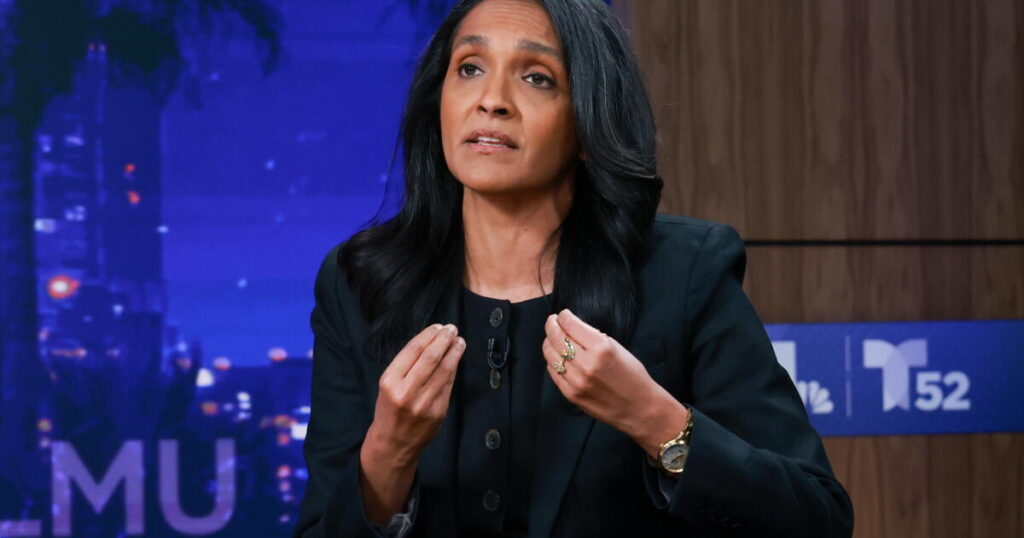
In the Los Angeles mayoral debate Tuesday night, I was reminded of two things.
First, as I’ve said before, it’s no surprise that roughly one third of likely voters remain undecided with less than three weeks to go until election day.
Second, there is one key difference between the two candidates: We know who Mayor Karen Bass is, but we don’t yet know who Councilmember Nithya Raman is, even though she’s been leading in most polls.
Those two points are connected. I think a majority of voters want a change at City Hall because of the marginal progress on homelessness, the erosion of basic services and the bad decisions before and after the Palisades disaster, among a host of other issues.
But they’re not sure what they’d be getting in Raman.
Why not?
If you haven’t already seen the story a few days ago by The Times’ longtime City Hall reporting ace, Dave Zahniser, you need to check it out right here. The headline neatly sums it up:
“L.A. mayoral candidate Nithya Raman has strong opinions. But they often change”
Raman has flip-flopped so many times, it’s as if she’s having a political identity crisis, which is not a great selling point for a candidate.
She endorsed Bass, an ally, for re-election, and then abruptly and surprisingly announced that she was running against her.
She rose to power as a darling of the Democratic Socialists of America, and vowed to defund the police, only to later support an LAPD budget increase.
She embraced the so-called mansion tax, then said it needed an overhaul.
She supported and helped fund Bass’ signature homelessness initiative, Inside Safe, and now has turned against it.
“That’s the real wild card,” said Sara Sadhwani, assistant professor of politics at Pomona College. “She has flip-flopped so extensively on policy that it’s unclear which version of her values we would get.”
Look, it’s not uncommon for a candidate of the left, or the right, to move toward the center to broaden support. And there’s nothing wrong with learning on the job and evolving. It’s all too rare, in fact.
The problem for Raman is that in somersaulting around on core issues, she’s alienating some of the people she would need as allies in order to be an effective mayor.
They might come around, because in the city’s shared system of power, there are times when the council and mayor need to paddle in the same direction in order to get anywhere. But among the 15 City Council members, 13 have endorsed Bass, and that support includes even the DSA wing of the council.
I like the idea of a rebel as L.A. mayor, but the job is hard enough with City Council allies. Without them, Raman could be cooked. And it’s not as if she’d have an easy time winning support for much of anything from the powerful public employee unions and traditional business interests, which are for the most part aligned with Bass, for better and for worse.
Both candidates had their moments in the debate, although I gave the edge to Bass. During The Times’ live chat I said I think L.A. really needs a leadership change, and I think Raman did not prove that she’s the answer.
It’s probably the second most important political job in the state, in one of the great cities of the world, and along with the ducking and punching, I wanted more love, more poetry, more unbridled passion and a contagious sense of possibility.
And please, all you Spencer Pratt toadies, don’t send me your whiny little notes about how he was the guy all along. Identifying some of the obvious problems is easy enough. (I do it all the time.) Having a plan is another matter, and that’s why I never ran for mayor, and why Pratt faded out of the picture.
So what next, as the final three weeks of the campaign play out?
If I were Raman, who is 45, I’d go heavy on touting the work she’s done on eviction protections and capping rent hikes, because nailing down younger voters could give her the keys to the throne. On homelessness, she knows the issue better than most, has detailed what’s wrong with the Bass program, has made headway in her own district, and has laid out a plan to speed up progress and efficiency citywide.
But her best argument is that City Hall and the entrenched political establishment need a major shakeup, because the machine is now a jalopy.
“We cannot afford another four years of decline, of mismanagement, of excuses,” Raman said in the debate.
As for Bass, 73, you can’t count her out just yet because she’s a fighter, and she’s better at campaigning than at being mayor. She also is likely to benefit from the fact that older voters — who are most likely to go to the polls — favor her by a huge margin.
“You are not ready for prime time,” Bass told her former ally during the debate, and Bass also hammered Raman for taking “different positions on different days of the week.”
In 2005, Mayor Jim Hahn became the first L.A. mayor to lose a re-election bid in more than three decades, falling to Antonio Villaraigosa. It was a rout, at 58% for Villaraigosa to 41% for Hahn.
I don’t see a rout this time.
The question for Los Angeles is this:
Have you had enough of the mayor you know, or are you ready to roll the dice on someone you don’t.
The post Post-debate, lingering questions about who Raman is and how she would lead appeared first on Los Angeles Times.