Elon Musk wants to bring satellite internet to India and is accusing some of the country’s richest businessmen of standing in his way. But the bigger obstacle might be the Indian government’s desire to control who can connect to the internet and when.
Mr. Musk, the world’s richest man, posted last week on his social-media network that Starlink, his satellite internet service, was “being blocked by certain oligarchs” from operating in India. He accused his rivals of protecting a “monopolistic chokehold on the Indian people.”
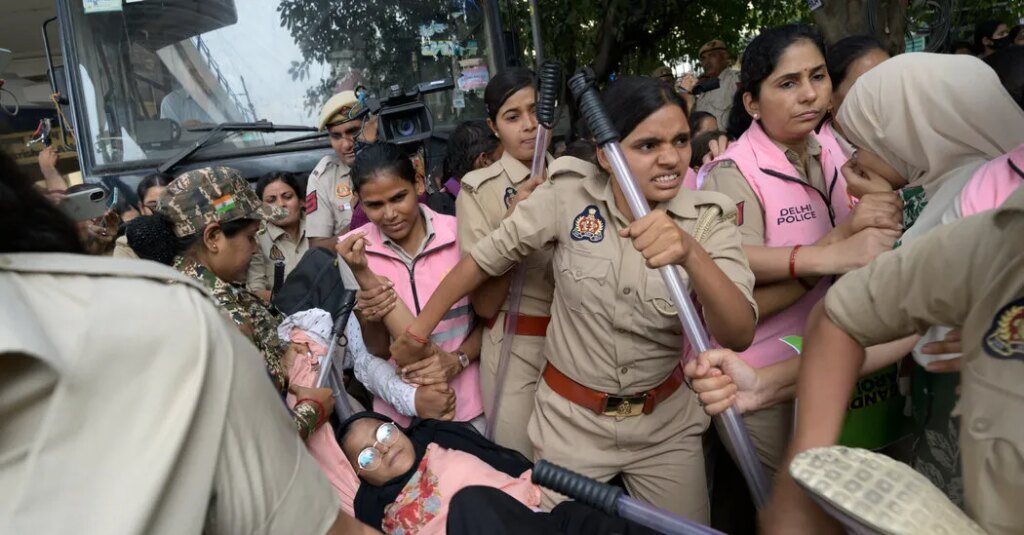
The dispute developed as the Indian authorities asserted control over communications. Before young people took to the streets of New Delhi on Saturday to protest a purge of election rolls, the police shut down mobile data connections within a 2.5-mile radius in the capital’s center.
For India’s police, such shutdowns have become a routine crowd-control tool. Protesters, journalists and bystanders were left without mobile internet access.
“If you want to ensure that any protest is nipped in the bud,” said Jayna Kothari, the executive director of the Center for Law and Policy Research in Bengaluru, “the main way to do it is internet shutdowns.”
Mr. Musk, however, had his eye on commercial competition.
He identified the oligarch he had in mind: Mukesh Ambani, one of the country’s richest man and owner of Jio, India’s largest mobile network. Jio is developing its own low-earth-orbit satellite system, which could compete with Starlink.
Mr. Ambani makes an odd target. Jio partnered with Starlink 18 months ago, and India’s other major telecom provider, Bharti Airtel, did too. All three companies are awaiting government permission to proceed.
Mr. Musk’s outburst coincided with the annual India Mobile Congress, held in New Delhi last week. Akash Ambani, one of Mukesh’s sons, promoted Jio’s planned satellite network as part of its broadband strategy. Satellite internet can reach remote areas beyond the range of wired broadband and cellular towers.
Starlink has more than 11,000 satellites in orbit, dwarfing the fleets of potential rivals. Mr. Musk called Starlink’s four-year delay in entering the market “a crime against the people of India!” He argued that his service could have been helping some of the country’s poorest citizens.
But for all the fuss, the commercial opportunity may be limited.
Roughly 95 percent of India’s internet access comes over mobile networks. Its consumers enjoy extensive 5G coverage and some of the world’s cheapest mobile data. The average monthly bill is around $2 to $3.
Satellite connectivity is generally more expensive.
Neil Shah, a founder of the Mumbai-based Counterpoint Research, estimates that India’s satellite internet business — split among Jio, Airtel and possibly Starlink — would be a “niche” market worth up to $2 billion. That would represent less than 2 percent of total internet traffic, he said.
Satellite connections could make a difference in the high Himalayas; on distant islands; aboard airplanes and merchant ships; and during natural disasters, as they did recently in Nepal. “Satellite broadband is a nice add-on in India’s internet connectivity story, but not the main hero which will come and save the day,” said Mr. Shah.
Mr. Musk escalated his attack by pretending Mr. Ambani, not Narendra Modi, was India’s prime minister. A Jio spokesperson did not immediately respond to a request for comment.
The joke wasn’t entirely out of left field. Large parts of India’s economy — including telecoms, airlines, food delivery, cement and more — are dominated by pairs of giant companies. Critics say the concentration of economic power deepens the political influence of India’s biggest conglomerates.
India’s foreign ministry rejected Mr. Musk’s comments as “baseless and misconceived.” An official review is underway, it wrote, with Starlink and its Indian competitors “at broadly the same regulatory stage.” Commentators noted that Mr. Musk is no stranger to wielding political influence.
The government cited security requirements to explain its protracted licensing process. Mr. Musk argued that 165 other countries have approved Starlink, though that list excludes authoritarian states like Russia, China and North Korea.
The war in Ukraine has demonstrated the strategic importance of satellite communications and the risks of relying on a private foreign provider. Mr. Musk has intervened in Russian and Ukrainian access to Starlink, affecting military operations at his own discretion.
Mr. Shah expects India’s security concerns to limit the role of foreign satellite operators in sensitive sectors such as aviation and maritime communications.
India also has a history of restricting satellite communications on security grounds. In the 2008 terrorist attacks on Mumbai, Pakistani gunmen who arrived by boat carried satellite phones served by a company in the United Arab Emirates.
The Indian government has repeatedly shut down mobile internet access to prevent Indians from communicating during protests and periods of unrest.
Ms. Kothari, from the Center for Law and Policy Research, described the practice of treating nonviolent protests as a threat to public order as “a weapon used by the government as and when it wants.” A 24-hour shutdown, like the one Delhi police imposed this week, can end before anyone has time to challenge it in court.
India is among the countries that frequently impose internet lockdowns within their borders. Last year, only Myanmar, where the military government is fighting a nationwide insurgency, shut down internet access more often, according to Access Now, a nonprofit organization that focuses on digital rights.
The post Musk Blames Tycoon for Stalling Satellite Internet Access in India appeared first on New York Times.