A member of parliament said security forces “pounced” on him and forced him into a police bus as he was speaking to reporters.
A university student said he was kicked in the face inside a police station. Another said she was dragged by police officers and thrown to the ground as she began marching.
They are among the people detained by the police in the Indian capital of New Delhi who have made allegations of mistreatment by law enforcement officials over 24 hours during an intense crackdown on protests over voting rights last weekend.
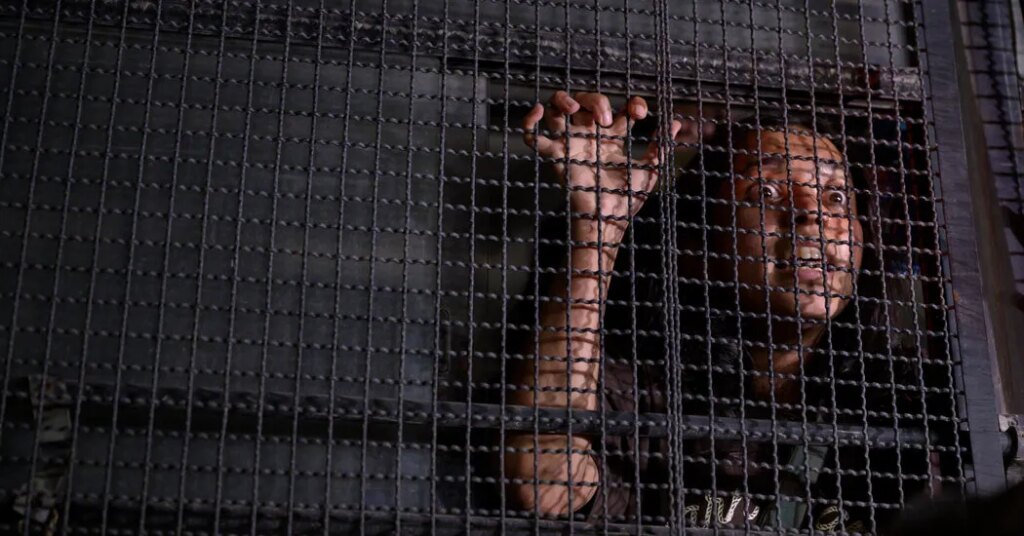
India’s security forces took extraordinary measures to prevent people from assembling in New Delhi in response to a planned protest on Saturday for which permission had been denied. They canceled some Delhi-bound trains, closed metro stations and shuttered the internet. For two days, security forces picked up protesters and would-be protesters lingering in the streets. Journalists from The New York Times saw officers dragging, pushing and hoisting detainees into police vans and buses. They were held in police stations and other detention centers several miles from the city center, often for many hours, before being released.
Lawyers’ groups said more than 1,000 people were detained.
The Delhi police have not said how many people they picked up, nor where they took them and on what grounds, only that they followed the law. On social media, the police force posted videos that showed detainees being fed. The police said some of their officers had been injured by protesters who tried to breach barricades and resist detention. “Do not pay attention to the misleading information and rumours being spread on social media,” the agency’s official account posted on X.
Two leaders of the Cockroach Janta Party, Saurav Das and Ashutosh Ranka, were arrested on Tuesday after they climbed over a gate and unfurled a flag at Jantar Mantar, the popular protest site where the police had prohibited rallies. A court remanded them to judicial custody for 5 days, the C.J.P. said.
Bushra Rehman, 32, was among the protesters who described run-ins with the police over the weekend. A doctoral student from Delhi, she began marching midmorning on Saturday from a Sikh house of worship in the city center toward Jantar Mantar. When they met a phalanx of police, Ms. Rehman and members of her leftist student group sat down on the road and locked arms.
They were outnumbered by security forces.
“I was thrown onto the ground,” Ms. Rehman said, adding that officers repeatedly pinched her skin as they tried to get a hold of her.
As she tried to slip away, other officers pulled her hair, grabbed her by the hand and shoved her onto a bus, she said.
Footage posted by a student union social media account and verified by The Times showed pink-vested female officers clashing with female protesters near Jantar Mantar.
Ms. Rehman’s hand was bruised and sore, and her knees were scraped, but she avoided more serious injuries. One teenage boy who was on the bus with her got his hand stuck in the door. It turned blue, Ms. Rehman recalled.
The Delhi police did not respond to a request for comment by phone and email.
Shortly afterward on Saturday, Shubham Kumar, 20, was standing outside the Connaught Place police station in central New Delhi, when he saw police officers forcefully take a man with a journalist badge into the station. He asked the police what they were doing, and was also dragged into the station. So was his friend Anushka Shukla, also 20.
Mr. Kumar, a sociology student, said he was taken down to the basement of the station. Uniformed officers hit his legs with a rod, slapped him, and punched him in the face and stomach, he said. When he fell to the ground, he said police kicked his face.
A doctor who examined him later at a hospital, where police took him for a medical examination, wrote that he had multiple abrasions on his shoulders, the left side of his body, right elbow and right knee. His left wrist was swollen, according to the notes shared with The Times by Mr. Kumar’s lawyer.
Mr. Kumar was then taken back to the police station, before being released the next afternoon, roughly 28 hours after he was detained.
His lawyer, Shaurya Vikram, said when he went to inspect the basement of the police station, he noticed there was no camera in the corner of the space where Mr. Kumar said he was assaulted.
Ms. Shukla was released earlier. She sat outside the police station and wept. She was scared for her friend, she said.
Mr. Kumar said he does not plan to rejoin protests anytime soon. “My parents are too much worried,” he said.
Kusum Dhanda, a police sub-inspector at the station, who was a signatory on Mr. Kumar’s police report and who was reached by phone on Tuesday said only: “Let him lodge a complaint at the police station,” before quickly hanging up.
Late on Sunday morning, not far from the Connaught Place police station, an Indian parliamentarian named John Brittas was speaking to news cameras when security forces, he said, “came and pounced on me, like they were pouncing on an enemy.”
They included Delhi police officers and members of a national gendarmerie sometimes used to combat insurgents, called the Central Reserve Police Force. Video footage of the encounter was captured by local media: Security forces speak to him, then push him, then grab him by the arms. He tries to extricate himself, but is carried away and into a bus parked nearby to hold detainees.
“They threw me into the van, pinned me into the seat,” Mr. Brittas, 60, who belongs to the Communist Party of India and represents the southern state of Kerala in the upper house of the Indian parliament, said in an interview. “I was nauseated. I was breathless.”
When it became clear who he was, the police van dropped him in a quieter part of Connaught Place, he said.
Neither the Delhi police nor the Central Reserve Police Force responded to requests for comment. The Ministry of Home Affairs also did not respond to an email inquiry.
The gendarmerie has in the past faced criticism for excessive use of force and violations of civil rights against civilians in parts of the country facing internal conflict. In August, the police in New Delhi faced scrutiny for using pellet guns, sticks and tear gas against young people protesting over failings in the country’s education system.
Mr. Brittas had already been detained for 8 hours on Saturday, he said. But when he was picked up on Sunday, he said, he was not participating in a protest or violating any police prohibitions.
“If a member of Parliament cannot stand on the street and talk to media what is the plight of the common man in the capital of the world’s largest democracy?” he said.
The post Indian Protesters Describe Rough Treatment by the Police appeared first on New York Times.