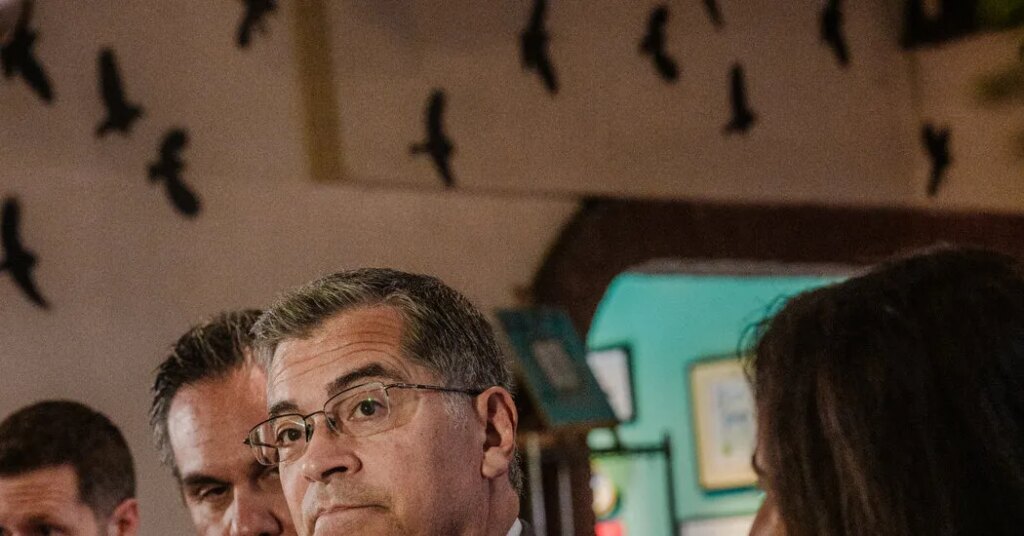
The table decorations at a Los Angeles event earlier this year told the story of the guest of honor, Xavier Becerra, a son of Mexican immigrants who has emerged as the front-runner to replace Gov. Gavin Newsom of California.
Colorful cards in the style of a Mexican lotería game represented his political rise, in Spanish, from El Congresista to El Fiscal General to El Secretario de Salud. The final card, El Gobernador, captured the hope of many of the Hispanic leaders at the event that Mr. Becerra would become California’s first Latino governor since 1875.
Those leaders have been more animated about the potential milestone than the candidate himself has been.
“I certainly am Latino, and I’m certainly proud of it,” Mr. Becerra said in an interview. “But identity has never been what has fueled my campaigns for office or public service.”
Mr. Becerra, a Democrat, is an overwhelming favorite to defeat Steve Hilton, a Republican endorsed by President Trump, in November in this heavily Democratic state.
If Mr. Becerra wins, it would be a watershed moment in California, coming 32 years after Gov. Pete Wilson, a Republican, targeted illegal immigrants during his re-election campaign in 1994. One of his commercials showed migrants entering California from Mexico by running across a major thoroughfare as a narrator intoned, “They keep coming.”
It helped Mr. Wilson win re-election. But critics saw the ad as racist at a time when the Latino population was rapidly growing throughout the state. The Wilson years inspired a generation of activists, a number of whom became prominent Democratic leaders serving today.
Latinos now serve as the state’s senior senator and as the two leaders of the State Legislature, and the election of a Latino governor would punctuate a rejection of Mr. Wilson’s movement in California.
But Mr. Becerra has not dwelled on that in his campaign.
While some Latino leaders of his generation rose to power marching in the streets, Mr. Becerra was better known as a mild-mannered lawyer who worked in the halls of power. He has built his career as a play-it-safe insider over his decades in public service.
“He doesn’t come out and wrap himself in the Mexican flag,” said Representative Lou Correa, a Democrat from Orange County. “But he has never tried to hide who he is or where he came from.”
‘California Is Changing’
Born in 1958, Mr. Becerra grew up in Sacramento with a father who worked in construction and a mother who was a clerical worker. He remembers his father playing records by Jorge Negrete and Pedro Infante, ranchera-style music that Mr. Becerra said he still enjoys today.
Photos from his high school yearbook show Mr. Becerra with the golf team, with feathered hair and bell-bottom pants. He earned a scholarship to Stanford University, where he would meet his wife, Dr. Carolina Reyes, who is now a physician specializing in high-risk pregnancies.
After a brief time in the State Legislature, Mr. Becerra was elected to the House in 1992 and spent more than two decades in Congress. By 2016, he had already been chairman of the Congressional Hispanic Caucus and was the fourth-ranking Democrat. There was speculation that he could be a future House speaker.
Instead, at the end of 2016, Gov. Jerry Brown appointed Mr. Becerra as California’s attorney general.
Mr. Brown said in an interview that he considered about a dozen people and found Mr. Becerra’s résumé the most impressive — two degrees from Stanford University, a career as a veteran congressman and a stint working as a deputy attorney general in the same office he would lead.
Mr. Brown said that Mr. Becerra’s Latino heritage was not a major factor in his decision. But the former governor acknowledged a desire to share power with leaders who reflected California’s population.
“You don’t want just a club of one segment of California to be the government,” Mr. Brown said. “But I think it’s a rather hazardous course to start picking and choosing based on race, on ethnicity, on gender, on perhaps some other qualifications of people that are not related to the inherent worth of people.”
The office of attorney general has often been a stop on the way to the governorship, and Mr. Brown said he knew that his appointee would have a strong shot at winning that office someday. Mr. Brown had served as attorney general, as had his father, who was governor in the 1960s. He was mindful that 40 percent of the state’s residents were Latino.
“California is changing,” Mr. Brown said. “That will express itself everywhere.”
Mr. Becerra and Mr. Brown teamed up on legal battles against the first Trump administration. They defended California’s sanctuary state law and helped win protections for young adults whose parents brought them across the border as children, the so-called Dreamers.
Mr. Becerra said his background as the son of immigrants had no bearing on his legal strategy but informed the “passion and the personal interest” he brought to such cases.
Shortly after Joseph R. Biden Jr. was elected president in 2020, he named Mr. Becerra as secretary of health and human services.
Robert Rivas, the speaker of the California Assembly, remembers flying to Washington in 2022 to meet with Mr. Becerra, whom he saw as an effective fighter with a collaborative spirit. Over dinner at an Asian fusion restaurant in Virginia, Mr. Rivas floated the idea that Mr. Becerra should return home and run for governor.
“There were all those whispers at that time, like, ‘Who’s going to be next? Who’s going to be after Newsom?’” recalled Mr. Rivas, who traces his own political roots to his grandfather’s participation in the farmworker movement. “Xavier is just someone that had the experience. He checked all the boxes. Not to mention, he’s Latino.”
Republicans have questioned whether Mr. Becerra was qualified for his appointments. Gloria Romero, the Republican candidate for California lieutenant governor, said she had known Mr. Becerra early in his career and liked his unassuming style and his moderate politics as a congressman. (Ms. Romero was a longtime Democratic state lawmaker before she switched parties.)
She said she was disappointed when Mr. Biden named him secretary of health and human services because she didn’t think Mr. Becerra had the right expertise.
“I remember thinking, ‘What a mistake,’” Ms. Romero said. “He had become a D.E.I. appointment.”
She said she believed Mr. Biden was hiring based on diversity and that “he needed a Latino to fill out his cabinet.”
Ms. Romero said she felt Mr. Becerra had struggled to respond to a surge of migrant children who crossed the border without their parents because he wasn’t qualified for the job. Many of the children ended up living with sponsors who put them to work in unsafe conditions.
“That was a real failure,” Ms. Romero said.
Mr. Becerra has said that children were not exploited while under his agency’s care and that he helped fix problems he inherited from the first Trump administration. He rebuffed criticism that he was unprepared for the job as “par for the course.”
“I think I’ve heard that every position I’ve had,” he said, “that I’ve been a D.E.I. hire, or I got lucky because it’s D.E.I.”
The Work Ahead
Amid a year of immigration raids that largely targeted Latinos, and the downfall of Cesar Chavez, an iconic Latino leader, Mr. Becerra’s rise has brought a sense of triumph for many Latinos in California.
He campaigns smoothly in both English and Spanish, and as his standing in the polls surged in the spring, Mr. Becerra’s aides played off his image as a boring uncle with online memes calling him “Tío Xavier.”
This month, Mr. Becerra appeared at a Mexican restaurant in Los Angeles to campaign against Proposition 39, which would require additional identification to vote.
Mr. Becerra sipped hot chocolate from a traditional Mexican clay mug while guests noshed on taquitos and tostadas. On the walls were posters that read “Defend California’s Elections” in Spanish.
Mr. Becerra said the ballot initiative would disenfranchise new voters. He spoke of his mother, a naturalized American citizen from Mexico, in bilingual remarks.
“I want to make sure I protect my mother’s right to vote,” he said. “My mother became a citizen when she came to this country.”
Mr. Becerra’s father was born in Sacramento, and then moved back to Mexico as a child before returning to the United States. Though Mr. Becerra has not focused much on Latino issues during the governor’s race, he has invoked his family history at almost every public appearance.
Like Mr. Becerra, Senator Alex Padilla is also a son of Mexican immigrants whose rise traces the evolution from California’s politics of the 1990s, when many Latino residents felt targeted by a hostile state government.
Yet even as Mr. Becerra is on the cusp of grasping the state’s most powerful post, many Latino residents still struggle with high rates of poverty and low levels of education. So greater political power for California Latinos comes with both an enormous opportunity and a sober responsibility, Mr. Padilla said in an interview.
“Representation is great, representation is important,” Mr. Padilla said. “But we have a lot of work to do to improve people’s lives.” Mr. Becerra’s campaign has been light on policy proposals.
Instead, he has leaned on his experience and argued that California needs “a working-class governor.”
“Most Latinos are working class, but there are a whole bunch of folks who aren’t Latino who are working class,” Mr. Becerra said. “And it is a community that I have great affinity with.”
Alain Delaquérière contributed research. Gabriela Bhaskar contributed reporting.
The post He’s Played It Safe. But He Could Make California History as Governor. appeared first on New York Times.