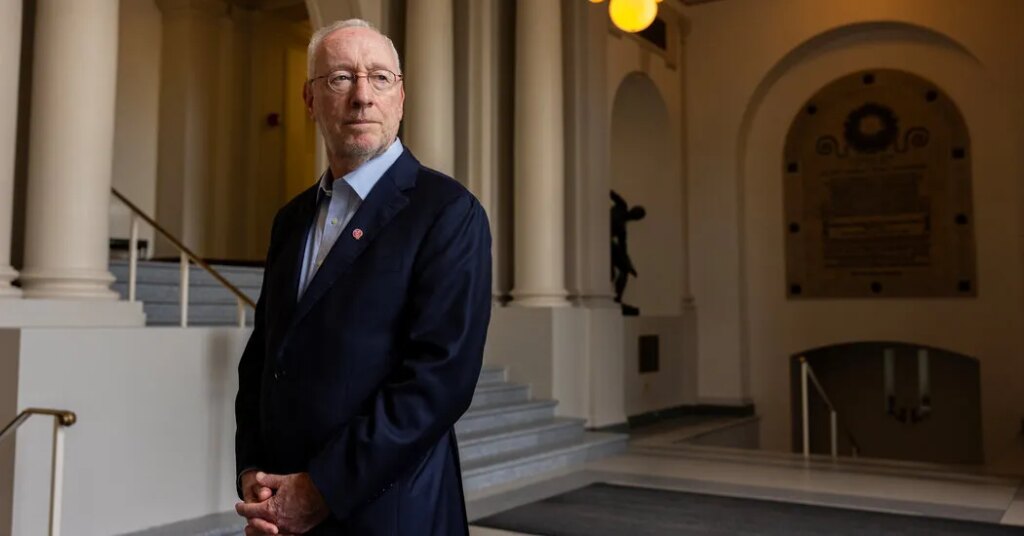
The president of Cornell University, Michael Kotlikoff, has come under harsh criticism over the university’s handling of a former student’s claims that she was gang-raped at a fraternity party in 2024.
The allegations, contained in a lawsuit filed by the former student last month, have touched off a fierce debate about consent and sexual assault on college campuses and led to calls for Dr. Kotlikoff’s resignation.
On Tuesday, Dr. Kotlikoff gave an interview to The New York Times, his first since the woman’s allegations surfaced publicly. He was joined by Anne Smalling, the chairwoman of the university’s board of trustees, in an implicit endorsement of his leadership.
Over 90 minutes, Dr. Kotlikoff was often remorseful and contrite, and occasionally clinically detached. He resisted assigning blame for any shortcomings in the handling of the rape allegation. He acknowledged the pain of the moment and asked for time for an independent review to be conducted into what, if anything, had gone wrong.
Here are five key moments from that conversation, condensed and edited for clarity:
Dr. Kotlikoff on facing campus protests and calls for his resignation
“People are angry. I understand that anger. My response is to listen and communicate and to take action, and the actions that we’re announcing today will address a lot of those concerns. This does come overlaid on a conversation we’ve been having for the last two years around political passions on campus, which you know, frankly, is part of what is upsetting students and creating an outlet for passions that all of us are dealing with.”
Dr. Kotlikoff on whether he was aware that the former student had dropped out
“The information was not transmitted. I do think there’s an argument for what you said, which is that if in fact a student has withdrawn because she feels unsafe at the outcome of the” university’s administrative review process “or there’s specific concerns around individuals — you know that there were no-contact orders for those individuals — I think that’s something that leadership should be made aware of. I would agree with that.”
Dr. Kotlikoff on the use of alcohol and drugs by students on campus
“I think this is a problem if you talk to any university president. If they say this is not a problem on their campus, I don’t think they’re being fully forthcoming. I think that this is problem that relates to 20-year-olds, 21-year-olds leaving home for the first time, coming into an environment where there’s access to alcohol, where there is unfortunately in some cases access to drugs. And they’re not prepared. And of course they’ve been exposed to social media, pornography, misogyny. This is a challenge for us. We have to respond by building character, judgment, responsibility and care for each other.”
Dr. Kotlikoff on criticisms that he had failed to respond to the former student’s allegations until she filed a lawsuit last month
“Well, I think we did act at the time in establishing” a presidential task force to examine sexual assault on campus, “but I do think it’s important to understand we have more information now than we had at that time. We’ve learned some more information that has come out around how this process unfolded.”
Ms. Smalling on the board’s posture toward the university’s leadership
“I understand the frustration. I understand the anger. I think what Mike and his team are doing is facing the problem head on. Taking action. Listening to the community. Understanding the issues, trying to find solutions, looking for ways to improve, looking for ways to be better. Ultimately I hope that what comes out of this situation is us as an institution being held up as, ‘Here’s an institution that faced criticism, faced the problem head on, and found ways to make itself better.’”
The post Five Key Moments From The Times’s Interview With Cornell’s President appeared first on New York Times.