It was an age of VCRs, videotapes and Blockbuster late fees.
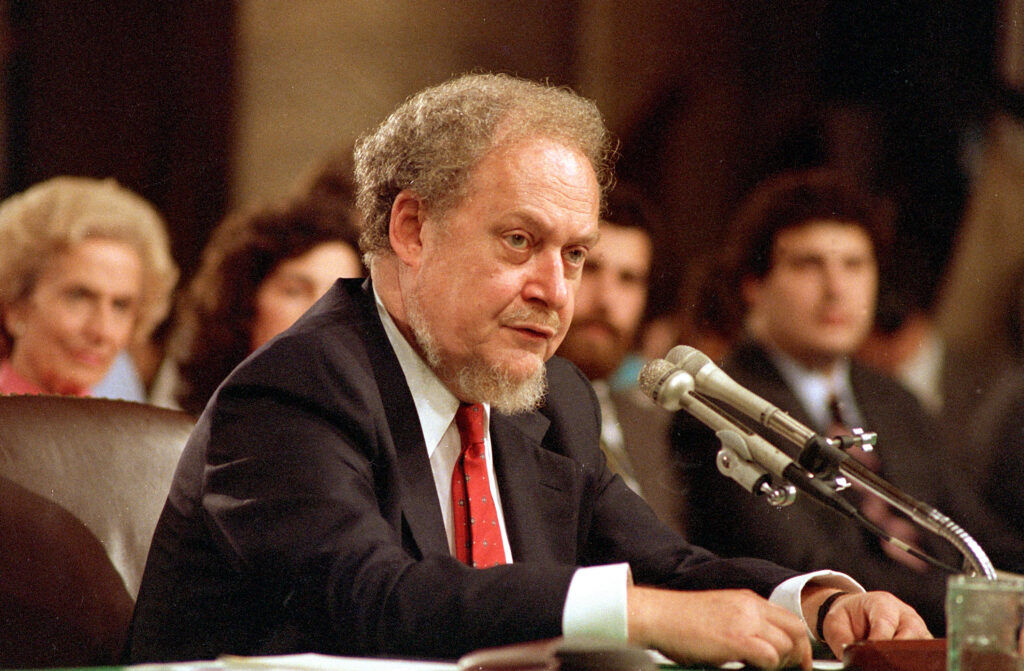
The year was 1987, and it was also the era of a would-be Supreme Court justice named Robert H. Bork.
The Washington City Paper had published a story based on a list of 146 of Bork’s video rentals, a snarky attempt to peer inside the conservative judge’s psyche. (Spoiler alert: Bork was a big fan of James Bond and Alfred Hitchcock movies.)
The story was not among the factors that derailed Bork’s nomination to the high court. But members of Congress were so concerned about the disclosure that, year later, they passed the Video Privacy Protection Act, or VPPA. The measure prohibited video stores from disclosing what tapes their customers rented.
While video cassettes and their purveyors have become relics of that bygone era, the VPPA lives on. The law is now the focus of a Supreme Court case involving one of the world’s largest media conglomerates — and a man named Michael Salazar, who says the company violated the VPPA when it gave his video watching history to Facebook.
For those reasons, Salazar, a California resident, argues that Paramount Global should pay him — and others like him — $2,500 in damages for the alleged invasion of his privacy. But experts say the case is about more than that relatively small sum.
In recent years, the Supreme Court has grappled with questions of personal privacy in the age of the internet and other rapidly evolving technology.
This summer, the court held that law enforcement officers must generally obtain a warrant before seeking location data collected by Google and other companies. The justices made a similar finding in a 2018 case involving cell site data, reasoning that the Constitution’s age-old protections against “unreasonable searches and seizures” applied to the 21st century technology.
The VPPA, passed in 1988, similarly did not contemplate how pervasive the internet would become in everyday life and the privacy concerns that have followed.
Yet a growing number of plaintiffs and privacy advocates say that the law applies to watching videos online, and they have cited the law to sue media companies over disclosing their viewing histories to tech companies for targeted advertising efforts.
Some privacy advocates and scholars say that is a valid use of the law, especially since there are so few federal statutes to protect web users against widespread data collection.
“This litigation … reflects a larger policy failure: Congress has not enacted comprehensive federal consumer privacy protections,” Carolina Rossini, director of the Public Interest Technology Initiative at the University of Massachusetts at Amherst, said in an email. “People are turning to the narrower laws available to them, leaving courts to determine how those laws apply to today’s tracking practices.”
“In my view, there is a strong legal argument for applying the VPPA” in Salazar’s case, Rossini added.
Paramount’s attorneys, along with an array of business groups, counter that lawsuits like Salazar’s are predatory and stretch the videotape law beyond any commonsense reading. (The case predates Paramount’s recent takeover of Warner Bros. Discovery.)
Lily Li, an attorney at the California-based Metaverse law firm, said she represents small businesses who receive lawsuit threats under the VPPA because they feature videos on their websites — “even if that isn’t the core competency like or what they do,” she said.
“If the court rules for Salazar, it does open the floodgates of litigation,” Li added.
The outcome will turn on the legal question of whether Salazar is considered a “consumer” under the law’s definition: a “subscriber of goods or services from a video tape service provider.”
Salazar says he is, and should therefore be allowed to sue Paramount under the law. He subscribed to a free newsletter provided by 247sports.com, a sports news website owned by Paramount, which gave him access to its videos.
The website tracked Salazar’s video watching habits with Meta Pixel, which sent the data to Facebook to feed the company’s targeted advertising system, Salazar alleges. That, he argued, made him a “consumer” by the law’s definition, because he subscribed to goods and services (a newsletter) from Paramount (a video tape service provider).
Paramount counters that Salazar should not be considered a “consumer” just because he signed up for a free newsletter and then, separately, watched videos on 247sports.com. The company said the same would be true if Salazar bought an non-video product like a bandanna from Paramount, and then sued because the company disclosed his viewing habits of footage unrelated to the bandanna.
“The statute thus does not create privacy rights for everyone who purchases non-video materials or merely views free videos,” Paramount wrote in a brief to the court.
The post Does a video store privacy law apply online? The Supreme Court will decide. appeared first on Washington Post.