President Volodymyr Zelensky of Ukraine said on Tuesday that Kyiv had received no warning from its Western partners before a Russian ballistic missile attack the night before. His statement came days after the Trump administration appeared to threaten to cut off intelligence sharing unless Ukraine stopped striking Russian oil refineries.
It was unclear whether Mr. Zelensky was suggesting that the United States had stopped sharing satellite intelligence, which would be a major escalation in President Trump’s latest feud with Ukraine, or whether Washington had simply failed to detect the attack. Ukraine relies on the intelligence to detect incoming missile attacks.
Mr. Trump said on Tuesday that the United States was continuing to share intelligence with Ukraine. “We are helping them, and we are sharing intel,” he told reporters. “We want the war to end, so we’re working with them and Russia on getting the war to end.”
In a social media post, Mr. Zelensky said that five Russian ballistic missiles had hit civilian infrastructure in the strike on Monday night, without specifying whether it had caused any casualties.
Russia has previously fired missiles that Western satellites have struggled to track, including S-400 missiles, which Ukraine has at times described as ballistic weapons. Serhiy Beskrestnov, a military expert who advises Mr. Zelensky, said after the attack on Monday that it was not the first time Western partners had failed to detect a launch of S-400 missiles.
Hours later, at a security conference in Warsaw on Tuesday morning, Ukraine’s foreign minister, Andrii Sybiha, said that intelligence sharing continued and that the attack went undetected “because of a special type of weaponry which was used by the Russian side.”
Fears that Washington might cut off intelligence sharing with Ukraine emerged after Mr. Trump struck a deal with President Vladimir V. Putin of Russia to buy millions of tons of Russian fuel. The agreement, before the U.S. midterm elections, is part of an effort to bring down sky-high diesel prices caused mostly by the U.S.-Israeli war against Iran.
As they presented the deal to the Ukrainians at a meeting last week in Miami, Trump administration officials asked Kyiv to stop striking Russian oil refineries so that Russian diesel could flow back onto the market. They said Kyiv owed Washington for critical U.S. intelligence assistance, which some in the room took as a veiled threat. A U.S. official later denied any suggestion that intelligence support would be withheld.
Mr. Zelensky said Ukraine had refrained from attacking Russian oil refineries over the past two days, framing it as a gesture of good will toward Mr. Trump, who on Friday declared an energy cease-fire that neither Kyiv nor Moscow has confirmed. Ukraine has warned that such a cease-fire would work only if Russia stopped its attacks on Ukrainian energy facilities.
The Trump administration has shown before that it is willing to withhold intelligence as a lever against Ukraine. After a meeting between Mr. Trump and Mr. Zelensky devolved into a shouting match in early 2025, Washington paused intelligence sharing with Ukraine for a few days.
On Monday, Russian missiles struck Kyiv around 10 p.m. local time. Air-raid alerts sounded too late, after the missiles had been launched, leaving residents with no warning. The lapse immediately prompted speculation online that Washington had cut off intelligence sharing.
Ukraine lacks the extensive satellite-based intelligence capabilities of the United States and relies on information from Western partners to monitor Russian military preparations signaling an attack. That includes activity at air bases, movements of ships and the deployment of ballistic missile launchers.
“Our NATO partners inform us when there is activity involving strategic aviation. Flights from one airfield to another. Where missiles are being delivered,” Col. Yurii Ihnat, a Ukrainian Air Force spokesman, said in an interview this summer. Sometimes, he added, Western satellites detected a flash indicating a missile launch, and partners immediately informed Ukraine.
Commenting on the overnight attack, Colonel Ihnat told Ukrainian national television that Western intelligence sometimes “fails to arrive.”
“This is not the first case,” he said. “If there were certain technical issues this time, I believe the experts can sort it out. And we will resolve this problem together with our partners.”
Mr. Zelensky said Western intelligence was critical. “This is what helps prevent killings when there is a warning about ballistic missiles,” he said in a social media post on Tuesday.
The cost of missing early warnings is perhaps felt most keenly in the eastern Ukrainian city of Kharkiv, which lies only about 20 miles from the Russian border. Air-raid alerts sometimes cannot be sounded fast enough when Russia attacks the city.
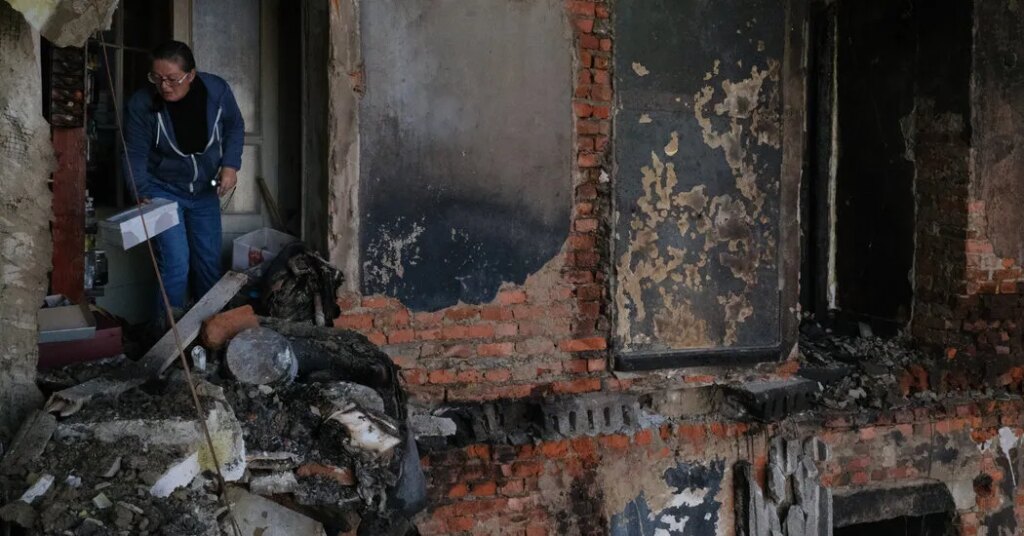
On Monday night, volleys of drones hit Kharkiv, rocking the city center with loud, rumbling explosions. Fires burned in several locations. One strike tore into a residential building, collapsing apartments to the ground. The mayor, Ihor Terekhov, said in a social media post that four people had been killed on Monday and that two more strikes hit the city the next day.
On Tuesday, rescuers who worked through the night were still at the site of the residential building, pulling a body from the wreckage. Exhausted firefighters rested on the open trunks of vehicles as bulldozers cleared blackened rubble of bricks and belongings. A burning smell hung in the air.
Lyubov Smal, 69, one of the residents, with stitches on cuts to her face, said she had been cooking cutlets in her kitchen when a drone struck the building.
Bleeding, she made her way through smoke to the landing and was helped out by firefighters. Twelve hours later, she came back to plead for help in finding her cat. Resting from working through the night, two rescuers jumped up and climbed the blackened stairs to a third-floor apartment.
“He won’t bite us?” they jokingly asked. Minutes later, they were back with a big gray cat with yellow eyes. He dug his claws into the fleece of a neighbor, jumping at loud noises as bulldozers resumed clearing rubble.
Kamila Hrabchuk contributed reporting from Kharkiv.
The post Zelensky Comment Raises Fears Over U.S. Intelligence Sharing appeared first on New York Times.