If you believe the artificial intelligence industry, they’re thirsting for government regulation; at least, some of their leaders are.
OpenAI issued a whole “blueprint for democratic governance” of AI in June. Around the same time, Dario Amodei, the chief executive of the AI firm Anthropic, called for “more serious and binding regulation of AI” akin to that of cars, airplanes and drugs, modeled on agencies such as the Federal Aviation Administration.
That looks encouraging, on the surface. But it demands a much closer look. The truth is that the AI camp is down with government regulation, as long as it’s regulation it has designed. Nothing says the devil is in the details more than its approach to regulation.
Leading AI executives have already been talking about limits on government oversight. In an interview earlier this month with Politico, OpenAI CEO Sam Altman advocated a “lighter touch regulatory stance,” predicated on the idea that “the world should accept some bad things happening for the benefits of this technology and people having the agency.”
That’s a familiar argument among technology entrepreneurs in almost every category — that what they’re doing is so danged important for the world that government should back off. Do you believe that decisions about how to balance bad consequences of AI technology with its benefits can safely be placed in the hands of the Sam Altmans of the world? (Me neither.)
Government regulation of technology is, of course, nothing new. It dates back at least to the late 1800s. But its enduring feature is that it almost always comes well after the drawbacks and public costs of a new technology have manifested themselves.
That was the case with hydraulic mining in the West, which involved aiming a torrent of water under high pressure to blast away soil and boulders to expose the underlying gold veins. Hydraulic mining was in effect outlawed in 1884 — by a court order, not legislation — but by then the environmental devastation it had unleashed in the Sacramento Valley was inescapable.
“You may still see, in places, its grassy slopes and levels torn and guttered and disfigured by the avaricious spoilers of fifteen and twenty years ago,” wrote Mark Twain in his autobiographical book Roughing It, published in 1872.
The stock market crashed in 1929, begetting federal securities regulations including the creation of the Securities and Exchange Commission — in 1934. The Federal Reserve System was created in 1913, but didn’t get effective oversight of the banking industry until it was restructured the via the Banking Act of 1935, drafted by Utah banker Marriner S. Eccles, in the wake of the banking crisis of 1933.
Regulation of workplace safety didn’t happen in the U.S. until the creation of the Occupational Safety and Health Administration in 1970. Over the next decade, OSHA finally began issuing standards for asbestos, lead and cancer-causing products at job sites. Black lung, that scourge of coal miners, had been identified in the mid-19th century but its cause, the inhalation of coal dust, did not come under federal oversight until 1969.
Another issue with government regulation of technology is which government — or governments — should be vested with oversight and enforcement. Efforts to institute regulations at an international level are often doomed to fail, typically because of geopolitical and economic competition.
J. Robert Oppenheimer, who had supervised the design at Los Alamos of the atomic bomb, especially the plutonium bomb dropped on Nagasaki in 1945, discovered that to his great disadvantage when he called for international oversight of nuclear weapon technology. His campaign made him a political target in the late 1940s and 1950s, when nuclear advocates in the U.S. government moved to discredit him as a communist fellow traveler.
The position of AI leaders like Amodei is that allowing a time lag in the case of artificial intelligence might leave it too late for regulation to be effective. Yet what the industry has ginned up has the veneer of regulation, not the reality.
That’s not unusual — industries typically ask for a seat at the table, the better to steer discussions to their benefit and dilute any resulting rules. In 2022, for instance, then-cryptocurrency tycoon Sam Bankman-Fried appeared before the House Agriculture Committee to advocate for what he called “regulatory clarity … for digital assets in the U.S.” because Americans were losing opportunities to profit from crypto investments.
Bankman-Fried supported a proposal to make the Commodity Futures Trading Commission “the model regulator for digital assets.” There was no mystery why he and the rest of the crypto community advocated this plan — it was because the CFTC is consistently underfunded and overwhelmed by its existing duties to regulate futures and options, and because the alternative proposed regulator, the Securities and Exchange Commission, is aggressive, well-funded and was known to be skeptical of crypto as an investment class.
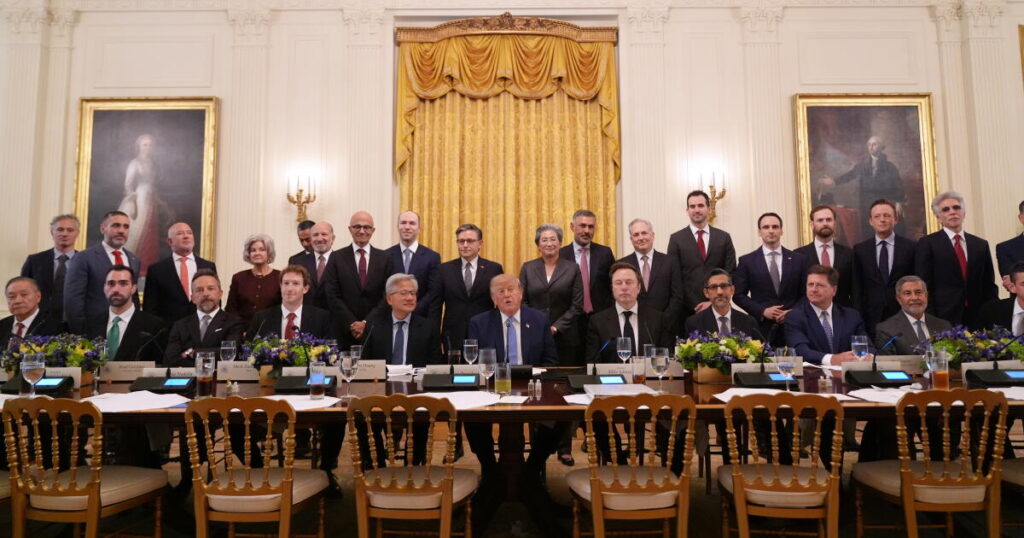
That brings us to the AI camp’s regulatory preferences. A recent summit conference that brought a clutch of AI leaders to the White House begat an “accord on super intelligence.” It urged AI firms to implement “robust internal controls” to prevent their products from hacking outside systems; “empower an internal team” to ensure the products are “operating as intended”; and employ independent external auditors; and designate an “independent” committee of its board of directors to oversee AI development.
Quite obviously, this was as pure an endorsement of self-regulation as even an AI bot could imagine. There’s no mention whatsoever of government oversight.
It was signed by top executives of Google, Anthropic, OpenAI, Meta, Nvidia and Elon Musk, whose company is XAI, all of which have an interest in the government keeping its distance from almost anything they wish to do. Trump described the accord as “tremendous self-policing.” AI analyst Gary Marcus had a different view: “Reading between the lines,” he wrote, the accord said “1. We agree not to be regulated, 2. We agree not to give the public a voice, 3. Trust us.”
Another signpost was a “blueprint for democratic governance of frontier AI,” a regulatory manifesto that OpenAI published in June. The blueprint advocated making the Center for AI Standards and Innovation, a unit of the government’s National Institute of Standards and Technology, the “primary institution” for U.S. regulatory oversight of AI.
The problem with that is that the center could become a cat’s paw of the AI industry, with virtually every AI company and academic research institution listed as a member of a NIST consortium on AI standards. Whether it could exercise anything resembling independent oversight is questionable.
One theme that permeates all AI-generated regulatory proposals is that AI is unique, requiring a new regulatory scheme. That’s dubious. Among the skeptics is Zephyr Teachout, an expert on tech policy at Fordham Law School.
Teachout dismisses AI developers’ claims that many of the known problems created by their systems, including hacks of other digital systems, were inadvertent and therefore nobody’s fault.
“A lot of people are treating OpenAI’s repeated claims that they didn’t intend the break-ins, suicides, murder, and building of defective products as dispositive,” Teachout told Marcus.
“That’s what people who don’t want to be held responsible often say. They say they didn’t mean it and they didn’t cause it. But police and prosecutors and civil enforcers don’t then shrug and move on — they investigate to see what actually happened, and that’s what should happen now.”
Lina Khan, the former chair of the Federal Trade Commission, also rejects the industry’s position that existing laws don’t apply to its technology: “Policymakers should look to laws already on the books, not to the online manifestoes and blog posts written by tech chief executives, for guidance,” Khan wrote in a recent op-ed.
“Much of the commentary from the executives suggests they currently operate in a legal vacuum, as if A.I. has wiped clean the regulatory map. In fact, their business practices — including how they develop and deploy their technologies — are already subject to longstanding laws,” including product liability and tort law.
She’s right. The subtext of much of the industry’s palaver about the need for new regulations is that AI is so new-fangled that the old rules don’t apply. But they do, and enforcing them should be start of keeping AI’s dangers under control.
The post Of course the government should regulate AI, but not the way the AI industry prefers appeared first on Los Angeles Times.