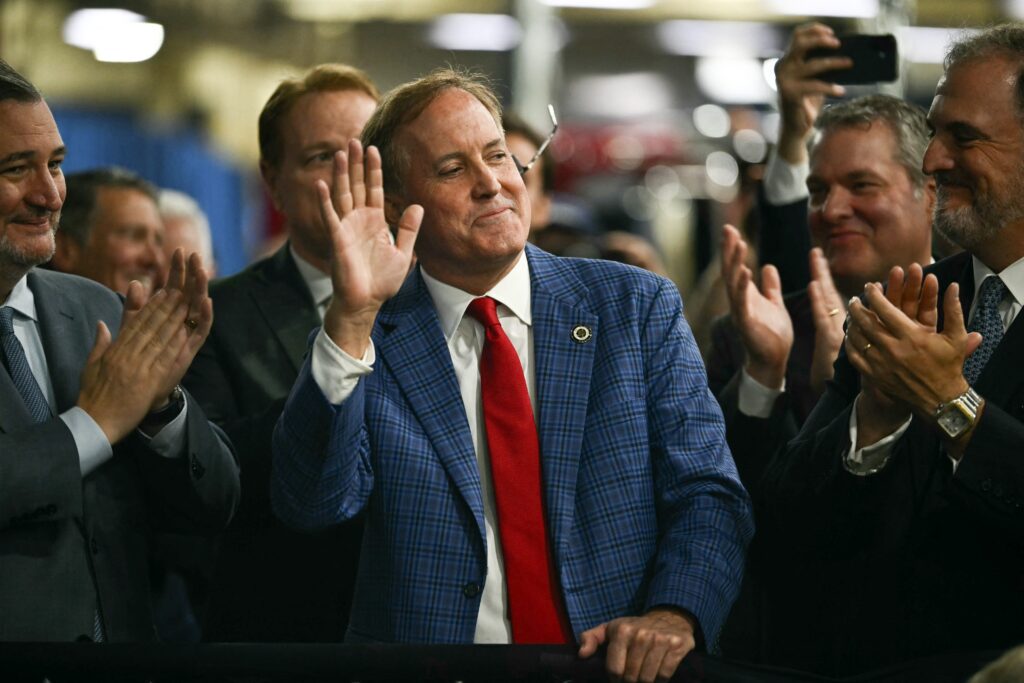
Texas Attorney General Ken Paxton, a candidate for U.S. Senate, received campaign contributions from the staff or political arms of five organizations with interests in legal matters on which his office weighed in.
The size of the contributions varied, with money from some firms or members of their staff totaling tens of thousands of dollars, according to state and federal campaign finance records.
It’s not illegal for an attorney general to accept campaign contributions from a group whose business has a stake in the attorney general’s actions, and Paxton’s case is not unique. Attorneys general elsewhere in the United States have faced scrutiny for campaign fundraising from parties dealing with their offices.
The parties that made the contributions include the manufacturers of a slot-machine-like device, an investor in a concrete facility attempting to overcome permitting constraints, and doctors associations hoping to secure greater control over anesthesia services. Attorney general opinions, which are public, are not judicial rulings, but they can carry sway in how the state government interprets and enforces the law.
Some of the contributions predate Paxton’s run for the Senate this year, in a competitive race against Democratic state Rep. James Talarico that has become the most expensive in the country.
Paxton’s campaign did not respond to requests for comment. The companies and organizations whose employees or political arms made the donations said the payments weren’t made to influence Paxton.
“Ideally you would avoid obvious conflicts of interest,” said Daniel Weiner, senior director of the elections and government program at the Brennan Center, a nonprofit law and policy organization that advocates for limiting money in politics. “But that’s very hard to do in the system we have right now, which is basically a free-for-all.”
Paxton has for years faced allegations of accepting bribes and using the power of his office to help a major donor. He has denied any wrongdoing and has never been convicted. However, Talarico has made Paxton’s past a cornerstone of his campaign.
This spring, Paxton’s campaign and fundraising committees received more than $100,000 from executives at Pace-O-Matic and Republic Amusements, the manufacturer and operator of a slot-machine-like game. Some of the executives had previously given to Paxton’s Senate race ahead of the primary, but none had ever contributed to his past campaigns for attorney general, according to state campaign finance disclosures.
At the time, Paxton’s office was reviewing whether certain slot-machine-like games counted as gambling, at the request of a state lawmaker opposed to gambling. Most forms of gambling are illegal in Texas. In a controversial ruling, a state court had said the year before that Pace-O-Matic and Republic Amusements’ game is not gambling and is skill-based. This decision meant the machines could operate in the state.
In June, Paxton’s office issued a legal opinion in response to a request from the state senator further clarifying what counted as gambling. The opinion said, based on current Texas law, that any game with any degree of chance in its gameplay should count as gambling — among the strictest definitions of gambling in the country.
It left open whether or not Pace-O-Matic’s machines counted as gambling and did not weigh in on last year’s controversial state court ruling — ambiguity that the Texas District and County Attorneys Association said could “cause a quandry [sic] for law enforcement and prosecutors.”
The Texas District and County Attorneys Association noted that attorney general opinions would not decide the legality of specific machines, because they interpret the law and not facts of individual cases. Petrus Wassdorf, a Texas attorney specializing in the state’s gambling law, said Paxton’s opinion was consistent with past interpretations of settled law.
Pace-O-Matic praised Paxton’s definition, saying it cracked down on gambling that masquerades as skill-based games.
Pace-O-Matic said in a statement to The Washington Post that its contributions were not related to Paxton’s opinion and that they were made by Pace-O-Matic and Republic Amusements employees in their personal capacity.
“Pace-O-Matic has consistently advocated for clear distinctions between legitimate games of skill and illegal gambling devices, and we welcomed the Attorney General’s opinion because it provided important clarity on that issue,” the company said. “Any suggestion that these individual political contributions were made in exchange for, or were otherwise tied to, the Attorney General’s opinion would be inaccurate.”
In another case, Paxton’s office issued a 2018 opinion on whether the Texas Commission on Environmental Quality was bound by municipal rulings; it suggested a concrete- and rock-crushing plant planned by donor Wallace Hall’s company could be built despite opposition from local government. Hall had previously donated more than $50,000 to Paxton dating back to 2014, according to state campaign finance records.
The city of Fort Worth had rejected the construction of the plant in 2016. But Paxton wrote in his opinion that a court would “likely conclude” that the Texas Commission on Environmental Quality could ignore the city’s opposition.
Hall used the opinion to lobby for a temporary permit for his concrete plant. Two months after the opinion, Hall donated an additional $10,000 to Paxton’s attorney general campaign. The permit was never granted for a rock-crushing operation.
Hall declined to comment.
In 2019, Paxton issued an opinion aligned with recommendations from the Texas Medical Association and the Texas Society of Anesthesiologists asserting that nurses can’t administer anesthesia unless delegated by a doctor to do so. The opinion cites the state legislature’s definition of nursing, which does not include diagnosing or prescribing treatment, including anesthesia.
The opinion was a priority for the medical groups, which have tried to limit non-doctors’ ability to administer anesthesia. Groups supporting nurse anesthetists have argued that a doctor’s sign-off shouldn’t be necessary and that it makes anesthesia more expensive. Anesthesiologists say doctors should oversee a procedure as complex and delicate as administering anesthesia.
One month after Paxton wrote his opinion, TSAPAC and TEXPAC, PACs aligned with the Texas Society of Anesthesiologists and the Texas Medical Association, donated to his campaign; the TSA’s then-president, Gerald Callas, gave as well. Together, their contributions totaled $24,000. All of the contributions were reported on the same day, according to state campaign finance records.
TSA President Jeremie Perry said in a statement to The Post that the group had backed Paxton for years before and after the opinion. The group made at least $120,000 in donations to Paxton’s campaign from 2014 until 2022, according to state campaign finance filings.
“TSAPAC, like other professional PACs, supports candidates and officeholders whose positions broadly align with issues important to its members and their patients,” Perry wrote. Callas did not respond to a request for comment sent to his practice.
Brent Annear, a spokesman for the Texas Medical Association, said in an email that the organization’s PAC gave to Paxton in 2019 as part of contributions to numerous candidates aligned with the TMA’s mission. He said there was no connection between the contribution and Paxton’s opinion. The TMA has given at least $33,500 to Paxton’s campaign since 2014, not including in-kind contributions for dining.
Paxton recently faced scrutiny over campaign contributions related to online betting. Last month, Politico reported that he had declined to join numerous bipartisan efforts by his fellow state attorneys general that would allow states to regulate prediction markets, despite his previous efforts to strictly regulate sports betting platforms.
Kalshi, one of the largest prediction market platforms, contributed $5,000 to Lone Star Liberty PAC, a Paxton-aligned super PAC, in May 2025. Kalshi’s chief executive, Tarek Mansour, contributed an additional $7,000 to Paxton’s campaign the following month, according to FEC filings. A spokesperson for the company told Politico that it supports candidates of both parties. Kalshi did not respond to The Post’s request for comment.
Paxton faced criticism this year after intervening on behalf of Texas Tech football player Brendan Sorsby, who had been disciplined by the Big 12 for gambling on his football games. Paxton wrote a letter to the Big 12 saying that if it tried to punish Texas Tech, he could file a suit against the conference that could expose it to more than $200 million in damages and legal fees. The letter was panned by the Republican attorneys general of Kansas, Oklahoma and Utah.
The day before Paxton sent his letter, Texas Tech Board of Regents Chair Cody Campbell donated $247,300 to Paxton’s joint fundraising committee. The Texas Tribune first reported Campbell’s contribution. Campbell denied to the Fort Worth Star-Telegram that he was engaging in pay-for-play. Campbell has donated to numerous Republican candidates for years, according to state campaign finance records. Campbell declined a request for comment.
Because Texas’s attorneys general are elected, some of Paxton’s predecessors also have faced questions about whether they were influenced by campaign contributions.
Sen. John Cornyn (R), a former Texas attorney general who lost this year’s Republican primary to Paxton, drew similar scrutiny for his fundraising efforts in 2000 for the Republican Attorneys General Association. Among the donors courted at the time were large companies that were being sued by states represented by Republican attorneys general. At the time, Cornyn dismissed any insinuation that he was susceptible to influence as “outrageous.” Cornyn’s staff declined to comment when contacted by The Post.
Paxton has been dogged by allegations of conflicts of interest during his tenure as attorney general — including corruption allegations that led to his 2023 impeachment in the state House. In that case, he was accused of accepting bribes and abusing his office to benefit a real estate developer and major donor, Nate Paul. Paul denied wrongdoing at the time.
Paxton had been accused of ordering his staff to intervene and defend Paul in multiple cases, including protecting him from foreclosure and fast-tracking public records requests to help him learn more about a criminal investigation against him. In addition to making campaign contributions, Paul hired a woman with whom Paxton was accused of having an affair. Paxton’s own staff reported the attorney general to the FBI on suspicion of corruption. Paxton denied any criminal conduct during his impeachment; his legal team did not deny the affair at that time.
The state Senate acquitted Paxton on all charges, and the federal investigation didn’t lead to charges.
The post Ken Paxton took campaign funds from donors with interests before his office appeared first on Washington Post.