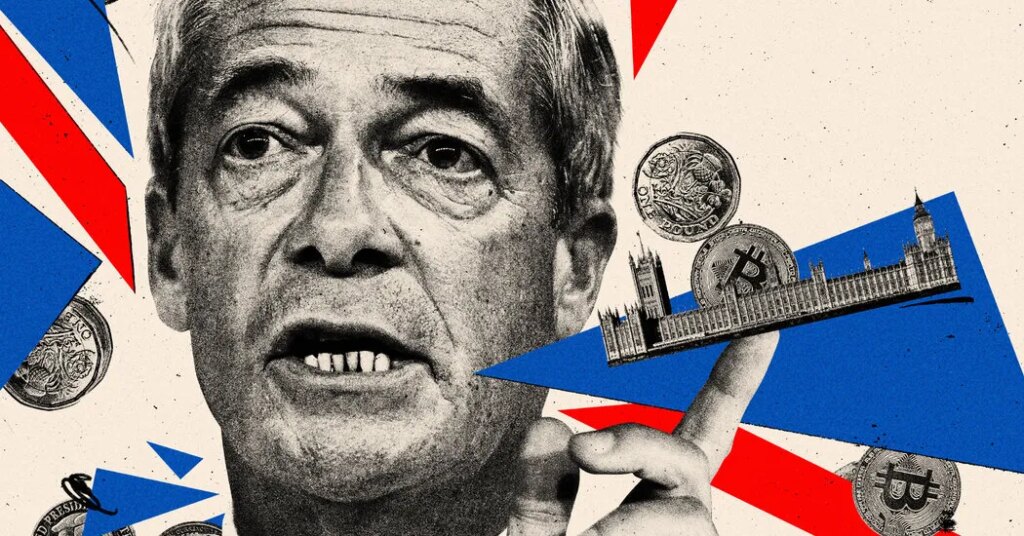
For a pub-going, cigarette-puffing man of the people, Nigel Farage, the leader of the Reform U.K. party, sure has some very rich friends. And two of them keep sending him and his party great gobs of money.
The gobs are so great, in fact, that the money has become Britain’s political scandal of the year. Driven by disclosures in the country’s Farage-obsessed news media, the tale has all the makings of a Netflix-worthy dramedy, one starring a pair of low-profile billionaires who rarely speak and a pinstriped populist who won’t stop talking.
That populist is Mr. Farage, 62, a jovial and polarizing scrapper who achieved national eminence as a champion of Brexit. His nativist zeal — he once claimed he was two hours late for a rally because he was stuck in traffic caused by foreigners — is matched only, it seems, by his yearning for wealth. In 2023, he was paid 1.5 million pounds (about $1.86 million) to appear on the reality TV show “I’m a Celebrity … Get Me Out of Here.” (He came in third.) He’s also a highly paid brand ambassador for a London gold dealer, Direct Bullion.
But these paydays were modest compared with the £5 million (about $6.3 million) that Mr. Farage pocketed in April 2024, when he was campaigning for the party as a private citizen. It was an “unconditional gift,” Mr. Farage would later explain, from a grateful Brexit supporter named Christopher Harborne, a British-born crypto investor who lives in Thailand, where he’s known as Chakrit Sakunkrit. In a rare interview with The Telegraph in April, Mr. Harborne said he “wasn’t expecting anything in return” for the money.
This arched some eyebrows. Mr. Harborne is worth roughly $24 billion, The Sunday Times estimates, most of it from a well-timed investment in Tether, the company behind the dollar-pegged stablecoin USDT. In June, The Guardian revealed that Mr. Farage had landed a meeting with the governor of the Bank of England and urged him to drop plans for a digital pound, known as Britcoin.
Were it issued, Britcoin would compete with Tether. Maybe there was some pro quo for all that quid.
Today, Mr. Farage is under investigation by the Parliamentary Commissioner for Standards for failing to report Mr. Harborne’s £5 million gift. He says he’s done nothing wrong. The gift was just the start of his troubles.
In early September, Channel 4 aired secretly recorded footage of senior Reform figures, including Mr. Farage, appearing to discuss ways to evade Britain’s ban on overseas campaign funding. (In one video, Mr. Farage drinks wine, eats oysters and praises polls purported to be paid for by a wealthy American donor.) A few days later, London’s Metropolitan Police opened an investigation into possible breaches of election law.
A Reform insider complained to the BBC that the party was starting to look “a bit like a pirate ship.” If that was the problem, one ardent supporter devised a curious corrective: more booty.
On Sept. 11 news broke that Ben Delo, another crypto billionaire and a self-described “maths geek,” gave Reform the equivalent of $48.7 million, the largest single political donation in U.K. history. As he explained in an opinion piece published in The Telegraph, he wanted to help Reform turn into a credible governing party.
Mr. Harborne apparently felt one-upped. The following day, he sent Reform $48.7 million of his own.
“My competitive spirit inspired me to match it,” he wrote, also in The Telegraph, “so that is what I’ve done.”
The donations caused face-palms all over Britain, where there are no super PACs and where parties receive limited public funding for parliamentary work and policy development, not campaigns. The whole system operates on a shoestring compared with the United States. Consider: In Britain’s last general election, the candidates from every party, in every constituency, spent a combined total of $125 million, said Sam Power, a lecturer at the University of Bristol, who studies political finance and corruption.
That’s about what the campaigns spent in Montana’s 2024 Senate race.
“We are seeing an increasing Americanization of the way in which people are financing politics in the U.K., and we kind of point to the U.S. as the system of worst practices,” Dr. Power said. “It’s not necessarily a Reform problem. It’s a system problem. And it has focused minds into asking, is this actually the way we want British democracy to go?”
In just two days, Reform was deluged with enough money to transform the arithmetic of British politics. And nearly every shilling came from opaque fortunes made abroad, courtesy of a donor base that could fit in a phone booth.
‘Bang for Buck’
Britain is not the only country where politics is being reshaped by crypto. In the United States, crypto companies and their billionaire backers have emerged as a bruising new force, rewarding candidates of both parties who support industry-friendly rules and punishing those who don’t. President Trump, who once dinged crypto as “highly volatile and based on thin air” has had a conversion. In the first year of his second term, he reported more than $1.4 billion in income from his family’s cryptocurrency businesses, much of it from his $TRUMP memecoin.
Mr. Farage declined through a representative to speak for this article, as did Mr. Delo and Mr. Harborne. But Mr. Farage has styled himself as a Thames-side Trump, a grinning combatant at war with legacy finance, status quo politics and the mainstream media.
At first glance, he seems an unlikely crypto fan. He is obsessed with borders and nothing ignores borders quite like digital assets. It’s odd, too, that he favors El Salvador-based Tether over a homegrown alternative that has “Brit” right in the name.
But crypto is consonant with his image as a fearless outsider and a scourge of the establishment. It’s part of a persona he has been fine-tuning since his middle-class upbringing in the Kentish countryside, the son of an alcoholic stockbroker who left the family when Nigel was 5.
He skipped college and worked in the City, London’s financial district, as a less-than-successful metals trader, says Michael Crick, author of “One Party After Another: The Disruptive Life of Nigel Farage.” Then he served for more than 20 years as member of the European Parliament,
which was a cushy gig, but not one that pays anything close to the salaries in finance.
“He does love the trappings of prosperity,” Mr. Crick said, “and of course he has this huge resentment that he devoted his life to politics.”
In recent months, a pattern has emerged. Mr. Farage mixes money and politics and a public relations disaster ensues. After the Parliamentary Commissioner opened an inquiry into Mr. Harborne’s undisclosed £5 million gift, Mr. Farage promptly quit his seat representing the faded resort town of Clacton-on-Sea. He then announced he would run again for the same job.
“The people of Clacton can decide whether they back me,” he said in a video statement, “or whether they back the establishment.”
The establishment shrugged. None of the major parties fielded a candidate and Mr. Farage’s only real opponent was Count Binface, a comedian wearing a trash can on his head and claiming intergalactic origins.
Though Mr. Farage easily won, that summer sideshow wounded Reform. Then came Channel 4, which broadcast what was essentially a sting operation by Verbatim, a self-described investigative organization. In one of the surreptitiously recorded videos, an actor posing as an American benefactor discussed with Mr. Farage opinion polls measuring support for British parties that Channel 4 says were commissioned by Reform but paid for by a U.S. company. If the polls were an overseas-funded benefit accepted by the party, that could breach Britain’s political-donation rules
“Amazing,” Mr. Farage said of the polls. “Bang for buck.”
He later said he hadn’t been listening to that part of the conversation. Two senior aides stepped down after the broadcast. Reform has denied wrongdoing, and an internal inquiry found that the aides, not the party, commissioned the polls.
After the by-election and the Channel 4 report, Reform’s popularity started dropping. Labour’s numbers went up, propelled by the elevation of Andy Burnham, the former Greater Manchester mayor, to prime minister.
So for Reform, the noisy arrival of roughly $100 million was well-timed It changed the subject from “Reform is hurt” to “Reform is rich.”
With the windfall came a risk. Mr. Farage says his party is the voice of “ordinary people.” There’s nothing ordinary about the two billionaires now bankrolling the party.
Both have spent much of their careers overseas, though Mr. Delo said he has returned to Britain specifically so that he can give Reform as much money as he wants. To Ben Habib, a former deputy leader of Reform and now a critic of Mr. Farage, catering to rich émigrés is no better than catering to poor immigrants.
“None of the policies that Farage makes, with the exception of perhaps crypto, will have any impact on these guys,” Mr. Habib said. “And yet they’re crafting the direction of travel for British politics and the way our country is governed. And I find that really unhealthy.”
‘I Can Spend It on Ferraris’
For men so politically consequential, Mr. Harborne and Mr. Delo are barely visible.
Much of what’s publicly known about Mr. Harborne comes from a defamation complaint he filed in 2024 against The Wall Street Journal over a story that he said falsely implicated him in efforts by cryptocurrency firms to mislead banks. A former McKinsey consultant, he moved to Thailand in the 1990s and founded an aviation-fuel business.
Most of his money originated from transactions that started with a fiasco and ended with a fortune. He was trading on Bitfinex, one of the world’s largest crypto currency exchanges, when it was hacked in 2016. Customers were compensated with dollar-denominated BFX tokens, which many sold. Mr. Harborne saw an opportunity and bought. He converted the tokens into equity and, through subsequent transactions, acquired roughly 12 percent of Tether.
Tether is now valued at $183 billion and Mr. Harborne owns roughly 12 percent of it. In his defamation suit, which both sides agreed to end in July. Mr. Harborne said he’s never had a management position with Tether.
“He just happened to be at the center of something massive at a very opportune time,” said Carol Alexander, a professor of finance at the University of Sussex. “It was very risky and it could have gone either way.”
Mr. Harborne has little social media presence and seems never to have submitted to a long interview or appeared on a podcast. One of the rare recordings of his voice is the snippet of a presentation he gave at his Thai resort, Kamalaya.
“One of the things we try to help all of our guests at Kamalaya is change one thing, on each visit,” he says, seated at a table, wearing a button-down shirt and sounding exceedingly chilled out. “Just one thing.”
Mr. Harborne came to his apparent serenity well into middle age. In a video clip described by The Guardian, he told listeners at a Kamalaya talk that in his late 40s, he’d worked 18-hour days, one after another, fueled by chocolate milk and cookies. Around that time, a two-seater plane he was piloting crashed into the garden of a couple in Hampshire, England. The couple were unscathed. Mr. Harborne was airlifted to a hospital with serious head injuries.
His politics are not easy to label. There’s not a peep in his opinion piece about borders or immigration. Instead, he says his main concerns are artificial intelligence, nuclear war and climate change. As for the £5 million gift, he says that the idea was born in 2019 after witnessing a protester toss a banana milkshake at Mr. Farage at a campaign stop in Newcastle.
The affront led to his resolve to “support Nigel’s security not just now, but for the rest of his life,” Mr. Harborne told The Telegraph in April. When the gift became public, Mr. Farage told a talk radio show that he might spend the money to protect himself. Or not.
“With all due respect, what’s it got to do with you?” he asked the interviewer, a bit indignantly, when asked about his plans for the cash. “I can spend it on Ferraris if I want.”
‘I’m Pleased to Have Cleared My Name’
Mr. Delo grew up in Oxford, where he was tossed out of three primary schools, The Telegraph reported. (In one, his offense was vandalizing the teachers’ toilets.) At age 11, he was diagnosed with Asperger’s, a form of autism, which he said made it hard for him to read social cues. Or maybe he likes making mischief. At a formal dinner at Oxford, from which he graduated in 2005, he once wore a wet suit under his gown, The Times of London reported. The rules said that a suit was required, but didn’t offer more specifics.
He’s routinely described in the British media as the country’s youngest self-made billionaire. Whatever his net worth, which is not an easy number to pin down, his path to riches included one very public setback.
After moving to Hong Kong to work for J.P. Morgan, he co-founded BitMEX, a platform for trading crypto derivatives, in 2014. Six years later, U.S. prosecutors charged him and his co-founders with willfully failing to establish adequate anti-money-laundering and customer-identification controls. In February 2022, Mr. Delo pleaded guilty to one count of violating the Bank Secrecy Act and agreed to pay a $10 million fine. Four months later, he was sentenced to 30 months of probation.
In March 2025, President Trump issued him a full pardon.
“A legal wrong has been righted today,” Mr. Delo said in a statement. “I’m pleased to have cleared my name and to be able to continue my life and philanthropic work without the burden of an unfounded conviction.”
Mr. Delo has since been on a philanthropic spree. He’s reportedly spent more than $100 million on a variety of charitable causes, from autism to his Oxford alma mater. His standout venture is known as the Sanctuary, a cross between a WeWork space and private members club, located in a neo-Gothic building a few steps from Westminster Abbey. There is no sign on the door and those admitted are asked not to post images of the interior.
“It has Chesterfield sofas, old tapestries depicting medieval scenes, Champagne, a Fabergé egg, a taxidermy penguin,” said Harry Shukman of Hope Not Hate, a British investigative group, who has researched the Sanctuary. “It also has maps of St. Helena, the island on which Napoleon was exiled.”
The Sanctuary hosts anti-woke and right-leaning thinkers, podcasters and politicians. Among the politicians is Rupert Lowe, the founder of Restore Britain, a party that has positioned itself as a harder-right alternative to Reform.
“I think he’s concerned about the direction that Britain is taking, and that he’s doing his bit to try and change that in the way in which he judges it to be best,” Mr. Lowe said of Mr. Delo in a phone interview. “I think he’s a very good man.”
In his opinion piece, Mr. Delo said he was “out of the crypto business” and wasn’t donating in the hopes of getting even richer. His passion is the destruction of political correctness, which he once described as a “totalising ideology that’s actually strangling our societies.”
Reform, it seems, is the only party equipped to fight this amorphous enemy. In his opinion piece, Mr. Delo likened the party to a start-up outmatched by entrenched rivals that have been around for hundreds of years.
“One of the reasons why the old parties have lasted so long is that they have made it very expensive to challenge them,” he wrote. “I want a fair fight and a level playing field.”
‘It’s Sort of Priced In’
The playing field might now tilt the other way. The party plans to hire as many as 400 campaign managers for targeted seats across the country. Mr. Farage also said he wants to build “the best research and policy operation British politics has ever seen.”
That presumes that Reform is able to keep the money.
In March, Labour introduced legislation that would cap political donations from Britons living overseas, and from those newly returned to the country, at £100,000 a year. The law would backdate these restrictions to March 25 and lead to the mother of all clawbacks. If Mr. Delo and Mr. Harborne lived overseas before that March deadline, Reform might have to return virtually all of the £72 million.
Which is why the whereabouts of these men is a pressing national matter.
“We just know that they have complied with the rules and regulations,” Richard Tice, Reform’s deputy leader, said in a BBC interview, “both existing and proposed.”
The legislation is on track to pass the House of Lords in the coming months, but the fate of the crypto bounty may well end up in court. Win or lose, Mr. Farage will cement his place as Britain’s leading populist, the local face of an ethnonationalist movement surging across Europe.
First, he might need to run for his seat in Clacton yet again. A report by the Parliamentary Commissioner is reportedly imminent, and an adverse decision could lead to a recall petition. Mr. Farage would then have to run a third time for same job. Should he win, a formidable task awaits — convincing voters across the country that he and Reform are ready for power.
“There’s no doubt this scandal stuff has damaged him,” said Alastair Campbell, a podcaster and the press secretary for former Prime Minister Tony Blair of the Labour Party. “But he’s hoping that he can be a bit like Trump, that it’s sort of priced in, it’s built in. That people will say ‘Yeah, Nigel’s a character, but let’s be honest, they’re all corrupt.’”
The post How Two Crypto Billionaires Are Making British Politics More American appeared first on New York Times.