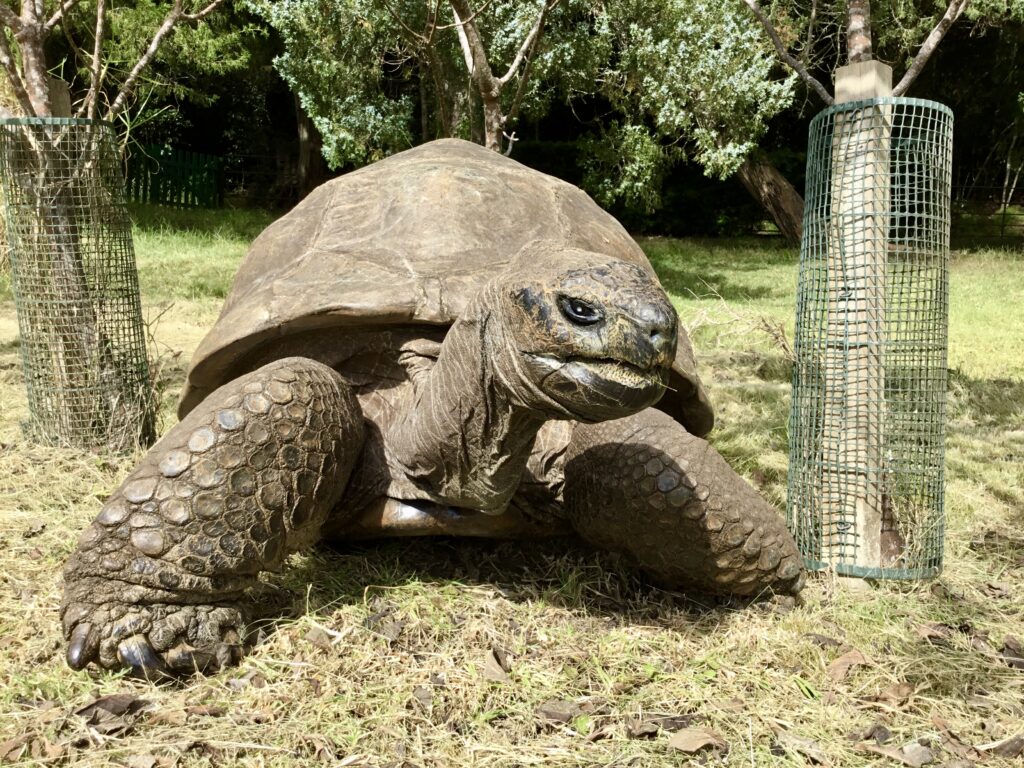
Jonathan is blind, but the 194-year-old giant tortoise knows it’s time to eat when he hears Joe Hollins call his name.
Jonathan chomps at the air, expecting Hollins to feed him pears, cucumbers or carrots. But a few times in recent years, Hollins, a veterinarian, tricked Jonathan and slid a cotton swab into the giant tortoise’s mouth to get a saliva sample.
He said he hoped that the saliva of the world’s oldest living land animal would serve a great purpose.
“Maybe a medicine or medication will come out of this,” Hollins said.
The DNA samples were sent to scientists who were searching for clues to Jonathan’s longevity and how they might help extend the human lifespan. The researchers said there was no better animal to study than Jonathan.
“He’s very unique,” said Stephen Clark, one of the researchers. “It’s always exciting to see the first kind of data — when you’re realizing you’re actually seeing Jonathan’s sequence.”
In people and most animals, including tortoises, genes undergo biochemical alterations as they age, which affect when and how well they work. The scientists’ research, published last week in the journal Science Advances, found that a subset of Jonathan’s genes remained remarkably stable despite his age, which might have helped him manage his blood sugar, reduce inflammation and guard against cancer.
In particular, genes involved in the function of Jonathan’s mitochondria — which are structures inside cells that produce energy — appeared similar to those from a 5-year-old tortoise named Hatchling.
“I was looking at the plots I made for the results and going, ‘Oh, wow, does it really show that?’” said Benjamin Vaisvil, a study author. “It’s crazy.”
After confirming their findings, the researchers suspect Jonathan’s youthful mitochondria have been key to his exceptional longevity.
After all, Jonathan, who was probably alive for President Andrew Jackson’s second inauguration in 1833, is still thriving.
He is estimated to have hatched in 1832 because he was fully grown when he arrived on St. Helena, a remote British island in the South Atlantic, five decades later. He became a tourist attraction during the past two decades.
But Jonathan wasn’t always in good health. When Hollins began working on the island in 2009, he said Jonathan had a crumbly beak and a thin reptilian hide. Hollins said Jonathan’s health improved — and his beak grew sharper — after he fed him a regular diet of fruits and vegetables.
Clark’s interest in Jonathan for his research began in 2017, when he was traveling to his great-uncle’s 100th birthday party in Portland, Oregon. On the way, he said, he learned his great-uncle had died of a stroke.
On his drive through Northern California, Clark marveled at the redwood trees and wondered how the trees — some of which might be 2,000 years old — lived so much longer than humans.
That question motivated Clark to better understand aging among plants and animals and to look for hints to extend humans’ lifespan. He joined a growing group of scientists studying long-living animals — including bowhead whales, Greenland sharks and naked mole rats — in hopes of discovering clues to healthy aging.
Hollins, 69, said he was happy to collect Jonathan’s saliva when Clark contacted him — even if he risked getting bitten. There was still a limitation to the samples: Researchers said they couldn’t draw Jonathan’s blood because St. Helena officials worried about the risk of infection.
A blood sample could reveal more about how Jonathan’s genes operate, said Steven Austad, a researcher who studies aging at the University of Alabama at Birmingham, who was not involved in the study.
There’s reason to believe research on Jonathan and other animals could lead to advancements for people, Austad said. He pointed to how a molecule in Gila monster venom inspired GLP-1 medicine, originally developed to help manage diabetes but has since expandedto help treat people with many other conditions.
“Nature has had billions of years to try billions of experiments to see better and better ways of, let’s say, repairing your DNA,” Austad said. “So it could turn out that tortoises have something that we can identify and ultimately translate into humans. We just don’t know.”
Clark, the chief scientist for the Kallel Foundation, a nonprofit in Tennessee that studies aging, said researchers are still trying to figure out why Jonathan’s genes and mitochondria are so stable.
He hopes to eventually develop treatments for humans that help preserve healthy mitochondrial function. Healthy mitochondria are linked to healthy aging in people; a study last year found a 117-year-old woman had “efficient mitochondrial function.”
The researchers said they plan to further study Jonathan in hopes of learning more of his secrets.
“When he dies, of course, we can take all [the] samples in the world,” Hollins said. “But we’re hoping that’s not soon.”
Gretchen Reynolds contributed to this report.
The post At age 194, Jonathan the tortoise offers clues to longevity, study says appeared first on Washington Post.