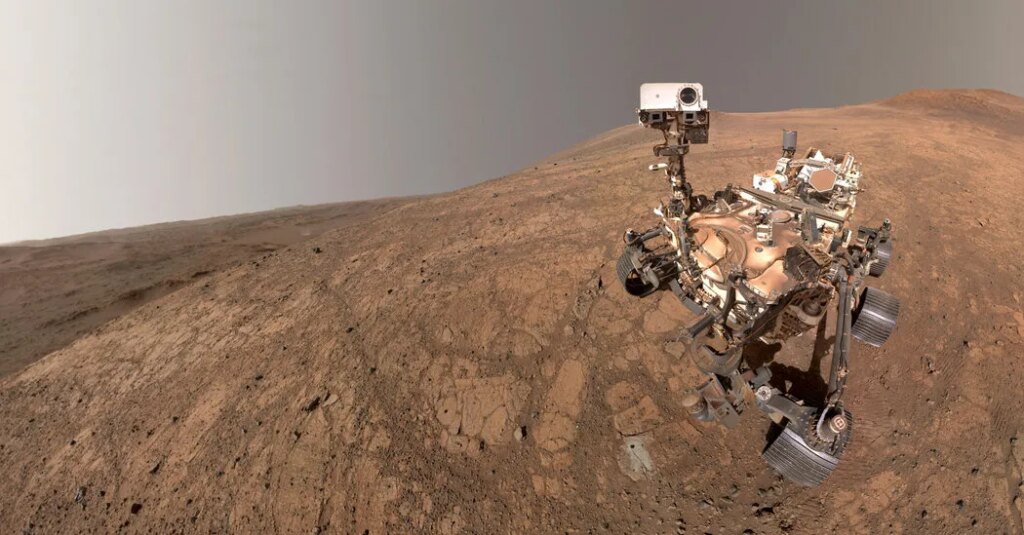
NASA’s Perseverance rover has now driven farther than any other vehicle in the solar system — except those on Earth, of course.
On Sunday, Perseverance’s odometer ticked past 28.06 miles, the distance it has traveled in and around Jezero Crater since it landed on Mars in February 2021. That surpasses the distance that Opportunity, one of NASA’s earlier, smaller Mars rovers, trundled from 2004 until it fell silent in 2018.
NASA’s Jet Propulsion Laboratory, which operates the rover, announced the news on Monday after confirming Perseverance’s location and new total driving distance: 28.1 miles.
Mission managers had thought Perseverance would pass the milestone back in August, but then it came upon intriguing, light-colored rocks that may be some of the oldest ever studied on Mars. And thus, it dawdled for two months.
“Science is the reason that rover is on the surface of Mars,” Katie Stack Morgan, the project scientist, said in an interview in early October. “We’re excited to get the record when we get it. But in the meantime, it’s the rocks that really drive the mission.”
Perseverance most likely still has many miles to go in the coming years. Here are some highlights from its drive so far.
The First Stop: Jezero Crater Drop-In
On Feb. 18, 2021, Perseverance landed in Mars’s Jezero Crater, a 30-mile-wide depression that had been a lake when the planet was warmer and wetter, during the early years of the solar system.
The pattern on the parachute that slowed the Perseverance spacecraft as it descended through the Martian atmosphere contained a secret message: “Dare mighty things.”
Flight of the Marscopter
Among the mission’s early tasks was one that did not involve much driving at all.
Tucked under the belly of Perseverance was a small helicopter named Ingenuity. Once it was dropped onto the Martian landscape, Ingenuity made the first controlled, powered flights on another planet. Perseverance sat nearby to observe as well as to relay data from the helicopter back to Earth.
The four test flights were so successful that the mission managers decided Ingenuity should tag along with Perseverance on its exploration of Mars. Ingenuity made 72 flights until one of its rotors broke in January 2024.
Putting Self-Driving to the Test
Perseverance spent much of its first year driving around the Jezero Crater floor, which is made of rock that melted and then hardened in the aftermath of a meteor impact that created the crater.
Like some of the newest cars on Earth, Perseverance uses self-driving technology to figure out how to make its way from Point A to Point B without turn-by-turn directions from Earth.
Because of an additional, faster computer chip, it is even better at this than its near-twin, the Curiosity rover, which landed more than eight years earlier and has covered less distance. (Curiosity, heading up a mountain, is also in less of a rush.)
The capabilities of Perseverance, which is the size of a small car, dwarf what NASA’s first robotic rover, Sojourner, could do in 1997. That rover moved 341 feet — less than one-fifteenth of a mile — over 12 weeks and could perform only the exact commands it was sent. Once, it got wedged with a wheel stuck raised against a rock because its driver miscalculated the distance.
“Just dramatically different,” Matthew Wallace, an engineer at the NASA Jet Propulsion Laboratory, said of the complex work that a team of engineers on Earth needed to do just to plan a tiny drive for Sojourner, compared with what Perseverance can do by itself.
Rivers, Rocks and Ridges
After exploring the crater floor, the next leg of Perseverance’s journey was driving to an ancient river delta along the crater, where it arrived in April 2022. That was considered a promising location to search for hints of organic remnants, should life ever have existed on Mars. This was NASA’s primary motivation for choosing the Jezero Crater as Perseverance’s destination.
Beyond Jezero
Perseverance has since driven up and out of Jezero and is now exploring rocks that are some four billion years old in a region known as Lac de Charmes, after a reservoir in France. Bedrock that old is not found on Earth, because plate tectonics continually pushes the continental crust down into the interior of the planet.
“What Perseverance is offering us is really a view into that very early solar system history, like in the first half a billion years,” said Vivian Sun, the acting deputy project scientist. “There’s a lot that we can learn from these rocks.”
Those rocks include the light-colored ones that have intrigued the NASA scientists since August.
Most of the Martian crust is made of basalt, a fine-grained volcanic rock that is a dark gray. (The reddish tint of Mars comes from the dust. When rock weathers, iron in the minerals rusts.)
“And so anytime we see something that is distinctly light-toned, it attracts attention,” Dr. Stack Morgan said.
At the northern end of a valley in Lac de Charmes, the scientists spotted a collection of light-colored rocks so the rover took a detour to take a look.
The light-colored rocks are what are known as gabbros — coarse-grained volcanic rocks that are similar in composition to basalt, but which probably formed farther underground where the magma cooled more slowly and allowed larger crystals to form.
“We’ve been seeing in these rocks evidence for very intense melting and shock, and this is exactly what we expect to see in really, really ancient pre-Jezero rocks representing the crust of Mars,” Dr. Stack Morgan said.
The scientists think the blocks of rock might even be the result of three separate meteor impacts — one that melted the Martian crust and produced the gabbro, a second that created patterns of shock and additional melting and a third that propelled them to their current location just outside Jezero.
“It’s very much a detective mystery here,” Dr. Stack Morgan said.
Perseverance attempted to drill one of the rocks but failed, because it was too hard.
NASA has not made long-term plans about where to send Perseverance after it finishes surveying the current region. At some point, the agency will also need to decide what to do with the rock samples that Perseverance is carrying.
But an effort known as Mars Sample Return, which would have brought them back to Earth, has been canceled, because the mission, which would have been a collaboration between NASA and the European Space Agency, was deemed too expensive.
NASA could revive it as a commercial mission but has not made any announcements.
Before launch, NASA had certified that Perseverance was capable of driving 20 kilometers, or 12.4 miles. “We’re way past that now,” said Steven Lee, the mission’s project manager.
Now, NASA is working to extend the certification to 100 kilometers, or just over 62 miles.
“I could certainly see it eclipse a hundred kilometers if it just keeps going the way it’s going,” said Mr. Wallace, who is now the deputy director for flight systems at J.P.L. “But you never know. We might find a holy grail science sort of location and decide to stay for a long time and investigate.”
The post 28 Miles and Counting: NASA’s Perseverance Rover Sets a Mars Driving Record appeared first on New York Times.