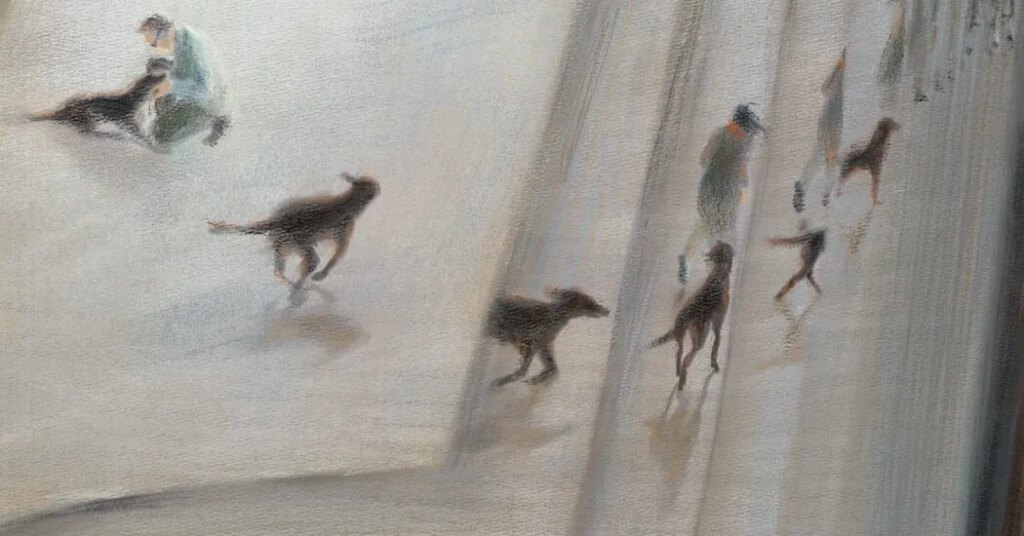
LUNA, PHOENIX, QUEEN, by Julie Orringer
If a novel can be considered a container for intimacy — not just between characters, but between book and reader as well — then a novel within a novel might heighten that intimacy, offering privileged access to a private world. That’s the case in Julie Orringer’s thrilling “Luna, Phoenix, Queen,” which features another novel, one that has been pillaged and repurposed, at its center.
But before this theft takes place, Orringer introduces us to the dynamics of an uneasy marriage. Barr Pennington, a fiction writer who teaches at the same university as his wife, an esteemed English professor named Dava, is frustrated. His latest novel, about two brothers in Philadelphia during the Depression, received little attention, which Barr blames on the current unpopularity of “his demographic.” Dava’s gentle suggestion to write something “more intimate, something that entailed more personal risk,” leads to a prizewinning story, but it’s not enough to satisfy his ego.
Meanwhile, Dava has been more and more absent — taking long walks alone and traveling to academic conferences — and working on a secret writing project of her own. “Night after night she wrote by hand on yellow legal pads, sometimes filling six or seven in a single evening,” but when Barr wakes in the morning, the legal pads are nowhere to be found. “What if her work, when it came to light, eclipsed his own?” Barr thinks. Never mind: “A work of literary criticism, no matter how groundbreaking, would never be a great novel.”
But Dava’s memory is failing, and she’s eventually diagnosed with early-onset Alzheimer’s. Years pass, and one night, months after he’s moved her to a memory-care facility, Barr is sitting at her desk, feeling lonely and unmoored, when he accidentally comes upon her mysterious project, which she stashed in a hole behind the wall of her office. He’s shocked to find that it’s a novel about a romantic affair between two women, confirming what “he had known about in his heart for years. Svetlana White, professor of Russian literature, Dava’s closest friend, was also her lover.”
Feeling doubly betrayed — the protagonist’s husband is “a small-minded ill-liked school principal … who believed himself more intelligent than he actually was” — Barr starts editing, and then freely rewriting, his wife’s manuscript as his own. He simplifies its character developments and its “Jamesian” density, reduces “pages and pages” of “transcendent sex” into “a few covert encounters,” and trades the “pedantic principal husband” for one “who was sometimes distant but brilliant and sensitive.” In his grandiosity he decides he himself wrote the novel, which becomes a critical and commercial success.
Barr’s appropriation is disturbing and exciting material, but it’s only backstory for the true drama of the novel, which concerns the fallout — the ways his actions reverberate over time. Spouses share a particular dialogue that no one else has access to; when one partner is unable to participate in it, the loss to the other is profound. Barr needs to confide in someone. His choice of confidante is startling.
On an animal shelter website he finds Luna, a dog who has been badly burned in a fire, and he feels drawn to her. Here Orringer makes an unexpected, and clever, literary choice: When Barr goes to the shelter and takes her for a walk, Luna begins to speak to him. “You look like you want to say something,” she says, and so he does, and their relationship deepens.
“He told her how beautiful Dava had been” and “about the pleasure of listening to her describe her work,” about his jealousy of her accomplishments “and how small his own successes had seemed in comparison.” He details her illness and, finally, “the rough pleasure of tearing open Dava’s novel, of remaking it.” Here Barr seems to be guided by his own animal instinct, free of the rules of human decency and morality.
As Orringer’s title indicates, the wounded dog serves different functions for different characters, whose multiple perspectives allow the book to open outward. We are given the points of view of Svetlana; the Penningtons’ sons, Milo and James; and Barr’s research assistant, Evie, who plays a pivotal role in the plot.
We also get an early, poignant glimpse of Dava’s inner life, full of moving observations though already losing track of time and space. Orringer writes that Luna’s injuries make the dog appear “blurred in places”; the phrase might also be used to describe the later effects of Dava’s illness.
This is a novel as saturated in plot and characters as it is in other works of fiction (and not just Dava’s): There are references to Virginia Woolf’s “Night and Day,” Tolstoy’s “Anna Karenina” and Chekhov’s stories; and one chapter is named “Hans My Hedgehog,” after a fairy tale by the Brothers Grimm.
At the book’s astonishing climax, the dog helps provide a partial window onto another narrative: its own. “Luna, Phoenix, Queen” brilliantly emphasizes the agony of isolation in its various forms, and the relief that can only come in telling a story for oneself.
LUNA, PHOENIX, QUEEN | By Julie Orringer | Knopf | 271 pp. | $32
The post In This Marriage, Infidelity Is Not the Only Betrayal appeared first on New York Times.