Regarding the Oct. 2 news article “Bipartisan bill seeks to ban cellphones in schools nationwide”:
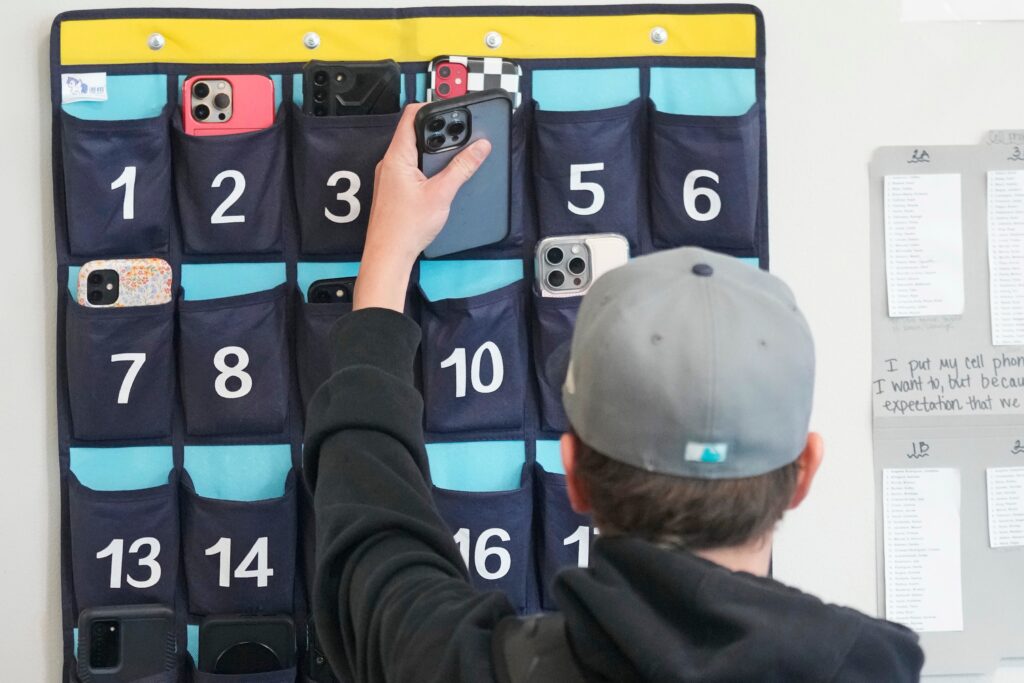
I’m a high school student, and I believe that phones should stay in schools. I recently discovered that I have attention-deficit/hyperactivity disorder, and I have worked with my doctor to find strategies to help with my learning. One of them is listening to music. It helps me block distractions and allows me to be present during class. And it’s not helping just me: An April 2026 study published in Psychiatry International found that among students with ADHD, listening to music while studying was associated with a higher GPA. Taking phones out of schools would take away easy and discreet access to the music that helps me learn.
Meara Power, Cleveland
I’m a high school student, and I strongly believe that technology should be used in the classroom. One of the main issues that this bill attempts to address is mental health, but I can vouch for the fact that if any mental health damage is sustained, it is most definitely not because someone wanted to text their mom in class. This leads to my next point: Having smartphones in school lets students easily communicate with home, which can help ease anxiety during emergencies.
Phones also allow students to easily access learning materials and tools. I don’t think cellphones will get any less prevalent in the future, so having them in schools allows students to learn in both a fun and up-to-date way.
Hughes Wilson, Cleveland
How to improve Trump accounts
The Oct. 8 editorial “A good step to build wealth for American kids” argued the Trump accounts would have greater buy-in had the president not politicized the initiative by insisting the accounts bear his name.
I think it is the lack of progressivity in the account structure that prevents broader buy-in, not the name. Sen. Cory Booker (D-New Jersey) and Rep. Ayanna Pressley (D-Massachusetts) offered the forerunner to the Trump accounts through their baby bonds legislation. Their version provided decidedly higher contributions for low-income households than the Trump accounts do.
The editorial board argued the private Dell grant is an efficient way to redistribute resources to “children in lower-income areas.” The Dell gift provides $250 across a very broad group of children (about 70 percent of children in the target age range qualify). The gift is indeed generous, but it will not meaningfully change the ultimate wealth accumulation of children from low-income families.
I agree with the editorial board that the Trump accounts are a good step, but they need to be improved. A straightforward approach is for the government or charitable foundations to target sizable contributions to children who reside in truly low-income areas. Specifically, targeting new contributions to the 5 million children who reside in persistent poverty counties in the United States would be a good and simple next step. This might help the accounts get the broader political buy-in that is currently lacking and hopefully encourage their use long after President Donald Trump leaves office.
David A. Weaver, Columbia, South Carolina
The writer is a former director of health, retirement and long-term analysis at the Congressional Budget Office.
The grid needs backup
Brian Deese and Anna Pasnau’s Oct. 7 online op-ed, “The battery-storage backlash is a costly case of mistaken identity,” was right to warn against conflating battery energy storage with the debate over data centers. But the case for battery storage goes well beyond accommodating America’s growing appetite for computing power.
Consider what happens on a sweltering summer afternoon when air conditioners are running full blast and electricity demand surges. Battery systems can deliver stored power exactly when the grid needs it most, easing pressure on utilities and helping contain costs for families and businesses.
That flexibility matters just as much when severe weather threatens. Hurricane Isaias showed that the importance of reliable electricity is anything but abstract. Battery storage can help stabilize the grid and, when properly configured for backup power, support critical services during outages. With winter approaching, these are benefits communities need whether or not a data center is anywhere nearby.
None of this means dismissing legitimate safety concerns. Battery installations demand rigorous testing, appropriate siting and strong fire protection measures. A practical path forward would be implementing modern, consensus-based safety standards that protect communities without shutting the door on technologies they increasingly need.
America’s energy future comes down to three core priorities: more electricity, greater reliability and lower costs. Americans should be making it easier to deploy technologies that help deliver all three, not erecting new barriers to them.
Patrick Hughes, Arlington
The writer is the senior vice president of strategy, technical and industry affairs at the National Electrical Manufacturers Association.
Letter submissions
Send letters to [email protected].
Submissions must be exclusive to The Post and should include the writer’s address and day and evening telephone numbers. Letters are subject to editing and abridgment. Please do not send letters as attachments. Because of the volume of material we receive, we are unable to acknowledge submissions; writers whose letters are under consideration for publication will be contacted.
The post I’m a student. This is why I need my phone at school. appeared first on Washington Post.