BEIJING — To hear American officials tell it, Moonshot AI developed its powerful artificial intelligence models through “malicious” pilfering from American tech firms and is part of a Communist Party plot to hook U.S. companies on low-cost Chinese AI.
But at the company’s head office here, an unremarkable building in the Zhongguancun high-tech district, there are no signs of such anti-American malevolence.
Moonshot’s meeting rooms are named for American rock legends like Metallica and Led Zeppelin; the company’s very name stems from founder Yang Zhilin’s affection for Pink Floyd’s “The Dark Side of the Moon.” Company executives bask in tweeted praise from prominent Americans like Elon Musk. And Yang, who earned his doctorate in Pittsburgh at Carnegie Mellon University, even gives his models his English-language nickname, Kimi.
Moonshot is emblematic of the deep ties between two nations supposedly locked in an all-out battle for AI dominance.
While President Donald Trump’s administration — and U.S. tech leaders — routinely paint AI development as a winner-take-all contest, many U.S. companies rely on Moonshot’s latest offering, Kimi K3, as an inexpensive alternative to products from Silicon Valley. U.S. data centers are full of made-in-China equipment and AI-enabled products such as Meta’s smart glasses are made by Chinese workers.
“We’re so deeply intertwined,” said Kyle Chan, an AI specialist at the Brookings Institution in Washington. “There’s a lot of actual dependency.”
Those links are striking given the alarms raised in Washington about Chinese AI development. In April, Congress began probing U.S. companies’ use of Chinese AI models, citing alleged national security risks. And last month, the FBI, the National Security Agency and the Department of Homeland Security’s cybersecurity arm issued a joint advisory accusing Moonshot and five other Chinese AI companies of basing their development strategy on unauthorized training on U.S. models.
U.S. demand for low-cost Chinese AI is so robust that when the Trump administration in July considered banning it for national security reasons, a coalition of nearly 300 domestic companies loudly objected. The craving for Kimi K3 among American customers, wrote Wei Sun, an AI analyst for Counterpoint Research here, “marked the moment open intelligence itself becomes a geopolitical dependency.”
“Open weight” AI models made by Chinese companies such as Moonshot, Deep Seek and Alibaba can be customized by users and are far cheaper than the “closed” models offered by Silicon Valley companies like Anthropic and OpenAI. Though the closed models are more advanced, U.S. companies such as DoorDash and Airbnb have found that the Chinese products are more than adequate for many routine tasks. (The Washington Post has a content partnership with OpenAI.)
The Chinese companies “are a threat to Anthropic and OpenAI, the closed models — who are driving, by the way, the entire U.S. economy,” said Paul Triolo, a partner at DGA-Albright Stonebridge Group, a Washington consultancy. “And the U.S. government is now in a difficult position, because what do you do about that?”
Indeed, the U.S. hold on cutting-edge technologies that most Americans have long regarded as a national birthright now faces perhaps its stiffest challenge since Sputnik.
U.S. labs retain a lead of several months over China in the pursuit of artificial general intelligence or AGI, a level of cognitive ability that would exceed human capabilities. But Chinese researchers are innovating in ways once thought impossible in authoritarian nations. And they are capitalizing on their nation’s unrivaled manufacturing base to spread AI through the economy long before reaching that goal.
“China is doing a lot in hardware. I think that’s a major distinction between China and the U.S.,” said Hao Chen, a research fellow at Harvard Kennedy School, specializing in the Chinese economy and AI industry. “The U.S. logic is: The model is the most important. But China thinks the models and the hardware are equally important. And China has an advantage in manufacturing.”
In the United States, AGI is akin to the Holy Grail. Top AI companies are pursuing ever more sophisticated models, even hiring religious scholars and philosophers to advise on their creations’ moral attributes. If China achieves AGI first, Treasury Secretary Scott Bessent warned last month, “nothing else would matter.”
Many Chinese companies, however, place less emphasis on AGI. Taking their cue from Chinese leaders, they instead approach AI as an all-purpose technology to use throughout industry, government and everyday life.
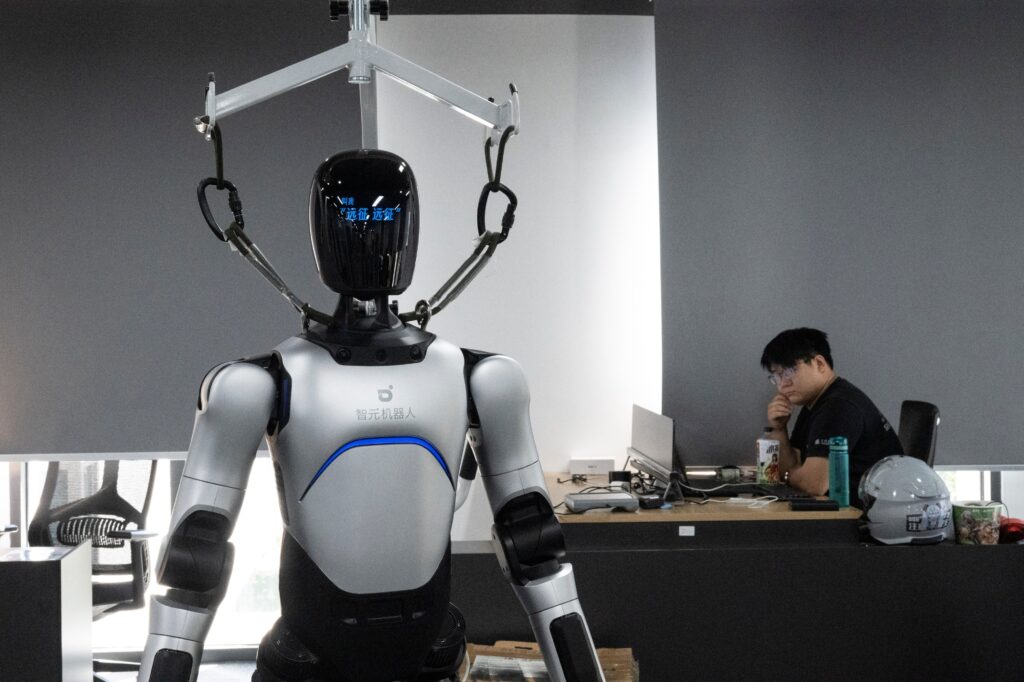
Today, that means robot butlers in many big-city hotels, home assistants powered by Bytedance’s Doubao app, ubiquitous AI-generated short videos and ever-vigilant state surveillance systems. Tomorrow, it may mean even more.
China’s State Council last year updated a two-year old “AI Plus” initiative, saying it should “promote the extensive and in-depth integration of AI with all sectors and fields of the economy and society.” By 2030, six priority sectors — including science, government and industrial development — should reach 90 percent adoption rates of intelligent agents and terminals, the council said.
In the shadows of a shuttered steel factory in western Beijing, Chinese technologists are using artificial intelligence to equip robots with the fine motor skills needed to lift an egg without crushing it, insert an electronic part into its housing or even separate the head of a crayfish from its body.
Tashan Technology specializes in “tactile processing chips” that allow robots to distinguish between light and heavy objects and use the appropriate grip strength for each.
At the company’s research center, workers direct robots to perform jobs such as wiping up kitchen spills or fetching a product from a mock store shelf. One product that’s nearly complete would upgrade hotel robots to hand guests their room service orders rather than merely deliver them to their doors.
“I think this reflects an interesting difference between the Chinese industry and the U.S. industry,” said Chen Jinlin, the head of Tashan’s international business. “On the U.S. customer side, they will have a huge vision or a huge goal at the first stage. [But in China] there will be customers who are willing to pay for these products even if they could only do one task.”
China’s incremental strategy is born of necessity. Compared with AI companies in the U.S., Chinese companies are short of capital and computational resources or “compute.”
Altogether, China’s top six AI companies report about 10 percent of the combined annual revenue of Anthropic and OpenAI, according to Epoch AI, a research firm in San Francisco.
Raising money from investors isn’t any easier.
Chinese companies face greater regulatory scrutiny both at home and in the U.S. before being able to list in New York. Moonshot is aiming for an initial stock offering in Hong Kong early next year that could raise up to $5 billion, Bloomberg reported this week. In contrast, Anthropic’s much-anticipated IPO later this year could bring in 20 times that amount.
The compute shortfall is equally daunting. Thanks to Washington’s export controls on the most advanced computer chips, U.S. companies enjoy a 10-to-1 advantage in the processing power needed to develop, test and run AI models, according to an August report from the Institute for Progress, a Washington nonprofit that says it favors pro-growth innovation policies.
U.S. security officials last month said six Chinese AI companies — Moonshot, DeepSeek, Alibaba, Minimax, StepFun, and Z.AI — engaged in extensive campaigns to train their models on the best U.S. frontier models, violating the U.S. companies’ terms of use.
Still, Chinese companies enjoy the world’s most extensive manufacturing base, which allows for rapid prototyping, testing and product improvement across an array of AI goods.
Over the past several decades, a sprawling network of Chinese electronics suppliers has developed in cities such as Shenzhen, Shanghai and Hangzhou. Those producers of motion controllers, sensors and inertial measurement units represent a competitive advantage that is especially important in the robotics sector.
For example, making Tesla’s Optimus 2 humanoid robot with Chinese suppliers would cost about $46,000 for materials, according to Morgan Stanley. But making it with a non-Chinese supply chain nearly triples the cost to $132,000.
Many of the Chinese companies that serve the burgeoning robotics sector do double duty feeding electric vehicle makers, Chen said.
Tashan is an example of this industrial overlap. The company got its start in 2017 developing electronics for automakers, including BYD, China’s largest. One early product was a “kick sensor” that let drivers open the trunk by waving a foot under the rear bumper.
Today, Tashan claims 80 percent of the Chinese market for tactile sensors. The company has more than 200 customers and is partnering with Nvidia, the world’s most valuable company, on robotic simulations.
“China has the clear advantage and it’s not one that the U.S. can easily overcome because of the manufacturing, the supply chain, the lower costs, the faster time to market. Products can be built, iterated and improved in a cycle that could be four times faster than the American equivalent company,” said Kai-Fu Lee, chief executive of 01.AI in Beijing and former head of Google China.
The U.S. has tried for most of the past decade, under two presidents, to reduce its dependence on China for critical goods. Yet hopes of spreading AI’s benefits to American consumers and businesses depend on Chinese suppliers.
Already, early AI-enabled products, including many of Meta’s smart glasses, emerge from Chinese factories. The Pebble Index smart ring, which records voice notes and transmits them to a user’s smartphone, likewise is made in China.
Chinese factories also have been an important, though declining, source of material for the massive U.S. data center build out of recent years. U.S. hyperscalers imported roughly $45 billion worth of AI-related goods from China last year, including computer hardware, power equipment, heating and cooling systems and fire safety gear, according to a recent paper by economist Michael Waugh of the Federal Reserve Bank of Minneapolis.
That amount was down from roughly $55 billion two years earlier, and China’s decline was even sharper as a percentage of total AI-related imports, falling by about half to 7 percent in 2025 and to 3 percent in the first half of this year, Waugh said. Suppliers in Taiwan and Vietnam took on a larger role, which suggests some Chinese goods may have been shipped to the U.S. via those nations.
One Chinese beneficiary of the U.S. data center boom is Zhongji InnoLight, a maker of optical transceivers. Nearly 60 percent of the company’s business comes from U.S. customers such as Alphabet, Amazon and Nvidia.
In June, the Pentagon added Zhongji InnoLight to its list of suppliers with links to the Chinese military. The Trump administration also is reportedly considering a ban on imports of new Chinese-made data center gear, according to a Reuters report.
“Building the data centers and training U.S. models depends on a lot of data center components that come from China,” said Brookings’s Chan. “When you think about something like decoupling or dependency, you don’t have to scratch too far below the surface to start to see Chinese parts and Chinese connections throughout the U.S. AI supply chain.”
The post In the race for AI dominance, the U.S. relies on a surprising ally: China appeared first on Washington Post.