President Trump on Saturday accused Ukraine of causing a “world problem” with Russian refinery attacks and said it should “get a new president,” further undermining Kyiv a day after saying he would open U.S. markets to Russian diesel.
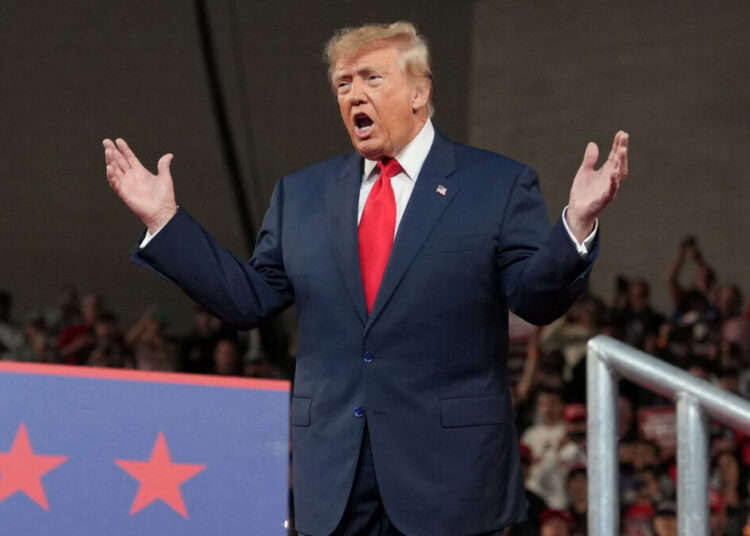
Speaking to reporters at the White House on Saturday, he said the United States had told Ukraine, “you can do whatever you want to Russia. Don’t hit the refineries because that’s a world problem that’s caused.”
President Volodymyr Zelensky of Ukraine, he said, “wants to make problems for the world.” He added, “I think it’s time for Ukraine to get a new president.”
Over four years since Russia launched its full-scale invasion, Ukraine has pursued a strategy of mid- and long-range strikes that have battered Russian supply lines and oil infrastructure. The attacks have helped Ukraine stall Russian advances and even claw back some territory, but Mr. Trump on Saturday linked them to high fuel prices, which spiked this year after the United States and Israel attacked Iran.
“He wants to make problems for the world,” Mr. Trump said of Mr. Zelensky. “He wants to make problems for our farmers, our ranchers with diesel fuel because Russia supplies a large portion of the diesel fuel throughout the world.”
Later on Saturday, Ukraine’s foreign minister, Andrii Sybiha, said that Mr. Zelensky “has the support of the Ukrainian people, and they have the right to decide.” He added, “Statements from abroad only confirm that he is doing his job well.”
Mr. Trump’s announcement on Friday came despite a Russian ban on exporting fuel and was followed by the lifting of U.S. sanctions on Russian diesel exports until April. The Kremlin apparently offered no concessions in return.
Hours later, Russian officials said peace talks would not resume immediately.
“We will think about when these negotiations might be resumed,” Yuri Ushakov, President Vladimir V. Putin’s foreign policy adviser, said in a statement Friday night.
The diplomatic efforts fizzled shortly after Ukrainian negotiators arrived in Miami to meet with Mr. Trump’s top envoys, Jared Kushner and Steve Witkoff. As those talks were about to begin, Mr. Trump spoke at length with Mr. Putin over the phone.
While Mr. Trump’s announcement of the diesel deal made no mention of Ukraine, it was poised to hurt Ukrainian efforts to defend itself, as any major purchase of Russian fuel would help fund Moscow’s war machine.
Ukrainian officials said on Saturday that the talks in Miami had ended without a breakthrough.
In an online chat with reporters on Friday evening, Mr. Zelensky did not hide his sense of betrayal.
“I believe our team is simply being used as a smoke screen, and that is certainly not fair,” Mr. Zelensky said. He has worked hard to maintain a stable relationship with the White House as Mr. Trump has steered America closer to Russia and away from traditional democratic allies.
“It is certainly not how partners should treat each other,” Mr. Zelensky added, calling Mr. Trump’s diesel announcement a “weak decision.”
For Kyiv and its European allies, the short-lived talks in Miami laid bare how U.S. diplomacy has drifted from pursuing a durable peace settlement to hunting for business deals with Russia. The Trump administration has placed the burden of compromise almost entirely on Ukraine and put little pressure on Moscow to stop its campaign to destroy the Ukrainian state.
On Saturday, Mr. Trump similarly did not suggest that Mr. Putin should make compromises. The U.S. president said that Mr. Zelensky, though, “could have settled this war many times, many many times, and he chooses not to.”
On Saturday, Mr. Zelensky said Russia had directed five guided bombs at a residential area of Zaporizhzhia, Ukraine, killing at least 20 people, including three children. “In Russia, they take any easing of pressure to mean they can keep fighting, to mean they can keep dropping bombs on cities,” he said.
Daniel Fried, a longtime senior U.S. diplomat and former ambassador to Poland, said it was “very clear that the Russians are completely uninterested in any diplomatic approach and are simply standing back waiting for the West, the U.S., the Ukrainians to come to them with some bigger and better offer.”
“When you start chasing after them, they simply smirk and wait for you to purchase bigger and better bouquets to throw at their feet,” Mr. Fried said.
He said Mr. Trump was undermining not only Ukraine’s security but also Europe’s.
“All of this is taking place at a time when Russia is escalating its shadow warfare against Europe, and we are acting as if that is not occurring,” he said.
It is unclear whether Mr. Trump’s move to import Russian diesel will have much immediate impact on prices before the U.S. midterm elections.
In a statement after his call with Mr. Trump on Friday evening, Mr. Putin said that Russia had “confirmed its willingness to supply oil and petroleum products to the U.S. market and global markets at large,” but he did not specify any amounts.
Mr. Trump’s end run around Ukraine continued a pattern that had been playing out since he started his second term claiming he could end the war in 24 hours.
Last year, Kyiv agreed to Mr. Trump’s call for an immediate, unconditional cease-fire, but Moscow flatly rejected it. That first round of diplomacy established a dynamic that still defines negotiations: Ukraine received no reward for saying yes, and the Kremlin paid no price for saying no.
Since then, ambitions of forging a lasting peace have largely evaporated. Instead, only a handful of hastily announced tactical pauses and holiday truces have emerged.
Still, when the Trump administration opened the latest diplomatic track on the sidelines of the U.N. General Assembly in late September, Ukrainian officials were startled by how far Mr. Kushner and Mr. Witkoff went in their offerings to Russia.
According to officials familiar with the discussions, who spoke on condition of anonymity to discuss confidential diplomatic talks, the Americans put three lucrative economic incentives on the table to coax Moscow into a limited cease-fire, either on energy infrastructure or at sea.
Washington floated releasing billions of Russian sovereign assets immobilized in the West. The money, the officials said, was viewed as an upfront incentive for partial truces, not a reward for their enactment. This revived a proposal from last year to release funds to Russia. Then, the suggestion was to release up to $100 billion.
The Americans also revisited a plan to sell off parts of the Russian oil giant Lukoil in a multibillion-dollar deal that would go to a group of Middle Eastern investors, including some with business ties to U.S. negotiators.
And Mr. Witkoff and Mr. Kushner revived a U.S. proposal that would allow Belarus, the Kremlin’s ally and neighbor, to export potash, according to officials familiar with the talks.
Kyiv has avoided rejecting any proposal outright but has demanded guardrails. For instance, it has suggested dollar-for-dollar mirror payments of frozen assets to Ukraine or guarantees of additional military aid upon any truce breach.
But Mr. Zelensky’s frustration with Washington was clear earlier this week when he visited the site of a Russian missile strike on an apartment building in northern Ukraine, hundreds of miles from the front lines. The strike killed 22 people, including five children — among more than 100 civilians killed in Russian strikes last week alone.
Asked about Secretary of State Marco Rubio’s comments that talks to end the fighting were “proving elusive” because the war had reached a “strategic stalemate,” Mr. Zelensky bristled.
“We are not at a diplomatic dead end,” he said. The problem, he added, was that there was not enough pressure on Moscow.
“Shut down their entire economy,” he said. “Sew Russia’s mouth shut. Don’t feed them with your own sales.”
Valerie Hopkins and Ivan Nechepurenko contributed reporting.
The post Rebuking Ukraine Over Oil Strikes, Trump Says It Should ‘Get a New President’ appeared first on New York Times.