René Magritte, the Belgian Surrealist, was, famously, a crank. He once listed the things he hated, which included the past, the decorative arts, folklore, advertising, voices making announcements, aerodynamics, Boy Scouts, the smell of mothballs and drunken people.
Mostly, he despised anyone thinking they could detect symbolic meaning in his work.
In 1966, he showed a poet friend a new painting and was delighted when the poet took one look and felt bewildered. “I am repatriated by a moment of panic,” he later told the American art historian Suzi Gablik, as if the rejection of meaning was not an intellectual stance to take, but a country he could be returned to, the place he belonged. “These are the privileged moments that transcend mediocrity,” he added.
A group show titled “This Is Still Not a Pipe: The Afterlife of Magritte,” currently at Gagosian’s Grosvenor Hill gallery in London (until Dec. 12), investigates how artists continue to chase that same ability to confound.
In an interview in mid-September, the British curator Jasper Sharp, a co-curator of the exhibition, noted Magritte’s enduring newness. While his most famous works feel aged because they have been part of our visual language for so long — the titular painting of a pipe declaring it isn’t a pipe, the bowler-hatted man, the apple-headed figure — many Magrittes would not look out of place at Frieze London, the contemporary art fair held in Regent’s Park, open to the public from Thursday through Oct. 18.
Referencing the 1948 work “The Triumphal March,” with its bulbous, disembodied feet and their bawdy clown faces, Sharp said, “If you and I saw that, walking through Regent’s Park in October in the tent, you would be sure that was made in the last six months.”
Alongside 50 of Magritte’s paintings and works on paper (of which several are on loan from artists’ private collections) are pieces from 46 contemporary artists invited by Sharp and his co-curator, Bernard Lagrange, a Belgian director at Gagosian Art Advisory, the brand’s art-market consultancy.
Some of the artists were surprised by the call. One said no. Most jumped at the chance, several making new work. The idea was not, Sharp said, to identify everyone who has ever referenced Magritte by name. Rather, he was looking for commonalities of intent.
A New Taxonomy
Gablik wrote the first definitive book on Magritte, in 1970. She had spent eight months living in Belgium with the artist and his wife, Georgette, in 1959, and continued her research for years afterward. Many shows since, Sharp said, have cleaved to the categories into which Gablik sorted his work.
Sharp and Lagrange, by contrast, devised their own more nebulous themes, intuiting connections with the invited artists. These include dread, compression, claustrophobia and normalcy. “There is a banality I see in a lot of contemporary art, a willful banality or deadpanness, that I feel he is the master of,” Sharp said of Magritte.
On display are works made during Magritte’s lifetime. They include Yoko Ono’s “Sky TV” from 1966, for which she pointed a camera out the window and broadcast a feed of the sky on her household television; and an Ed Ruscha painting of a giant bird made that same year, around the time he met Magritte.
Among the new works, Sharp was surprised at how artists sometimes homed in on the same Magritte reference. The exhibition includes a gouache of a very early painting, “Pleasure,” from 1927, in which a woman munches on a crow, blood dripping on the white lace of her collar. “Three different artists all mentioned this piece to me,” said Sharp, including the American painter Dana Schutz, who produced a startling canvas titled “The Singer” in response.
Other artists have long flagged the kinship they feel with the Belgian master. The Venezuelan American conceptualist Alex Da Corte (recently highlighted as an innovator on the inaugural Time 100 Art 2026 list) has previously reprised Magritte titles for installations of his own.
Sharp has placed Da Corte’s 2018 sculpture, “Streetlamp For Drunk,” at the entrance, in front of a 2016 painting by the American artist Laura Owens of white scribbles against a blue-ish background. It is, Sharp said, a “slightly tongue-in-cheek” riff on Magritte’s iconic series “The Empire of Light” — 27 variations on a nocturnal streetscape lit by a streetlamp beneath a sunlit cloudy sky. “Magritte gives you permission, with the hang, to take those kinds of — not risks, but liberties,” Sharp said.
A Crowded Hang
“The Empire of Light” operates as an organizing principle for the exhibition. From the reception, visitors arrive in a large nighttime gallery. Under low lighting, several sculptures are gathered on a tall wood-clad pedestal in the middle of the room.
From there they move through a transitional cabinet room, the wood paneling on the walls darkened to match the floor. Here, works on paper by Magritte jostle with delicate drawings by the multimedia artist Matthew Barney and black and white prints of disembodied eyes by the Japanese photographer Kazuna Taguchi, among others.
In gallery two, the daytime room, a lower sculpture pedestal built of bricks displays Magritte’s suitcase, with which he traveled the world, alongside a medley of sculptures. These include small maquettes of some of the abstract shapes in Nairy Baghramian’s ongoing monumental sculptural series, “Sitzengebliebene” (“Stay Downers”). Sharp noted how exactly alike these are to characters in paintings from Magritte’s 1948 “vache” period. (When Baghramian suggested them, Sharp said, “My heart leapt!”)
Paintings include Magritte’s “The Equator” from 1942 — last seen in public in Wes Anderson’s 2025 film “The Phoenician Scheme” as a highlight of the art collection amassed by the lead character, the industrialist Zsa-Zsa Korda (played by Benicio Del Toro).
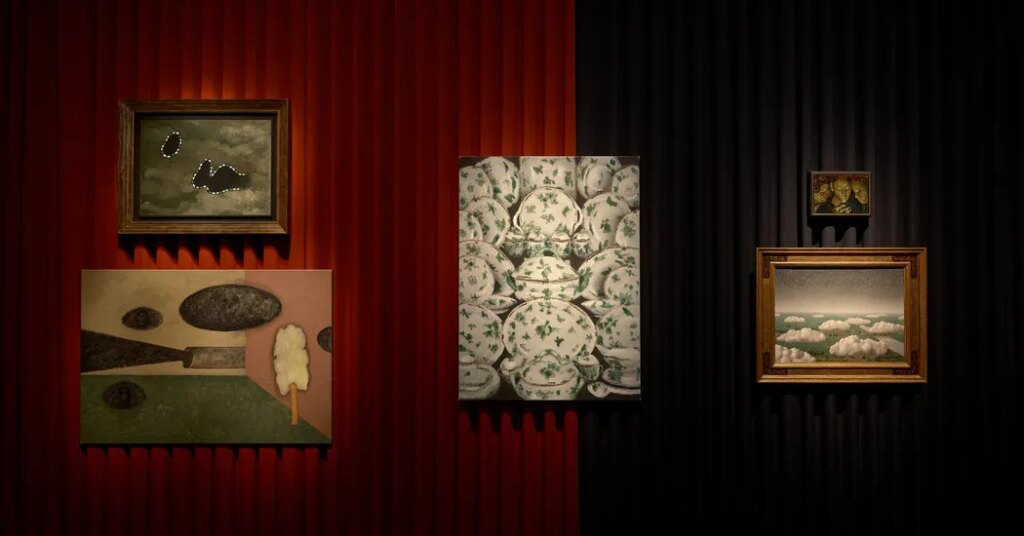
The exhibition design features heavy rolling drapes covering the walls from ceiling to floor, with cutout sections framing Magrittes inset behind glass. Curtains are a recurring motif in Magritte’s interiors. “The moment you see it, you’re like, ‘Of course!’” Sharp said. “It’s in all his work.”
The colors, too, are straight off Magritte’s canvases: a dark forest green, an orangey blush, a deep-vein red, two different blues.
Works are hung close together and often stacked, in that early 20th-century salon way Magritte would have been familiar with. Such proximity triggers rich visual conversations: Magritte’s sky-painted bottle standing next to a bottle with a brick in it by the Italian visual artist Maurizio Cattelan, with mini bricks by the American sculptor Charles LeDray heaped nearby.
Museums everywhere have feted the centenary of André Breton’s Surrealist Manifesto from 1924, and the market has been similarly ebullient. The Artnet Price Database shows a 65 percent increase in total sales of Surrealist works at auction between 2020 and 2024, with one of Magritte’s “The Empire of Light” works, from 1954, selling for $121 million, setting a new auction record for the artist’s work. But that’s not why Sharp proposed this show.
Rather, it is Magritte’s abiding influence. He was the artist that the likes of Jasper Johns, Robert Rauschenberg and Jeff Koons discovered for themselves in the 1960s, then went on to collect when they made their fortunes. He is the artist some of the biggest names in contemporary art today, including Sonia Boyce, who represented Britain at the Venice Biennale in 2022, point to as being of singular importance.
And he is on the minds of emerging artists, too: One of the artists in the show, the Polish painter Joanna Wos, is fresh out of art school, having only just graduated this year from the Academy of Fine Arts in Vienna.
Public affection for Magritte is similarly entrenched. During the six years Sharp worked at the Peggy Guggenheim Collection in Venice, from 1999 to 2005, the version of “The Empire of Light” held there was lent out just once, and, he said, visitors were very upset. “It had become part of the architecture of the building. When it wasn’t there, it was like a wall had fallen down,” he said.
Sharp described Magritte as “a fridge-magnet tea-towel artist” whose work, unlike that of others weakened by pop-culture ubiquity (he cited Salvador Dalí), has not lost any of its potency or relevance.
As visitors exit the gallery, they see two photographs taken at Magritte’s funeral in 1967, by the Belgian photographer Georges Thiry. One depicts the newly dug grave with a pile of earth beside it.
Sharp was gleeful when he found it. “It almost feels as if he’s escaped and he’s sort of running around,” he said. The trickster still keeping the art world on its toes.
The post Celebrating the Enduring Newness of Magritte appeared first on New York Times.