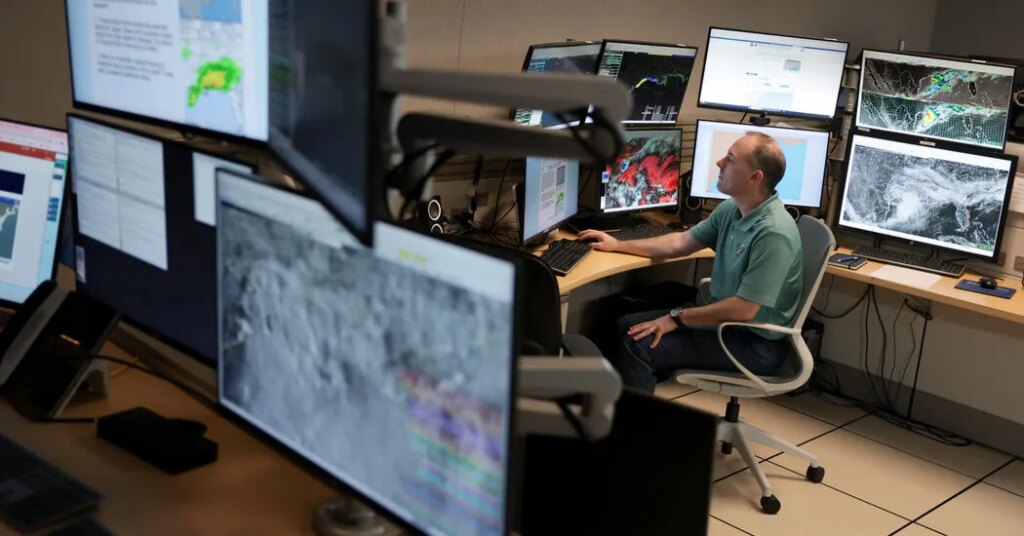
As Hurricane Isaias approached the Gulf Coast this week, forecasters at the National Hurricane Center were confronted with a striking split in their data.
The traditional models, the ones that for decades have used physics to help experienced meteorologists understand where a hurricane is most likely to go, had been projecting a western path toward Alabama and Mississippi. But a suite of new experimental models that used artificial intelligence were pushing the forecast path farther east, toward Pensacola, Fla.
The two approaches pitted meteorology’s most seasoned experts against the industry’s buzziest new technology.
These diverging paths were in constant tension this week. Forecasters at the Hurricane Center writing their official forecast updates, which are meant to serve as the synthesis of the competing models’ guidance, noted their differences openly and discussed which they were most aligned with on each pass.
As landfall drew nearer, the traditional models crept closer and closer to the new ones, and by Friday, they were generally in agreement that landfall would most likely happen between Mobile, Ala., and just east of Pensacola, Fla.
Jamie Rhome, the deputy director of the National Hurricane Center, said that people may assume that the experts at the Hurricane Center just look at models and pick a “winning horse” to base their forecasts on.
Instead, he said, forecasters use a consensus approach, blending different models together. This blending — a mix of the computers and the human exerts — often outperforms any one individual model.
In the 1950s, scientists wanting to understand where a hurricane would go began to leverage rapid advances in computer technology. At Princeton University, researchers using a computer they called the “electronic brain” hummed through 10 million arithmetic equations to process early national forecasts.
Over the next half-century, weather models evolved alongside processing power. By the 1970s, scientists accounted for the three-dimensional nature of the atmosphere, leading to the first global weather model in 1974. By the turn of the century, meteorologists began running “ensembles” — executing the same equations repeatedly with subtle tweaks to see what alternatives they would spit out.
Year by year, these tools dramatically improved hurricane predictions, giving residents and emergency officials more lead time to prepare for storms and to get out of their way if necessary.
Now, artificial intelligence is reshaping the field once again.
A.I. models trained on decades of historical weather data can quickly simulate hundreds of scenarios — far more than traditional computing models — comparing real-time global conditions to similar patterns from the past. By identifying how unusual setups evolved in the past, these models can often give forecasters a faster window into which atmospheric paths are most likely to become reality in the present.
In a paper published in August, researchers at Google’s DeepMind unit analyzed hundreds of hurricane forecasts from 2023-25. Their analysis found that A.I. models can outperform other widely used prediction models by significant margins. Exhibit A in their study was Hurricane Melissa, which hit Jamaica last year as one of the most dangerous hurricanes on record. Hurricane Center forecasters had incorporated Google’s model into their methodologies, and attributed their success in accurately forecasting the storm’s record intensity in part to artificial intelligence.
Mr. Rhome is a supporter of using the A.I. models, including Google’s DeepMind and others. “You can’t call it luck after you’re skillful so many times,” he said. With accurate consistency season after season, he said, it has become clear that the A.I. models are providing reliable information to forecasters about a storm’s path.
But, he added, his forecasters don’t just have to predict a storm’s path. They also have to consider things like how strong the storm will get and how its structure will change over time, both of which can have significant effects on what the storms actually do on land and where they do it. When it comes to intensity, he said, the A.I. models “are starting to show a lot of promise,” but aren’t quite matching up to the traditional approach yet.
Andy Hazelton helped revolutionize the physics models that are used by the National Oceanic and Atmospheric Administration to predict previously unpredictable phenomenon. When he started, it was almost impossible to know whether a storm would undergo a rapid intensification, becoming very strong very quickly.
Like hundreds of others at the agency, he lost his job in 2024 when the Trump administration slashed the size of the federal work force. Now a scientist at the University of Miami and still working on hurricane models, he said he was “surprised and impressed” by how consistently DeepMind has accurately predicted intensity.
A.I. models haven’t always gotten it right. When Hurricane Otis unexpectedly exploded near Mexico’s coast in 2023, it took residents and even hurricane experts by surprise. Google’s original model missed its path and rapid growth — but so did the traditional ones.
Forecast models have traditionally struggled with explosive cyclogenesis, or the rapid formation of storms. Otis formed in an area of the world that has very few weather sensors, and it’s those sensors that provide the initial burst of information to get the weather models, old and new, working. The compact storm above a pool of very warm water seemed to intensify out of nowhere and caught the models, and meteorologists, off guard.
One forecaster working in the thick of Isaias said he was impressed by how the A.I. models had evolved.
Jason Beaman, the meteorologist-in-charge at the Weather Service office in Mobile, not far from the storm’s anticipated landfall, said they were “certainly a great tool in our tool kit, no doubt about it.”
Mr. Rhome said the A.I. models won’t be replacing human meteorologists. With so much more information to synthesize, he said, it’s the humans who pull it all together and get information to the people who may be in harm’s way.
“Our role as trusted communicators will only increase,” he said.
Amy Graff contributed reporting.
The post A.I. Hurricane Models Were Front and Center as Isaias Headed Toward Land appeared first on New York Times.